







Question: please answer this question in 1500 words by reading the given case study. and provide good information. Question 2 Using the case study Innovation Teams
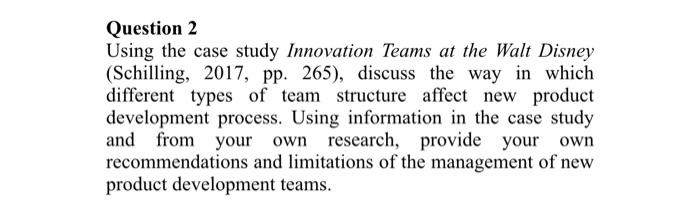
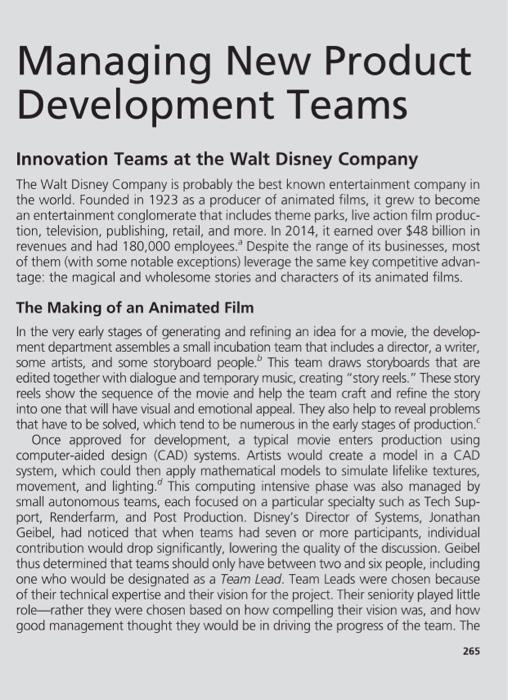
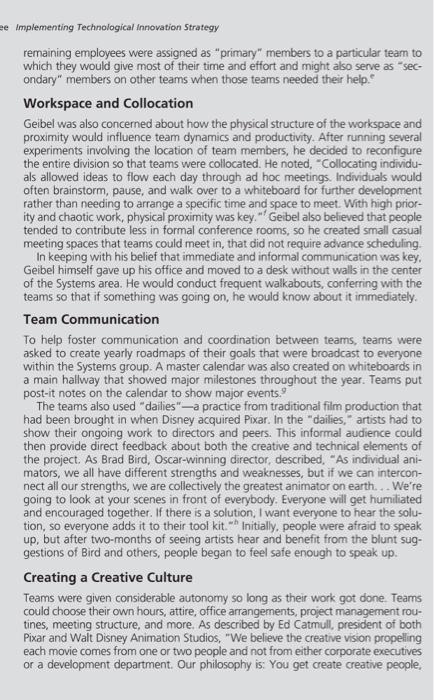
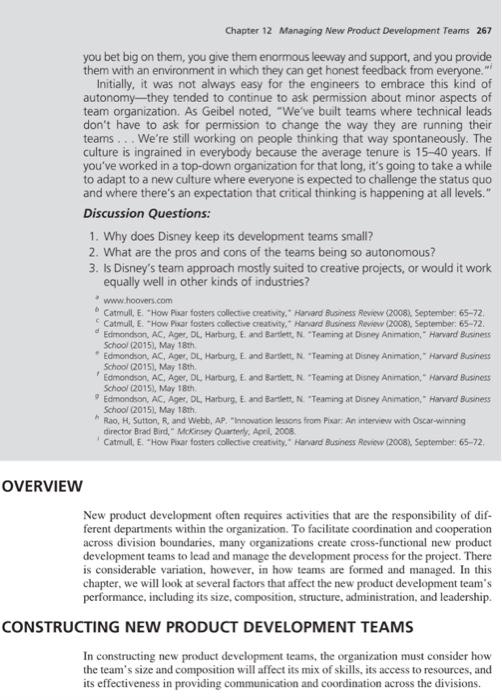
Question 2 Using the case study Innovation Teams at the Walt Disney (Schilling, 2017, pp. 265), discuss the way in which different types of team structure affect new product development process. Using information in the case study and from your own research, provide your own recommendations and limitations of the management of new product development teams. Managing New Product Development Teams Innovation Teams at the Walt Disney Company The Walt Disney Company is probably the best known entertainment company in the world. Founded in 1923 as a producer of animated films, it grew to become an entertainment conglomerate that includes theme parks, live action film production, television, publishing, retail, and more. In 2014, it earned over $48 billion in revenues and had 180,000 employees. 2 Despite the range of its businesses, most of them (with some notable exceptions) leverage the same key competitive advantage: the magical and wholesome stories and characters of its animated films. The Making of an Animated Film In the very early stages of generating and refining an idea for a movie, the development department assembles a small incubation team that indudes a director, a writer, some artists, and some storyboard people. " This team draws storyboards that are edited together with dialogue and temporary music, creating "story reels." These story reels show the sequence of the movie and help the team craft and refine the story into one that will have visual and emotional appeal. They also help to reveal problems that have to be solved, which tend to be numerous in the early stages of production." Once approved for development, a typical movie enters production using computer-aided design (CAD) systems. Artists would create a model in a CAD system, which could then apply mathematical models to simulate lifelike textures, movement, and lighting. d This computing intensive phase was also managed by small autonomous teams, each focused on a particular specialty such as Tech Support, Renderfarm, and Post Production. Disney's Director of Systems, Jonathan Geibel, had noticed that when teams had seven or more participants, individual contribution would drop significantly, lowering the quality of the discussion. Geibel thus determined that teams should only have between two and six people, including one who would be designated as a Team Lead. Team Leads were chosen because of their technical expertise and their vision for the project. Their seniority played little role-rather they were chosen based on how compelling their vision was, and how good management thought they would be in driving the progress of the team. The 265 implementing Technological innovation Strategy remaining employees were assigned as "primary" members to a particular team to which they would give most of their time and effort and might also serve as "secondary" members on other teams when those teams needed their help." Workspace and Collocation Geibel was also concemed about how the physical structure of the workspace and proximity would influence team dynamics and productivity. After running several experiments involving the location of team members, he decided to reconfigure the entire division so that teams were collocated. He noted, "Collocating individuals allowed ideas to flow each day through ad hoc meetings. Individuals would often brainstorm, pause, and walk over to a whiteboard for further development rather than needing to arrange a specific time and space to meet. With high priority and chaotic work, physical proximity was key. "' Geibel also believed that people tended to contribute less in formal conference rooms, so he created small casual meeting spaces that teams could meet in, that did not require advance scheduling. In keeping with his belief that immediate and informal communication was key. Geibel himself gave up his office and moved to a desk without walls in the center of the Systems area. He would conduct frequent walkabouts, conferring with the teams so that if something was going on, he would know about it immediately. Team Communication To help foster communication and coordination between teams, teams were asked to create yearly roadmaps of their goals that were broadcast to everyone within the Systems group. A master calendar was also created on whiteboards in a main hallway that showed major milestones throughout the year. Teams put post-it notes on the calendar to show major events." The teams also used "dailies" - a practice from traditional film production that had been brought in when Disney acquired Pixar. In the "dailies," artists had to show their ongoing work to directors and peers. This informal audience could then provide direct feedback about both the creative and technical elements of the project. As Brad Bird, Oscar-winning director, described, "As individual animators, we all have different strengths and weaknesses, but if we can interconnect all our strengths, we are collectively the greatest animator on earth. .. We're going to look at your scenes in front of everybody. Everyone will get humiliated and encouraged together. If there is a solution, I want everyone to hear the solution, so everyone adds it to their tool kit. h Initially. people were afraid to speak up, but after two-months of seeing artists hear and benefit from the blunt suggestions of Bird and others, people began to feel safe enough to speak up. Creating a Creative Culture Teams were given considerable autonomy so long as their work got done. Teams could choose their own hours, attire, office arrangements, project management routines, meeting structure, and more. As described by Ed Catmull, president of both Pixar and Walt Disney Animation Studios, "We believe the creative vision propelling each movie comes from one or two people and not from either corporate executives or a development department. Our philosophy is: You get create creative pecole, Chapter 12 Managing New Product Development Teams 267 you bet big on them, you give them enormous leeway and support, and you provide them with an environment in which they can get honest feedback from everyone."i Initially, it was not always easy for the engineers to embrace this kind of autonomy-they tended to continue to ask permission about minor aspects of team organization. As Geibel noted, "We've built teams where technical leads don't have to ask for permission to change the way they are running their teams... We're still working on people thinking that way spontaneously. The culture is ingrained in everybody because the average tenure is 1540 years. If you've worked in a top-down organization for that long, it's going to take a while to adapt to a new culture where everyone is expected to challenge the status quo and where there's an expectation that critical thinking is happening at all levels." Discussion Questions: 1. Why does Disney keep its development teams small? 2. What are the pros and cons of the teams being so autonomous? 3. Is Disney's team approach mostly suited to creative projects, or would it work equally well in other kinds of industries? - mwihooversicom " Carmull, E. "How fuar fosters collective ceativiy." Harard dusiness Review (2008) September: 65-72. 'Cotmull, E. "How Phar fortes collective ceatviy," Horard Aushess Reviow (2008). September: 65-72. 2 Edinondson, AC, Ages, DL, Harturg, E. and Eartert, N. "Teaning at Desney Anmation," Havand Eusiness School 2015), May 18 ith - Edinondion, AC, Ager, OL, Harturg. E. and Bartert, N. "Teaming at Diney Animation," Havard Rusiness School 2015), Mar 18 th. Eamondson. AC, Ages, OL, Harburg, E. and Eurtett N. "Teaming at Dusney Anmation," Harvard Bustess School (2015), May 18th. "Edimondion, AC, Age, OL. Harturg, E. and Eartett N. "Teaming at Disney Anmation," Havard Business Schoor (2015), May 18th. "Rao, H, Sutton, R, and Webb, Ap. "Innovation lessons from fiar: An inteview with Oscar-winning director Brad Bind, "Moknses, Quartedy. Apel, 2008. Catmull, E. "How Fuar fosters collective creativi," Hanard Business Revinv (2003), September: 65-72. OVERVIEW New product development often requires activities that are the responsibility of different departments within the organization. To facilitate coordination and cooperation across division boundaries, many organizations create cross-functional new product development teams to lead and manage the development process for the project. There is considerable variation, however, in how teams are formed and managed. In this chapter, we will look at several factors that affect the new product development team's performance, including its size, composition, structure, administration, and leadership. CONSTRUCTING NEW PRODUCT DEVELOPMENT TEAMS In constructing new product development teams, the organization must consider how the team's size and composition will affect its mix of skills, its access to resources, and its effectiveness in providing communication and coordination across the divisions
Step by Step Solution
There are 3 Steps involved in it

Get step-by-step solutions from verified subject matter experts
 Study Help