







Question: Please answer those question from the above articles, Why does science not solve the problem of being able to say that we know there is
Please answer those question from the above articles,
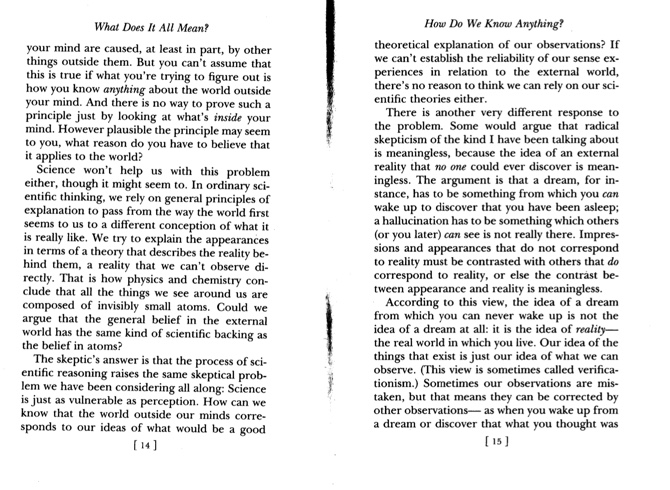
- Why does science not solve the problem of being able to say that we know there is an external world? (pp. 14 - 15)
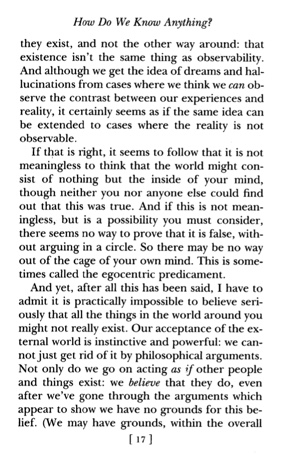
- What is the egocentric predicament? (p. 17)
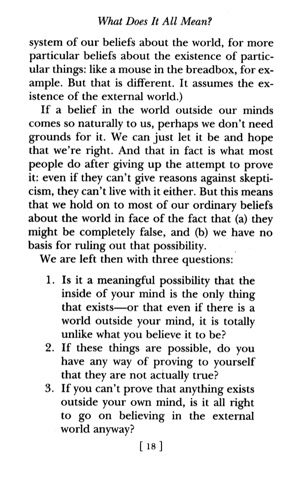
- If we concede that we cannot solve or address the skeptics' concerns, but still believe that there is a world outside of our minds what two possibilities must we accept about our ordinary beliefs? (p. 18)
What Does It All Mean? your mind are caused, at least in part, by other things outside them. But you can't assume that this is true if what you're trying to figure out is how you know anything about the world outside your mind. And there is no way to prove such a principle just by looking at what's inside your mind. However plausible the principle may seem to you, what reason do you have to believe that it applies to the world? Science won't help us with this problem either, though it might seem to. In ordinary scientific thinking, we rely on general principles of explanation to pass from the way the world first seems to us to a different conception of what it is really like. We try to explain the appearances in terms of a theory that describes the reality behind them, a reality that we can't observe directly. That is how physics and chemistry conclude that all the things we see around us are composed of invisibly small atoms. Could we argue that the general belief in the external world has the same kind of scientific backing as the belief in atoms? The skeptic's answer is that the process of scientific reasoning raises the same skeptical problem we have been considering all along: Science is just as vulnerable as perception. How can we know that the world outside our minds corresponds to our ideas of what would be a good [14] How Do We Know Anything? theoretical explanation of our observations? If we can't establish the reliability of our sense experiences in relation to the external world, there's no reason to think we can rely on our scientific theories either. There is another very different response to the problem. Some would argue that radical skepticism of the kind I have been talking about is meaningless, because the idea of an external reality that no one could ever discover is meaningless. The argument is that a dream, for instance, has to be something from which you can wake up to discover that you have been asleep; a hallucination has to be something which others (or you later) can see is not really there. Impressions and appearances that do not correspond to reality must be contrasted with others that do correspond to reality, or else the contrast between appearance and reality is meaningless. According to this view, the idea of a dream from which you can never wake up is not the idea of a dream at all: it is the idea of realitythe real world in which you live. Our idea of the things that exist is just our idea of what we can observe. (This view is sometimes called verificationism.) Sometimes our observations are mistaken, but that means they can be corrected by other observations - as when you wake up from a dream or discover that what you thought was [15] What Does It All Mean? system of our beliefs about the world, for more particular beliefs about the existence of particular things: like a mouse in the breadbox, for example. But that is different. It assumes the existence of the external world.) If a belief in the world outside our minds comes so naturally to us, perhaps we don't need grounds for it. We can just let it be and hope that we're right. And that in fact is what most people do after giving up the attempt to prove it: even if they can't give reasons against skepticism, they can't live with it either. But this means that we hold on to most of our ordinary beliefs about the world in face of the fact that (a) they might be completely false, and (b) we have no basis for ruling out that possibility. We are left then with three questions: 1. Is it a meaningful possibility that the inside of your mind is the only thing that exists-or that even if there is a world outside your mind, it is totally unlike what you believe it to be? 2. If these things are possible, do you have any way of proving to yourself that they are not actually true? 3. If you can't prove that anything exists outside your own mind, is it all right to go on believing in the external world anyway? [18 ] How Do We Know Anything? they exist, and not the other way around: that existence isn't the same thing as observability. And although we get the idea of dreams and hallucinations from cases where we think we can observe the contrast between our experiences and reality, it certainly seems as if the same idea can be extended to cases where the reality is not observable. If that is right, it seems to follow that it is not meaningless to think that the world might consist of nothing but the inside of your mind, though neither you nor anyone else could find out that this was true. And if this is not meaningless, but is a possibility you must consider, there seems no way to prove that it is false, without arguing in a circle. So there may be no way out of the cage of your own mind. This is sometimes called the egocentric predicament. And yet, after all this has been said, I have to admit it is practically impossible to believe seriously that all the things in the world around you might not really exist. Our acceptance of the external world is instinctive and powerful: we cannot just get rid of it by philosophical arguments. Not only do we go on acting as if other people and things exist: we believe that they do, even after we've gone through the arguments which appear to show we have no grounds for this belief. (We may have grounds, within the overall [17]
Step by Step Solution
There are 3 Steps involved in it

Get step-by-step solutions from verified subject matter experts
 Study Help