Question: Please answer. Will upvote! 1. Using concepts from course materials, explain why KPMG employees believing in the purpose of their work increases (1) job satisfaction,
Please answer. Will upvote!
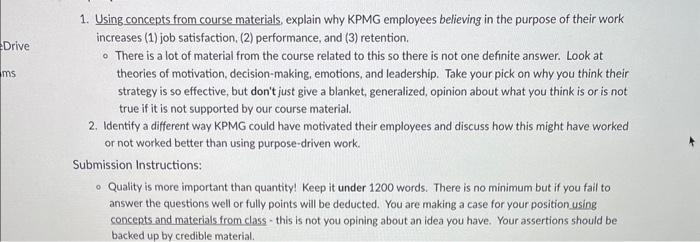
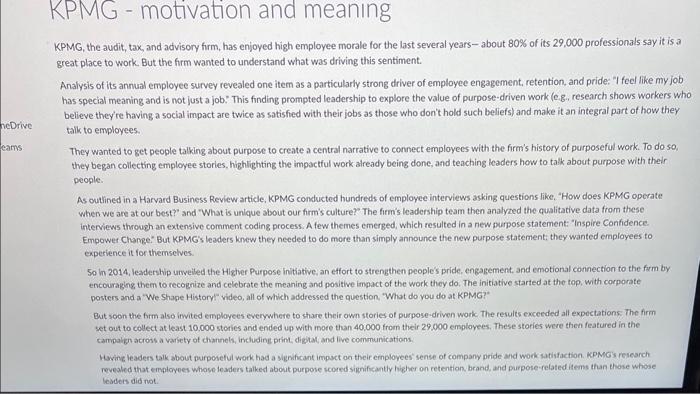
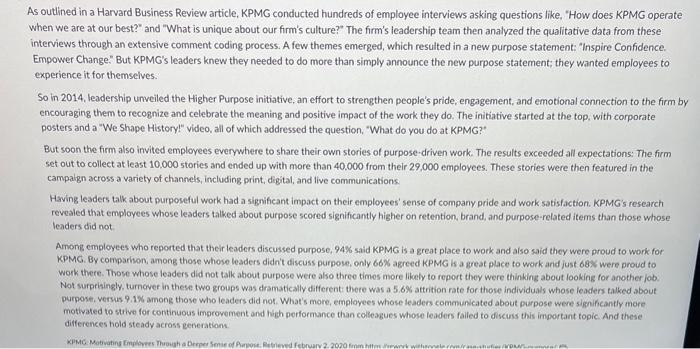
1. Using concepts from course materials, explain why KPMG employees believing in the purpose of their work increases (1) job satisfaction, (2) performance, and (3) retention. - There is a lot of material from the course related to this so there is not one definite answer. Look at theories of motivation, decision-making, emotions, and leadership. Take your pick on why you think their strategy is so effective, but don't just give a blanket, generalized, opinion about what you think is or is not true if it is not supported by our course material. 2. Identify a different way KPMG could have motivated their employees and discuss how this might have worked or not worked better than using purpose-driven work. Submission Instructions: - Quality is more important than quantity! Keep it under 1200 words. There is no minimum but if you fail to answer the questions well or fully points will be deducted. You are making a case for your position using concents and materials from class - this is not you opining about an idea you have. Your assertions should be backed up by credible material. XPMG, the audit, tax, and advisory firm, has enjoyed high employee morale for the last several years - about 80% of its 29,000 professionals say it is a great place to work. But the firm wanted to understand what was driving this sentiment. Analysis of its annual employee survey revealed one item as a particularly strong driver of employee engagement, retention, and pride: "I feel like my job has special meaning and is not just a job: This finding prompted leadership to explore the value of purpose-driven work (e. . research shows workers wh believe they're having a social impact are twice as satisfied with their jobs as those who don't hold such beliefs) and make it an integral part of how they tailk to employees. They wanted to get people talking about purpose to create a central narrative to connect employees with the firm's history of purposeful work. To do so, they began collecting employee storles, highlighting the impactful work already being done, and teaching lcaders how to talk about purpose with their people. As outlined in a Harvard Business Review article, KPMG conducted hundreds of employee interviews asking questions like, "How does KPMG operate when we are at our best?' and 'What is unlque about our firm's culture? "The firm's leadership team then analyzed the qualitative data from these interviews through an extensive comment coding process. A few themes emerged, which resulted in a new purpose statement: "Inspire Confidence Empower Change: But KPMG S leaders knew they needed to do more than simply announce the new purpose statement: they wanted employees to experience it for themselves. So In 2014, leadership unvelied the Higher Purpose initiative, an effort to strengthen people's pride, engagement, and emotional connection to the frm by encouraging them to recognize and celebrate the meaning and positive impact of the work they do. The initiative started at the top, with corporate posters and a "We Shape Historyl" video, all of which addressed the question. "What do you do at KPMG?" But soon the firm also itwited employees everywhere to stare their own stories of purpose-driven work. The results exceeded all expectations: The firm set out to collect at least 10,000 stories and ended up with more than 40,000 from their 29,000 employees. These stories were then featured in the campalen actoss a varisety of channels, including print, dietst, and live communications. Hywing leaders tak about purposetul work had a significant impsct on their employees' sense of company pride and work wtisfaction. KPMO: resesrch revested that ensplovees whose lesders taked abonit purpose scored significantly higher on retention, brand, and purpose-related items than those whose leaden did not. As outlined in a Harvard Business Review article, KPMG conducted hundreds of employee interviews asking questions like, "How does KPMG operate when we are at our best?" and "What is unique about our firm's culture?" The firm's leadership team then analyzed the qualitative data from these interviews through an extensive comment coding process. A few themes emerged, which resulted in a new purpose statement: "Inspire Confidence. Empower Change." But KPMG's leaders knew they needed to do more than simply announce the new purpose statement; they wanted employees to experience it for themselves. So in 2014, leadership unveiled the Higher Purpose initiative, an effort to strengthen people's pride, engagement, and emotional connection to the firm by encouraging them to recognize and celebrate the meaning and positive impact of the work they do. The initiative started at the top, with corporate posters and a "We Shape History!" video, all of which addressed the question, "What do you do at KPMG?" But soon the firm also invited emplovees evernwhere to share their own stories of purpose-driven work. The results exceeded all expectations: The firm set out to collect at least 10,000 stories and ended up with more than 40.000 from their 29,000 employees. These stories were then featured in the campalgn across a variety of channels, including print, digital, and live communications. Hawing leaders talk about purposeful work had a significant impact on their employees' sense of company pride and work satisfaction. KPMG's research revealed that employees whose leaders talked about purpose scored significantly higher on retention, brand, and purpose-related items than those whose leaders did not. Among employees who reported that their leaders discussed purpose, 94% said KPMG is a great place to work and also said they were proud to work for KPMG. By comparhon, among those whose leaders didn't discuss purpose, only 66% agreed KPMG is a geat place to work and just 68 were proud to work there. Those whose leaders did not talk about purpose were also three times more likely to report they were thinking about looking for another job. Not surpriaingly, turnover in these two groups was dramatically different there was a 5.6% attrition rate for those individuals whose leaders taked about purpose, versus 9.13 among thove who leaders did not. What's more, employees whose leaders communscated about purpose were significantly more motivated to stive for continuous improvement and high performance than collesgues whose leaders falled to discuis this important topic: And these differences hold steady across generation









 Study Help