Question: Please answer with excel spreadsheet formulas/instructions. Thank you! CASE STUDY #2: FORECASTING COMPUTER SALES AT THE UNIVERSITY BOOKSTORE The bookstore at the North Point University
Please answer with excel spreadsheet formulas/instructions. Thank you!
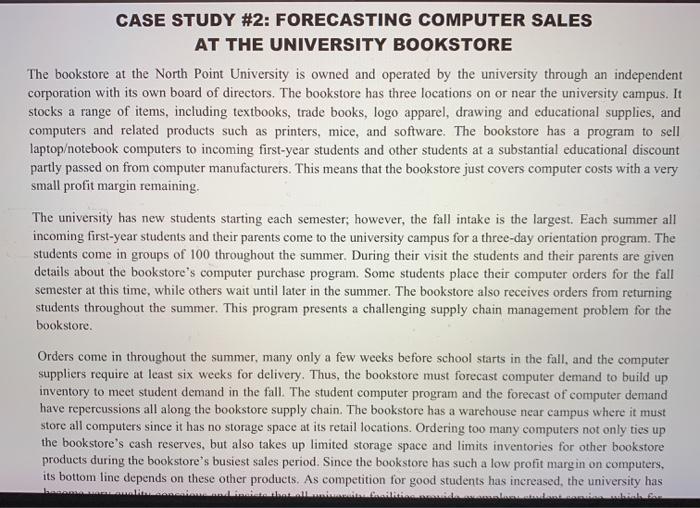
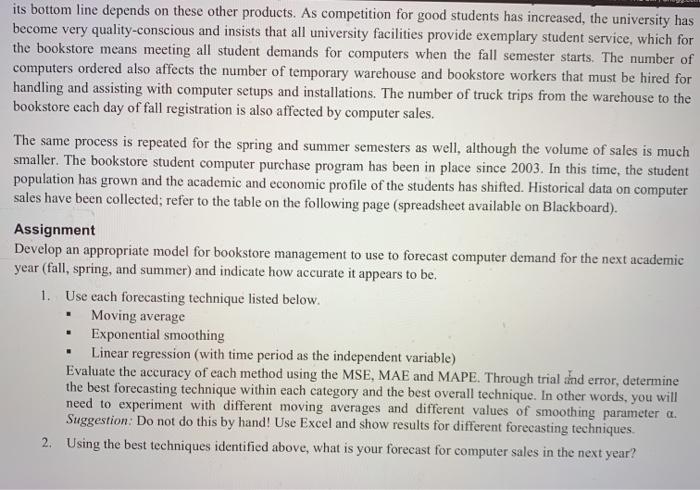
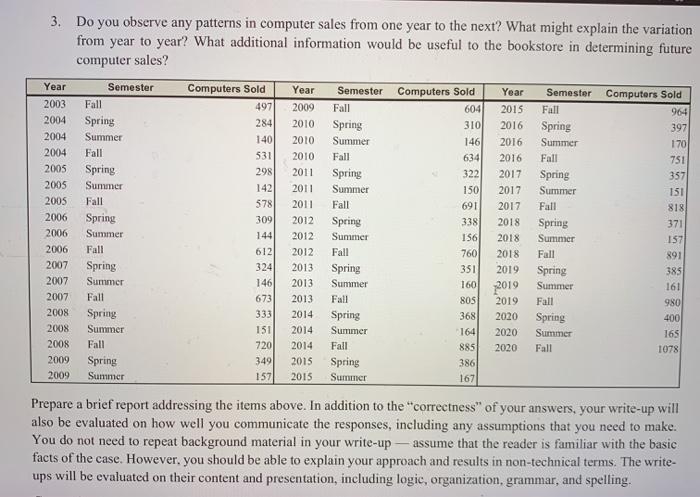
CASE STUDY #2: FORECASTING COMPUTER SALES AT THE UNIVERSITY BOOKSTORE The bookstore at the North Point University is owned and operated by the university through an independent corporation with its own board of directors. The bookstore has three locations on or near the university campus. It stocks a range of items, including textbooks, trade books, logo apparel, drawing and educational supplies, and computers and related products such as printers, mice, and software. The bookstore has a program to sell laptopotebook computers to incoming first-year students and other students at a substantial educational discount partly passed on from computer manufacturers. This means that the bookstore just covers computer costs with a very small profit margin remaining, The university has new students starting each semester; however, the fall intake is the largest. Each summer all incoming first-year students and their parents come to the university campus for a three-day orientation program. The students come in groups of 100 throughout the summer. During their visit the students and their parents are given details about the bookstore's computer purchase program. Some students place their computer orders for the fall semester at this time, while others wait until later in the summer. The bookstore also receives orders from returning students throughout the summer. This program presents a challenging supply chain management problem for the bookstore Orders come in throughout the summer, many only a few weeks before school starts in the fall, and the computer suppliers require at least six weeks for delivery. Thus, the bookstore must forecast computer demand to build up inventory to meet student demand in the fall. The student computer program and the forecast of computer demand have repercussions all along the bookstore supply chain. The bookstore has a warehouse near campus where it must store all computers since it has no storage space at its retail locations. Ordering too many computers not only ties up the book store's cash reserves, but also takes up limited storage space and limits inventories for other bookstore products during the bookstore's busiest sales period. Since the bookstore has such a low profit margin on computers, its bottom line depends on these other products. As competition for good students has increased, the university has Lilliamitiaa its bottom line depends on these other products. As competition for good students has increased, the university has become very quality-conscious and insists that all university facilities provide exemplary student service, which for the bookstore means meeting all student demands for computers when the fall semester starts. The number of computers ordered also affects the number of temporary warehouse and bookstore workers that must be hired for handling and assisting with computer setups and installations. The number of truck trips from the warehouse to the bookstore each day of fall registration is also affected by computer sales. The same process is repeated for the spring and summer semesters as well, although the volume of sales is much smaller. The bookstore student computer purchase program has been in place since 2003. In this time, the student population has grown and the academic and economic profile of the students has shifted. Historical data on computer sales have been collected; refer to the table on the following page (spreadsheet available on Blackboard). Assignment Develop an appropriate model for bookstore management to use to forecast computer demand for the next academic year (fall, spring, and summer) and indicate how accurate it appears to be. 1. Use each forecasting technique listed below. Moving average Exponential smoothing Linear regression (with time period as the independent variable) Evaluate the accuracy of each method using the MSE, MAE and MAPE. Through trial sind error, determine the best forecasting technique within each category and the best overall technique. In other words, you will need to experiment with different moving averages and different values of smoothing parameter a. Suggestion: Do not do this by hand! Use Excel and show results for different forecasting techniques. 2. Using the best techniques identified above, what is your forecast for computer sales in the next year? . 3. Do you observe any patterns in computer sales from one year to the next? What might explain the variation from year to year? What additional information would be useful to the bookstore in determining future computer sales? Year Semester Computers Sold Year Semester Computers Sold Year Semester Computers Sold 2003 Fall 497 2009 Fall 604 2015 Fall 964 2004 Spring 284 2010 Spring 310 2016 Spring 397 2004 Summer 140 2010 Summer 146 2016 Summer 170 2004 Fall 531 2010 Fall 634 2016 Fall 751 2005 Spring 298 2011 Spring 322 2017 Spring 357 2005 Summer 142 2011 Summer 150 2017 Summer 151 2005 Fall 578 2011 Fall 691 2017 Fall 818 2006 Spring 309 2012 Spring 338 2018 Spring 371 2006 Summer 144 2012 Summer 156 2018 Summer 157 2006 Fall 612 2012 Fall 760 2018 Fall 891 2007 Spring 324 2013 Spring 351 2019 Spring 385 2007 Summer 146 2013 Summer 160 2019 Summer 161 2007 Fall 673 2013 Fall 805 2019 Fall 980 2008 Spring 333 2014 Spring 368 2020 Spring 2008 Summer 151 2014 Summer 164 2020 Summer 165 2008 Fall 720 2014 Fall 885 2020 Fall 1078 2009 Spring 349 2015 Spring 386 2009 Summer 157 2015 Summer 400 167 Prepare a brief report addressing the items above. In addition to the correctness" of your answers, your write-up will also be evaluated on how well you communicate the responses, including any assumptions that you need to make. You do not need to repeat background material in your write-up - assume that the reader is familiar with the basic facts of the case. However, you should be able to explain your approach and results in non-technical terms. The write- ups will be evaluated on their content and presentation, including logic, organization, grammar, and spelling. CASE STUDY #2: FORECASTING COMPUTER SALES AT THE UNIVERSITY BOOKSTORE The bookstore at the North Point University is owned and operated by the university through an independent corporation with its own board of directors. The bookstore has three locations on or near the university campus. It stocks a range of items, including textbooks, trade books, logo apparel, drawing and educational supplies, and computers and related products such as printers, mice, and software. The bookstore has a program to sell laptopotebook computers to incoming first-year students and other students at a substantial educational discount partly passed on from computer manufacturers. This means that the bookstore just covers computer costs with a very small profit margin remaining, The university has new students starting each semester; however, the fall intake is the largest. Each summer all incoming first-year students and their parents come to the university campus for a three-day orientation program. The students come in groups of 100 throughout the summer. During their visit the students and their parents are given details about the bookstore's computer purchase program. Some students place their computer orders for the fall semester at this time, while others wait until later in the summer. The bookstore also receives orders from returning students throughout the summer. This program presents a challenging supply chain management problem for the bookstore Orders come in throughout the summer, many only a few weeks before school starts in the fall, and the computer suppliers require at least six weeks for delivery. Thus, the bookstore must forecast computer demand to build up inventory to meet student demand in the fall. The student computer program and the forecast of computer demand have repercussions all along the bookstore supply chain. The bookstore has a warehouse near campus where it must store all computers since it has no storage space at its retail locations. Ordering too many computers not only ties up the book store's cash reserves, but also takes up limited storage space and limits inventories for other bookstore products during the bookstore's busiest sales period. Since the bookstore has such a low profit margin on computers, its bottom line depends on these other products. As competition for good students has increased, the university has Lilliamitiaa its bottom line depends on these other products. As competition for good students has increased, the university has become very quality-conscious and insists that all university facilities provide exemplary student service, which for the bookstore means meeting all student demands for computers when the fall semester starts. The number of computers ordered also affects the number of temporary warehouse and bookstore workers that must be hired for handling and assisting with computer setups and installations. The number of truck trips from the warehouse to the bookstore each day of fall registration is also affected by computer sales. The same process is repeated for the spring and summer semesters as well, although the volume of sales is much smaller. The bookstore student computer purchase program has been in place since 2003. In this time, the student population has grown and the academic and economic profile of the students has shifted. Historical data on computer sales have been collected; refer to the table on the following page (spreadsheet available on Blackboard). Assignment Develop an appropriate model for bookstore management to use to forecast computer demand for the next academic year (fall, spring, and summer) and indicate how accurate it appears to be. 1. Use each forecasting technique listed below. Moving average Exponential smoothing Linear regression (with time period as the independent variable) Evaluate the accuracy of each method using the MSE, MAE and MAPE. Through trial sind error, determine the best forecasting technique within each category and the best overall technique. In other words, you will need to experiment with different moving averages and different values of smoothing parameter a. Suggestion: Do not do this by hand! Use Excel and show results for different forecasting techniques. 2. Using the best techniques identified above, what is your forecast for computer sales in the next year? . 3. Do you observe any patterns in computer sales from one year to the next? What might explain the variation from year to year? What additional information would be useful to the bookstore in determining future computer sales? Year Semester Computers Sold Year Semester Computers Sold Year Semester Computers Sold 2003 Fall 497 2009 Fall 604 2015 Fall 964 2004 Spring 284 2010 Spring 310 2016 Spring 397 2004 Summer 140 2010 Summer 146 2016 Summer 170 2004 Fall 531 2010 Fall 634 2016 Fall 751 2005 Spring 298 2011 Spring 322 2017 Spring 357 2005 Summer 142 2011 Summer 150 2017 Summer 151 2005 Fall 578 2011 Fall 691 2017 Fall 818 2006 Spring 309 2012 Spring 338 2018 Spring 371 2006 Summer 144 2012 Summer 156 2018 Summer 157 2006 Fall 612 2012 Fall 760 2018 Fall 891 2007 Spring 324 2013 Spring 351 2019 Spring 385 2007 Summer 146 2013 Summer 160 2019 Summer 161 2007 Fall 673 2013 Fall 805 2019 Fall 980 2008 Spring 333 2014 Spring 368 2020 Spring 2008 Summer 151 2014 Summer 164 2020 Summer 165 2008 Fall 720 2014 Fall 885 2020 Fall 1078 2009 Spring 349 2015 Spring 386 2009 Summer 157 2015 Summer 400 167 Prepare a brief report addressing the items above. In addition to the correctness" of your answers, your write-up will also be evaluated on how well you communicate the responses, including any assumptions that you need to make. You do not need to repeat background material in your write-up - assume that the reader is familiar with the basic facts of the case. However, you should be able to explain your approach and results in non-technical terms. The write- ups will be evaluated on their content and presentation, including logic, organization, grammar, and spelling









 Study Help