Question: Please assist with question 2 SECTION A [100 Marks] INTRODUCTION Much research exists about South African learners' low literacy and numeracy levels and about poorly
Please assist with question 2
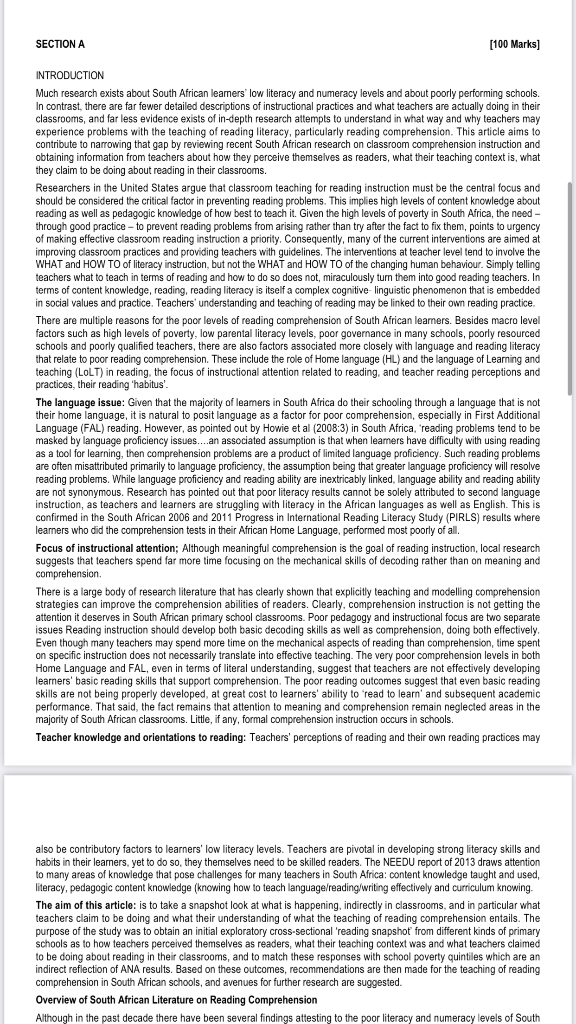
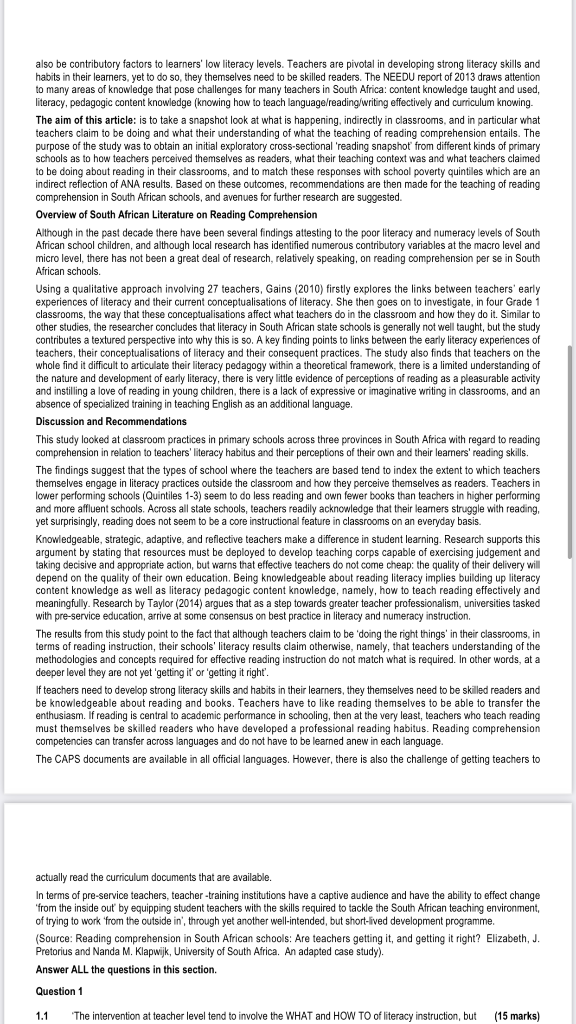

SECTION A [100 Marks] INTRODUCTION Much research exists about South African learners' low literacy and numeracy levels and about poorly performing schools. In contrast, there are far fewer detailed descriptions of instructional practices and what teachers are actually doing in their classrooms, and far less evidence exists of in-depth research attempts to understand in what way and why teachers may experience problems with the teaching of reading literacy, particularly reading comprehension. This article aims to contribute to narrowing that gap by reviewing recent South African research on classroom comprehension instruction and obtaining information from teachers about how they perceive themselves as readers, what their teaching context is, what they claim to be doing about reading in their classrooms. Researchers in the United States argue that classroom teaching for reading instruction must be the central focus and should be considered the critical factor in preventing reading problems. This implies high levels of content knowledge about reading as well as pedagogic knowledge of how best to teach it. Given the high levels of poverty in South Africa, the need - through good practice - to prevent reading problems from arising rather than try after the fact to fix them, points to urgency of making effective classroom reading instruction a priority. Consequently, many of the current interventions are aimed at improving classroom practices and providing teachers with guidelines. The interventions at teacher level tend to involve the WHAT and HOW TO of literacy instruction, but not the WHAT and HOW TO of the changing human behaviour. Simply telling teachers what to teach in terms of reading and how to do so does not, miraculously turn them into good reading teachers. In terms of content knowledge, reading, reading literacy is itself a complex cognitive- linguistic phenomenon that is embedded in social values and practice. Teachers' understanding and teaching of reading may be linked to their own reading practice. There are multiple reasons for the poor levels of reading comprehension of South African leamers. Besides macro level factors such as high levels of poverty, low parental literacy levels, poor governance in many schools, poorly resourced schools and poorly qualified teachers, there are also factors associated more closely with language and reading literacy that relate to poor reading comprehension. These include the role of Home language (HL) and the language of Learning and teaching (LoLT) in reading, the focus of instructional attention related to reading, and teacher reading perceptions and practices, their reading 'habitus'. The language issue: Given that the majority of leamers in South Africa do their schooling through a language that is not their home language, it is natural to posit language as a factor for poor comprehension, especially in First Additional Language (FAL) reading. However, as pointed out by Howie et al (2008:3) in South Africa, 'reading problems tend to be masked by language proficiency issues....an associated assumption is that when leamers have difficulty with using reading as a tool for learning, then comprehension problems are a product of limited language proficiency. Such reading problems are often misattributed primarily to language proficiency, the assumption being that greater language proficiency will resolve reading problems. While language proficiency and reading ability are inextricably linked, language ability and reading ability are not synonymous. Research has pointed out that poor literacy results cannot be solely attributed to second language instruction, as teachers and learners are struggling with literacy in the African languages as well as English. This is confirmed in the South African 2006 and 2011 Progress in International Reading Literacy Study (PIRLS) results where learners who did the comprehension tests in their African Home Language, performed most poorly of all. Focus of instructional attention; Although meaningful comprehension is the goal of reading instruction, local research suggests that teachers spend far more time focusing on the mechanical skills of decoding rather than on meaning and comprehension. There is a large body of research literature that has clearly shown that explicitly teaching and modelling comprehension strategies can improve the comprehension abilities of readers. Clearly, comprehension instruction is not getting the attention it deserves in South African primary school classrooms. Poor pedagogy and instructional focus are two separate issues Reading instruction should develop both basic decoding skills as well as comprehension, doing both effectively. Even though many teachers may spend more time on the mechanical aspects of reading than comprehension, time spent on specific instruction does not necessarily translate into effective teaching. The very poor comprehension levels in both Home Language and FAL, even in terms of literal understanding, suggest that teachers are not effectively developing learners' basic reading skills that support comprehension. The poor reading outcomes suggest that even basic reading skills are not being properly developed, at great cost to learners' ability to read to learn and subsequent academic performance. That said, the fact remains that attention to meaning and comprehension remain neglected areas in the majority of South African classrooms. Little, if any, formal comprehension instruction occurs in schools. Teacher knowledge and orientations to reading: Teachers' perceptions of reading and their own reading practices may also be contributory factors to learners' low literacy levels. Teachers are pivotal in developing strong literacy skills and habits in their learners, yet to do so, they themselves need to be skilled readers. The NEEDU report of 2013 draws attention to many areas of know challenges. achers in South Africa: content knowledge and used, literacy, pedagogic content knowledge (knowing how to teach language/reading/writing effectively and curriculum knowing. The aim of this article: is to take a snapshot look at what is happening, indirectly in classrooms, and in particular what teachers claim to be doing and what their understanding of what the teaching of reading comprehension entails. The purpose of the study was to obtain an initial exploratory cross-sectional 'reading snapshot from different kinds of primary schools as to how teachers perceived themselves as readers, what their teaching context was and what teachers claimed to be doing about reading in their classrooms, and to match these responses with school poverty quintiles which are an indirect reflection of ANA results. Based on these outcomes, recommendations are then made for the teaching of reading comprehension in South African schools, and avenues for further research are suggested. Overview of South African Literature on Reading Comprehension Although in the past decade there have been several findings attesting to the poor literacy and numeracy levels of South also be contributory factors to learners' low literacy levels. Teachers are pivotal in developing strong literacy skills and habits in their learners, yet to do so, they themselves need to be skilled readers. The NEEDU report of 2013 draws attention to many areas of knowledge that pose challenges for many teachers in South Africa: content knowledge taught and used, literacy, pedagogic content knowledge (knowing how to teach language/reading/writing effectively and curriculum knowing. The aim of this article: is to take a snapshot look at what is happening, indirectly in classrooms, and in particular what teachers claim to be doing and what their understanding of what the teaching of reading comprehension entails. The purpose of the study was to obtain an initial exploratory cross-sectional reading snapshot from different kinds of primary schools as to how teachers perceived themselves as readers, what their teaching context was and what teachers claimed to be doing about reading in their classrooms, and to match these responses with school poverty quintiles which are an indirect reflection of ANA results. Based on these outcomes, recommendations are then made for the teaching of reading comprehension in South African schools, and avenues for further research are suggested. Overview of South African Literature on Reading Comprehension Although in the past decade there have been several findings attesting to the poor literacy and numeracy levels of South African school children, and although local research has identified numerous contributory variables at the macro level and micro level, there has not been a great deal of research, relatively speaking, on reading comprehension per se in South African schools. Using a qualitative approach involving 27 teachers, Gains (2010) firstly explores the links between teachers' early experiences of literacy and their current conceptualisations of literacy. She then goes on to investigate, in four Grade 1 classrooms, the way that these conceptualisations affect what teachers do in the classroom and how they do it. Similar to other studies, the researcher concludes that literacy in South African state schools is generally not well taught, but the study contributes a textured perspective into why this is so. A key finding points to links between the early literacy experiences of teachers, their conceptualisations of literacy and their consequent practices. The study also finds that teachers on the whole find it difficult to articulate their literacy pedagogy within a theoretical framework, there is a limited understanding of the nature and development of early literacy, there is very little evidence of perceptions of reading as a pleasurable activity and instilling a love of reading in young children, there is a lack of expressive or imaginative writing in classrooms, and an absence of specialized training in teaching English as an additional language. Discussion and Recommendations This study looked at classroom practices in primary schools across three provinces in South Africa with regard to reading comprehension in relation to teachers' literacy habitus and their perceptions of their own and their learners' reading skills. The findings suggest that the types f school where the teachers are based tend to index the extent to which teachers themselves engage in literacy practices outside the classroom and how they perceive themselves as readers. Teachers in lower performing schools (Quintiles 1-3) seem to do less reading and own fewer books than teachers in higher performing and more affluent schools. Across all state schools, teachers readily acknowledge that their learners struggle with reading, yet surprisingly, reading does not seem to be a core instructional feature in classrooms on an everyday basis. Knowledgeable, strategic, adaptive, and reflective teachers make a difference in student learning. Research supports this argument by stating that resources must be deployed to develop teaching corps capable of exercising judgement and taking decisive and appropriate action, but warns that effective teachers do not come cheap: the quality of their delivery will depend on the quality of their own education. Being knowledgeable about reading literacy implies building up literacy content knowledge as well as literacy pedagogic content knowledge, namely, how to teach reading effectively and meaningfully. Research by Taylor (2014) argues that as a step towards greater teacher professionalism, universities tasked with pre-service education, arrive at some consensus on best practice in literacy and numeracy instruction. The results from this study point to the fact that although teachers claim to be 'doing the right things' in their classrooms, in terms of reading instruction, their schools' literacy results claim otherwise, namely, that teachers understanding of the methodologies and concepts required for effective reading instruction do not match what is required. In other words, at a deeper level they are not yet 'getting it' or 'getting it right. If teachers need to develop strong literacy skills and habits in their learners, they themselves need to be skilled readers and be knowledgeable about reading and books. Teachers have to like reading themselves to be able to transfer the enthusiasm. If reading is central to academic performance in schooling, then at the very least, teachers who teach reading must themselves be skilled readers who have developed a professional reading habitus. Reading comprehension competencies can transfer across languages and do not have to be learned anew in each language. The CAPS documents are available in all official languages. However, there is also the challenge of getting teachers to actually read the curriculum documents that are available. In terms of pre-service teachers, teacher-training institutions have a captive audience and have the ability to effect change 'from e inside out by equipping student teachers with the skills required to tackle the South African teaching environment, of trying to work from the outside in', through yet another well-intended, but short-lived development programme. (Source: Reading comprehension in South African schools: Are teachers getting it, and getting it right? Elizabeth, J. Pretorius and Nanda M. Klapwijk, University of South Africa. An adapted case study). Answer ALL the questions this section. Question 1 1.1 'The intervention at teacher level tend to involve the WHAT and HOW TO of literacy instruction, but (15 marks) Question 2 (20 Marks) Explain the steps (process) you would consider in the teaching and writing of a literary essay to your Grade 10 English Home Language class. Choose a play or a novel studied by Grade 10 learners









 Study Help