







Question: Please check my solution, and if there are comments, please let me know for the purpose of modifying the answer 4) Under what conditions is
Please check my solution, and if there are comments, please let me know for the purpose of modifying the answer
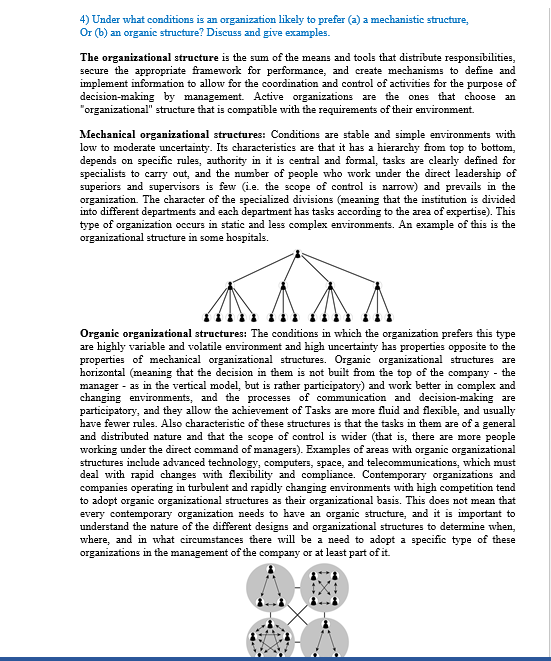
4) Under what conditions is an organization likely to prefer (a) a mechanistic structure, Or (b) an organic structure? Discuss and give examples. The organizational structure is the sum of the means and tools that distribute responsibilities, secure the appropriate framework for performance, and create mechanisms to define and implement information to allow for the coordination and control of activities for the purpose of decision-making by management. Active organizations are the ones that choose an "organizational structure that is compatible with the requirements of their environment. Mechanical organizational structures: Conditions are stable and simple environments with low to moderate uncertainty. Its characteristics are that it has a hierarchy from top to bottom, depends on specific rules, authority in it is central and formal, tasks are clearly defined for specialists to carry out, and the number of people who work under the direct leadership of superiors and supervisors is few (ie. the scope of control is narrow) and prevails in the organization. The character of the specialized divisions (meaning that the institution is divided into different departments and each department has tasks according to the area of expertise). This type of organization occurs in static and less complex environments. An example of this is the organizational structure in some hospitals. Organic organizational structures: The conditions in which the organization prefers this type are highly variable and volatile environment and high uncertainty has properties opposite to the properties of mechanical organizational structures. Organic organizational structures are horizontal (meaning that the decision in them is not built from the top of the company - the manager - as in the vertical model, but is rather participatory) and work better in complex and changing environments, and the processes of communication and decision-making are participatory, and they allow the achievement of Tasks are more fluid and flexible, and usually have fewer rules. Also characteristic of these structures is that the tasks in them are of a general and distributed nature and that the scope of control is wider (that is, there are more people working under the direct command of managers). Examples of areas with organic organizational structures include advanced technology, computers, space, and telecommunications, which must deal with rapid changes with flexibility and compliance. Contemporary organizations and companies operating in turbulent and rapidly changing environments with high competition tend to adopt organic organizational structures as their organizational basis. This does not mean that every contemporary organization needs to have an organic structure, and it is important to understand the nature of the different designs and organizational structures to determine when, where, and in what circumstances there will be a need to adopt a specific type of these organizations in the management of the company or at least part of itStep by Step Solution
There are 3 Steps involved in it
1 Expert Approved Answer
Step: 1 Unlock

Question Has Been Solved by an Expert!
Get step-by-step solutions from verified subject matter experts
Step: 2 Unlock
Step: 3 Unlock
 Study Help