







Question: Please choose the right answer and write why you choose option A or B and why you did not choose the opposite in about 70
Please choose the right answer and write why you choose option A or B and why you did not choose the opposite in about 70 to 100 words. You have to answer the light blue coloured question. For your reference, I have included one question at the beginning showing model answers of what to write or what not to write.
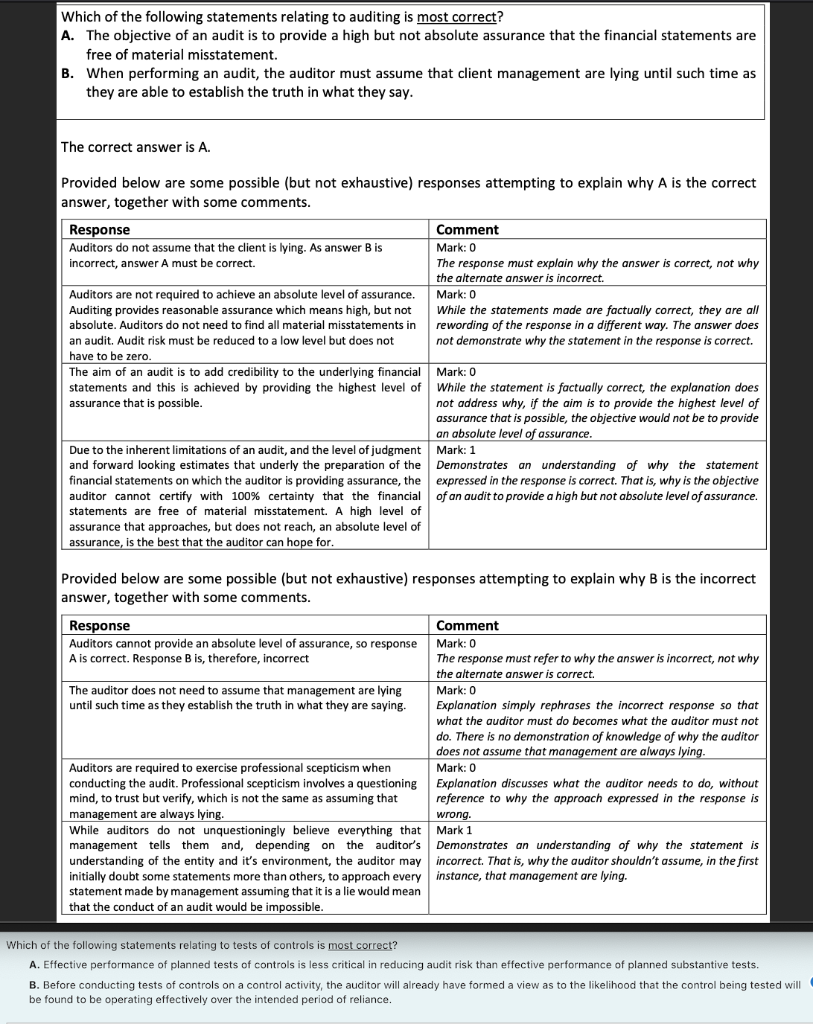
Which of the following statements relating to auditing is most correct? A. The objective of an audit is to provide a high but not absolute assurance that the financial statements are free of material misstatement. B. When performing an audit, the auditor must assume that client management are lying until such time as they are able to establish the truth in what they say. The correct answer is A. Provided below are some possible (but not exhaustive) responses attempting to explain why A is the correct answer, together with some comments. Response Comment Auditors do not assume that the client is lying. As answer B is Mark: 0 incorrect answer A must be correct. The response must explain why the answer is correct, not why the alternate answer is incorrect. Auditors are not required to achieve an absolute level of assurance. Mark: 0 Auditing provides reasonable assurance which means high, but not While the statements made are factually correct, they are all absolute. Auditors do not need to find all material misstatements in rewording of the response in a different way. The answer does an audit. Audit risk must be reduced to a low level but does not not demonstrate why the statement in the response is correct. have to be zero. The aim of an audit is to add credibility to the underlying financial Mark: 0 statements and this is achieved by providing the highest level of While the statement is factually correct, the explanation does assurance that is possible. not address why, if the aim is to provide the highest level of assurance that is possible, the objective would not be to provide an absolute level of assurance. Due to the inherent limitations of an audit, and the level of judgment Mark: 1 and forward looking estimates that underly the preparation of the Demonstrates an understanding of why the statement financial statements on which the auditor is providing assurance, the expressed in the response is correct. That is, why is the objective auditor cannot certify with 100% certainty that the financial of an audit to provide a high but not absolute level of assurance. statements are free of material misstatement. A high level of assurance that approaches, but does not reach, an absolute level of assurance, is the best that the auditor can hope for. Provided below are some possible (but not exhaustive) responses attempting to explain why B is the incorrect answer, together with some comments. Response Auditors cannot provide an absolute level of assurance, so response A is correct. Response B is, therefore, incorrect The auditor does not need to assume that management are lying until such time as they establish the truth in what they are saying. Comment Mark: 0 The response must refer to why the answer incorrect, not why the alternate answer is correct. Mark: 0 Explanation simply rephrases the incorrect response so that what the auditor must do becomes what the auditor must not do. There is no demonstration of knowledge of why the auditor does not assume that management are always lying. M Mark: 0 Explanation discusses what the auditor needs to do, without reference to why the approach expressed in the response is wrong. Mark 1 Auditors are required to exercise professional scepticism when conducting the audit. Professional scepticism involves a questioning mind, to trust but verify, which is not the same as assuming that management are always lying. While auditors do not unquestioningly believe everything that management tells them and, depending on the auditor's understanding of the entity and it's environment, the auditor may initially doubt some statements more than others, to approach every statement made by management assuming that it is a lie would mean that the conduct of an audit would be impossible. Demonstrates an understanding of why the statement is incorrect. That is, why the auditor shouldn't assume, in the first instance, that management are lying. Which of the following statements relating to tests of controls most correct? A. Effective performance of planned tests of controls is less critical in reducing audit risk than effective performance of planned substantive tests. B. Before conducting tests of controls on a control activity, the auditor will already have formed a view as to the likelihood that the control being tested will be found to be operating effectively over the intended period of reliance
Step by Step Solution
There are 3 Steps involved in it

Get step-by-step solutions from verified subject matter experts
 Study Help