







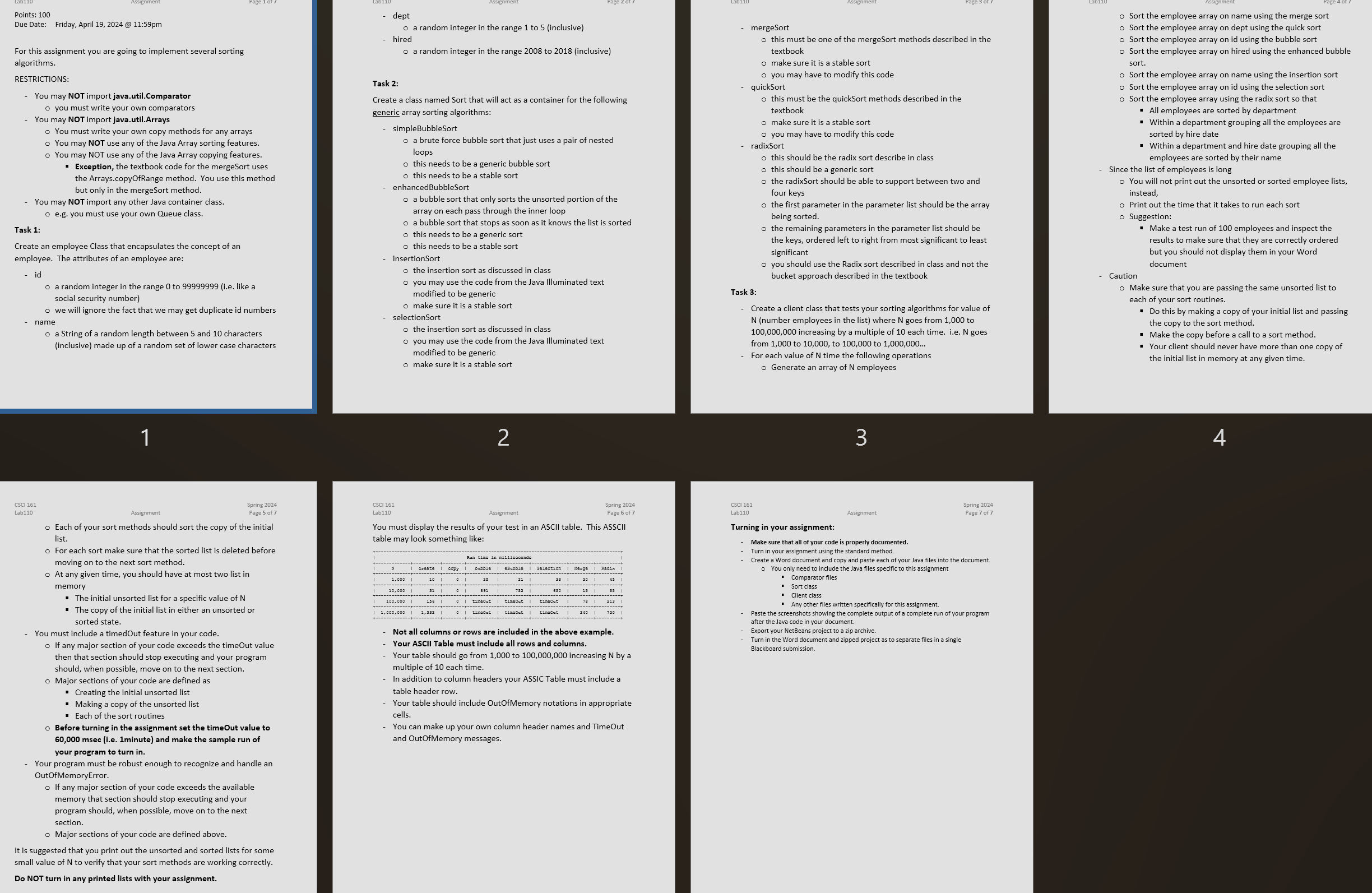
Question: Please code alll in Java - - - - - - - For this assignment you are going to implement several sorting algorithms. RESTRICTIONS: -
Please code alll in JavaFor this assignment you are going to implement several sorting algorithms.
RESTRICTIONS:
You may NOT import java.util.Comparator
o you must write your own comparators
You may NOT import java.util.Arrays
o You must write your own copy methods for any arrays
o You may NOT use any of the Java Array sorting features.
o You may NOT use any of the Java Array copying features.
Exception, the textbook code for the mergeSort uses the Arrays.copyOfRange method. You use this method but only in the mergeSort method.
You may NOT import any other Java container class.
o eg you must use your own Queue class.
Task :
Create an employee Class that encapsulates the concept of an employee. The attributes of an employee are:
id
o a random integer in the range to ie like a social security number
o we will ignore the fact that we may get duplicate id numbers
name
o a String of a random length between and characters inclusive made up of a random set of lower case characters
dept
o a random integer in the range to inclusive
hired
o a random integer in the range to inclusive
Task :
Create a class named Sort that will act as a container for the following generic array sorting algorithms:
simpleBubbleSort
o a brute force bubble sort that just uses a pair of nested loops
o this needs to be a generic bubble sort
o this needs to be a stable sort
enhancedBubbleSort
o a bubble sort that only sorts the unsorted portion of the array on each pass through the inner loop
o a bubble sort that stops as soon as it knows the list is sorted
o this needs to be a generic sort
o this needs to be a stable sort
insertionSort
o the insertion sort as discussed in class
o you may use the code from the Java Illuminated text modified to be generic
o make sure it is a stable sort
selectionSort
o the insertion sort as discussed in class
o you may use the code from the Java Illuminated text modified to be generic
o make sure it is a stable sort
mergeSort
o this must be one of the mergeSort methods described in the textbook
o make sure it is a stable sort
o you may have to modify this code
quickSort
o this must be the quickSort methods described in the textbook
o make sure it is a stable sort
o you may have to modify this code
radixSort
o this should be the radix sort describe in class
o this should be a generic sort
o the radixSort should be able to support between two and four keys
o the first parameter in the parameter list should be the array being sorted.
o the remaining parameters in the parameter list should be the keys, ordered left to right from most significant to least significant
o you should use the Radix sort described in class and not the bucket approach described in the textbook
Task :
Create a client class that tests your sorting algorithms for value of N number employees in the list where N goes from to increasing by a multiple of each time. ie N goes from to to to
For each value of N time the following operations
o Generate an array of N employees
o Sort the employee array on name using the merge sort
o Sort the employee array on dept using the quick sort
o Sort the employee array on id using the bubble sort
o Sort the employee array on hired using the enhanced bubble sort.
o Sort the employee array on name using the insertion sort
o Sort the employee array on id using the selection sort
o Sort the employee array using the radix sort so that
All employees are sorted by department
Within a department grouping all the employees are sorted by hire date
Within a department and hire date grouping all the employees are sorted by their name
Since the list of employees is long
o You will not print out the unsorted or sorted employee lists, instead,
o Print out the time that it takes to run each sort
o Suggestion:
Make a test run of employees and inspect the results to make sure that they are correctly ordered but you should not display them in your Word document
Caution
o Make sure that you are passing the same unsorted list to each of your sort routines.
Do this by making a copy of your initial list and passing the copy to the sort method.
Make the copy before a call to a sort method.
Your client should never have more than one copy of the initial list in memory at any given time.
o Each of your sort methods should sort the copy of the initial list.
o For each sort make sure that the sorted list is deleted before moving on to the next sort method.
o At any given time, you should have at most two list in memory
Step by Step Solution
There are 3 Steps involved in it
1 Expert Approved Answer
Step: 1 Unlock

To complete your assignment in Java we will break down the tasks as follows Task 1 Create an Employe... View full answer
Question Has Been Solved by an Expert!
Get step-by-step solutions from verified subject matter experts
Step: 2 Unlock
Step: 3 Unlock
 Study Help