







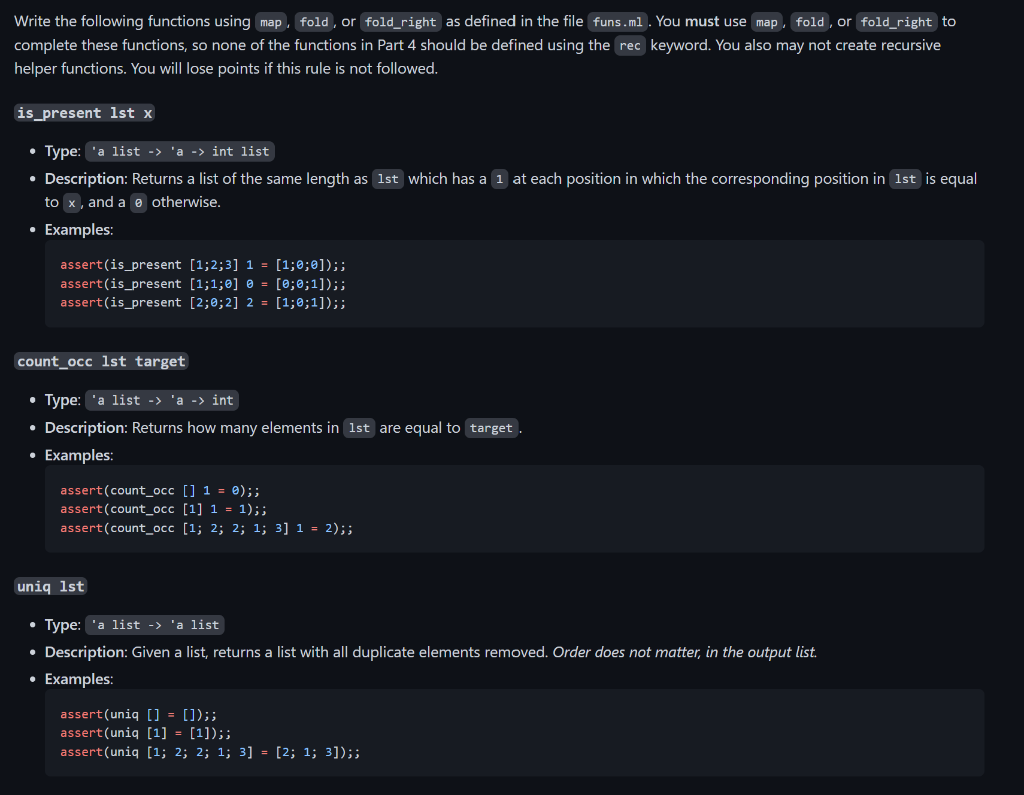
Question: Please code these 3 functions in OCaml language. DO NOT use recursion nor outside helper methods . There is also a limit to list library
Please code these 3 functions in OCaml language. DO NOT use recursion nor outside helper methods. There is also a limit to list library methods, and the only ones you are allowed to use are: reverse list and merge.
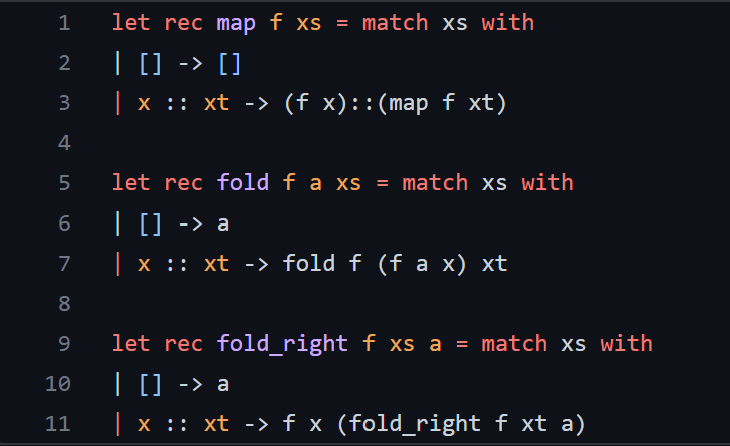
The functions from funs.ml is provided below, along with the typing for each function and their parameter.

I understand this is a lot to take in and very hard to code, especially with the restrictions spoken above, but please help me with them.
Write the following functions using map, fold, or fold_right as defined in the file funs.m1. You must use map, fold, or fold_right to complete these functions, so none of the functions in Part 4 should be defined using the rec keyword. You also may not create recursive helper functions. You will lose points if this rule is not followed. is_present lst x - Type: 'a list ' a int list - Description: Returns a list of the same length as 1 st which has a 1 at each position in which the corresponding position in 1 st is equal to x, and a otherwise. - Examples: \( \begin{aligned} \text { assert(is_present }[1 ; 2 ; 3] 1 & =[1 ; \theta ; \theta]) ; \\ \text { assert(is_present }[1 ; 1 ; \theta] \theta & =[0 ; \theta ; 1]) ; \\ \text { assert(is_present }[2 ; 0 ; 2] 2 & =[1 ; 0 ; 1]) ;\end{aligned} \) count_occ lst target - Type: 'a list ' a int - Description: Returns how many elements in lst are equal to target. - Examples: assert (count_occ [] 1=0);; assert ( count_occ [1]1=1);; assert(count_occ [1;2;2;1;3]1=2);; uniq lst - Type: 'a list 'a list - Description: Given a list, returns a list with all duplicate elements removed. Order does not matter, in the output list. - Examples: assert( uniq []=[]);; assert( uniq [1]=[1]);; assert( uniq [1;2;2;1;3]=[2;1;3])
Step by Step Solution
There are 3 Steps involved in it

Get step-by-step solutions from verified subject matter experts
 Study Help