







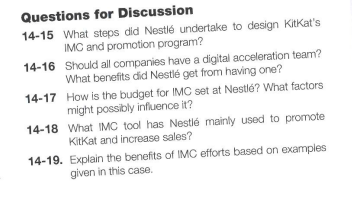
Question: Please complete questions attached at the top using the case study provided, thanks! :) Questions for Discussion 14-15 What steps did Nestl undertake to design
Please complete questions attached at the top using the case study provided, thanks! :)
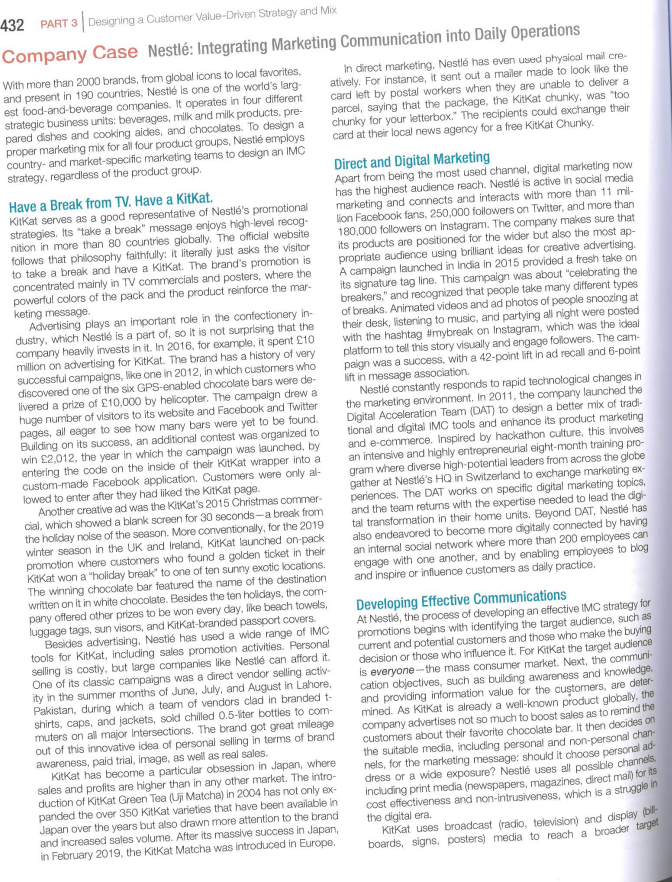
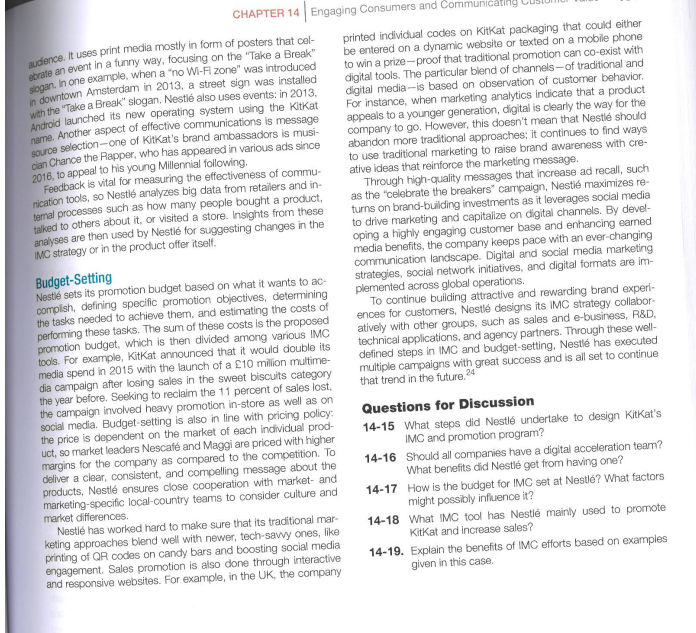
Questions for Discussion 14-15 What steps did Nestl undertake to design KitKat's IMC and promotion program? 14-16 Should all companies have a digital acceleration team? What benefits did Nestl get from having one? 14-17 How is the budget for IMC set at Nestl? What factors might possibly infuence it? 14-18 What IMC tool has Nestl mainly used to promote KitKat and increase sales? 14-19. Explain the benefits of IMC efforts based on examples given in this case. CHAPTER 14 audence. It uses print media mostly in form of posters that celebrate an event in a funny way, focusing on the "Take a Break" sogan. In one example, when a "no Wi-Fi zone" was introduced in downtown Amsterdam in 2013, a street sign was installed with the "Take a Break" slogan. Nestl also uses events: in 2013 , Android launched its new operating system using the KltKat neme. Another aspect of effective communications is message source selection-one of KitKat's brand ambassadors is musician Chance the Rapper, who has appeared in various ads since 2016 , to appeal to his young Millernial following. Feedback is vital for measuring the effectiveness of communication tools, so Nestl analyzes big data from retailers and intemal processes such as how many people bought a product, talked to others about it, or visited a store. Insights from these analyses are then used by Nestle for suggesting changes in the IMC strategy or in the product offer itself. Budget-Setting Nestle sets its promotion budget based on what it wants to accomplish, defining specific promotion objectives, determining the tasks needed to achieve them, and estimating the costs of performing these tasks. The sum of these costs is the proposed promotion budget, which is then divided among various IMC tools. For example, KitKat announced that it would double its media spend in 2015 with the launch of a 10 milion multimedia campaign after losing sales in the sweet biscuits category the year before. Seeking to reclaim the 11 percent of sales lost. the campaign involved heavy promotion in-store as well as on social media. Budget-setting is also in line with pricing policy: the price is dependent on the market of each individual product, so market leaders Nescaf and Maggi are priced with higher margins for the company as compared to the competition. To deliver a clear, consistent, and compelling message about the products, Nestl ensures close cooperation with market- and marketing-specific local-country teams to consider culture and market differences. Nestl has worked hard to make sure that its traditional marketing approaches blend well with newer, tech-sawy ones, like printing of QR codes on candy bars and boosting social media engagement. Sales promotion is also done through interactive and responsive websites. For example, in the UK, the company printed individual codes on KitKat packaging that could either be entered on a dynamic website or texted on a mobile phone to win a prize - proof that traditional promotion can co-exist with digital tools. The particular blend of channels - of traditional and digital media-is based on observation of customer behavior. For instance, when marketing analytics indicate that a product appeals to a younger generation, digital is clearly the way for the company to go. However, this doesn't mean that Nestle should abandon more traditional approaches; it continues to find ways to use traditional marketing to raise brand awareness with creative ideas that reinforce the marketing message. Through high-quality messages that increase ad recall, such as the "celebrate the breakers" campaign, Nesti maximizes returns on brand-building investments as it leverages social media to drive marketing and capitalize on digital channels. By developing a highly engaging customer base and enhancing earned media benefits, the company keeps pace with an ever-changing communication landscape. Digital and social media marketing strategies, social network initiatives, and digital formats are implemented across global operations. To continue building attractive and rewarding brand experiences for customers, Nestle designs its IMC strategy collaboratively with other groups, such as sales and e-business, R\&D, technical applications, and agency partners. Through these welldefined steps in IMC and budget-setting, Nestle has executed multiple campaigns with great success and is all set to continue that trend in the future. 24 Questions for Discussion 14-15 What steps did Nestl undertake to design KitKat's IMC and promotion program? 14-16 Should all companies have a digital acceleration team? What benefits did Nestl get from having one? 14-17 How is the budget for IMC set at Nestl? What factors might possibly infuence it? 14-18 What IMC tool has Nestl mainly used to promote KitKat and increase sales? 14-19. Explain the benefits of IMC efforts based on examples given in this case. Company Case Nestl: Integrating Marketing Communication into Daily Operations Nith more than 2000 brands, from global icons to local favorites, and present in 190 countries, Nestle is one of the world's largest food-and-beverage companies. It operates in four different strategic business units: beverages, milk and milk products, prepared dishes and cooking aides, and chocolates. To design a proper marketing mix for all four product groups, Nestle employs country- and market-specific marketing teams to design an IMC strategy, regardless of the product group. Have a Break from TV. Have a KitKat. KitKat serves as a good representative of Nestl's promotional strategies. Its "take a break" message enjoys high-level recognition in more than 80 countries giobally. The official website follows that philosophy faithfully: it literally just asks the visitor to take a break and have a KitKat. The brand's promotion is concentrated mainly in TV commercials and posters, where the powerful colors of the pack and the product reinforce the marketing message. Advertising plays an important role in the confectionery industry, which Nestle is a part of, so it is not surprising that the company heavily invests in it. In 2016, for example, it spent 10 million on advertising for KitKat. The brand has a history of very successful campaigns, like one in 2012, in which customers who discovered one of the six GPS-enabled chocolate bars were delivered a prize of 10,000 by helicopter. The campaign drew a huge number of visitors to its website and Facebook and Twitter pages, all eager to see how many bars were yet to be found. Building on its success, an additional contest was organized to win 2,012, the year in which the campaign was launched, by entering the code on the inside of their KitKat wrapper into a custom-made Facebook application. Customers were only allowed to enter after they had liked the KitKat page. Another creative ad was the KitKat's 2015 Christmas cormmercial, which showed a blank screen for 30 seconds - a break from the holiday noise of the season. More conventionally, for the 2019 winter season in the UK and Ireland, KitKat launched on-pack promotion where customers who found a golden ticket in their KitKat won a "holiday break" to one of ten sunny exotic locations. The winning chocolate bar featured the name of the destination written on it in white chocolate. Besides the ten holidays, the company offered other prizes to be won every day, like beach towels. luggage tags, sun visors, and KitKat-branded passport covers. Besides advertising, Nestl has used a wide range of IMC tools for KitKat, including sales promotion activities. Personal selling is costly, but large companies like Nestle can afford it. One of its classic campaigns was a direct vendor selling activity in the summer months of June, July, and August in Lahore, Pakistan, during which a team of vendors clad in branded tshirts, caps, and jackets, sold chilled 0.5 -liter bottles to commuters on all major intersections. The brand got great mileage out of this innovative idea of personal selling in terms of brand awareness, paid trial, image, as well as real sales. KitKat has become a particular obsession in Japan, where sales and profits are higher than in any other market. The introduction of KitKat Green Tea (Uji Matcha) in 2004 has not only expanded the over 350 KitKat varieties that have been available in Japan over the years but also drawn more attention to the brand and increased sales volume. After its massive success in Japan, in February 2019, the KitKat Matcha was introduced in Europe. In direct marketing, Nestl has even used physioal mail creatively. For instance, it sent out a maller made to look like the card left by postal workers when they are unable to deliver a parcel, saying that the package, the KitKat chunky, was "too chunky for your letterbox." The recipients could exchange their card at their local news agency for a free KitKat Chunky. Direct and Digital Marketing Apart from being the most used channel, digital marketing now has the highest audience reach. Nestle is active in social media marketing and connects and interacts with more than 11 million Facebook fans, 250,000 followers on Twitter, and more than 180,000 followers on instagram. The company makes sure that its products are positioned for the wider but also the most appropriate audience using brilliant ideas for creative advertising. A campaign launched in India in 2015 provided a fresh take on its signature tag line. This campaign was about "celebrating the breakers," and recognized that people take many different types of breaks. Animated videos and ad photos of people snoozing at their desk, listering to music, and partying all night were posted with the hashtag \#mybreak on Instagram, which was the ideal platform to tell this story visually and engage followers. The campaign was a success, with a 42-point lift in ad recall and 6-point lift in message association. Nestl constantly responds to rapid technological changes in the marketing environment. In 2011, the company launched the Digital Acceleration Team (DAT) to design a better mix of traditional and digital IMC tools and enhance its product marketing and -commerce. Inspired by hackathon culture, this involves an intensive and highly entrepreneurial eight-month training program where diverse high-potential leaders from across the globe gather at Nestle's HQ in Switzerland to exchange marketing experiences. The DAT works on specific digital marketing topics, and the team returns with the expertise needed to lead the digtal transformation in their home units. Beyond DAT, Nestle has also endeavored to become more digitally connected by having an internal social network where more than 200 employees can engage with one another, and by enabling employees to blog and inspire or influence customers as daily practice. Developing Effective Communications At Nestle, the process of developing an effective IMC strategy for promotions begins with identifying the target audience, such as current and potential customers and those who make the buying decision or those who influence it. For KitKat the target audience is everyone - the mass consumer market. Next, the communication objectives, such as building awareness and knowledge. and providing informetion value for the customers, are determined. As KitKat is already a well-known product globally, the company advertises not so much to boost sales as to remind the customers about their favorite chocolate bar. It then decides on the suitable media, including personal and non-personal channels, for the marketing message: should it choose personal address or a wide exposure? Nestl uses all possible channels. including print media (newspapers, magazines, direct mall) for its cost effectiveness and non-intrusiveness, which is a struggle in the digital era. KitKat uses broadcast (radio, television) and display (billboards, signs, posters) media to reach a broader target
Step by Step Solution
There are 3 Steps involved in it

Get step-by-step solutions from verified subject matter experts
 Study Help