







Question: please determine the limiting reagent please determine the limiting reagent from the alcohol dehydration of 10g menthol and 5ml phosphoric acid Experiment 3: DEHYDRATION OF
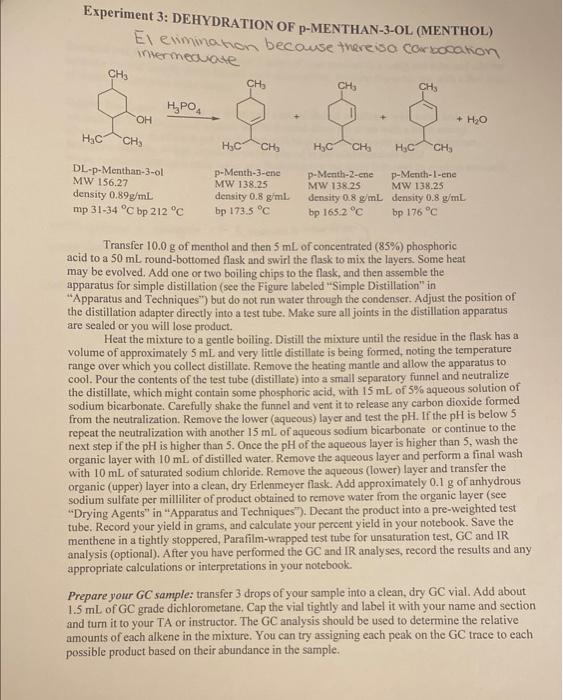
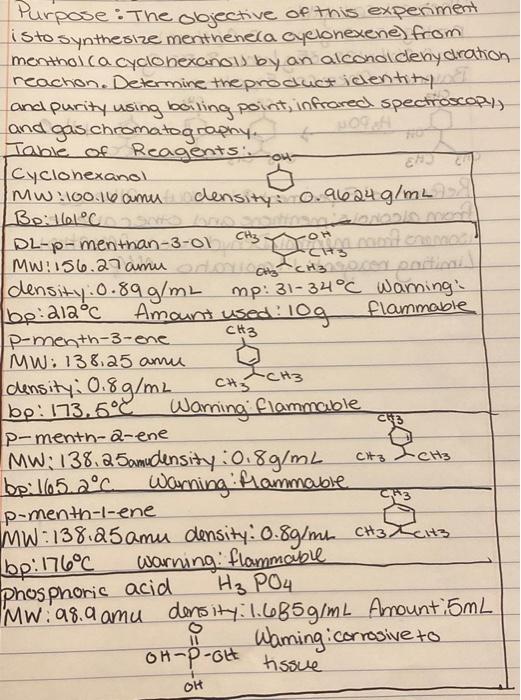
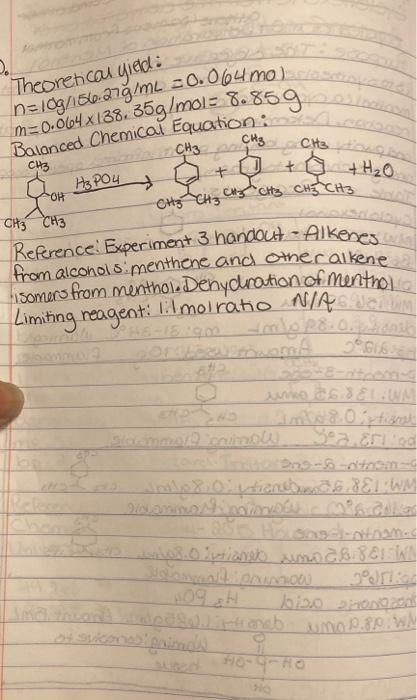
Experiment 3: DEHYDRATION OF p-MENTHAN-3-OL (MENTHOL) El elimination becouse there iso carbocation intermeavate DL-p-Menthan-3-olMW156.27density0.89g/mLmp3134Cbp212Cp-Menth-3-eneMW138.25density0.8g/mLbp173.5Cp-Menth-2-eneMW138.25density0.8g/mLbp165.2Cp-Menth-1-eneMW138.25density0.8g/mLbp176C Transfer 10.0g of menthol and then 5mL of concentrated (85%) phosphoric acid to a 50mL round-bottomed flask and swirl the flask to mix the layers. Some heat may be evolved. Add one or two boiling chips to the flask, and then assemble the apparatus for simple distillation (see the Figure labeled "Simple Distillation" in "Apparatus and Techniques") but do not run water through the condenser. Adjust the position of the distillation adapter directly into a test tube. Make sure all joints in the distillation apparatus are sealed or you will lose product. Heat the mixture to a gentle boiling. Distill the mixture until the residue in the flask has a volume of approximately 5mL and very little distillate is being formed, noting the temperature range over which you collect distillate. Remove the heating mantle and allow the apparatus to cool. Pour the contents of the test tube (distillate) into a small separatory funnel and neutralize the distillate, which might contain some phosphoric acid, with 15mL of 5% aqueous solution of sodium bicarbonate. Carefully shake the funnel and vent it to release any carbon dioxide formed from the neutralization. Remove the lower (equeous) layer and test the pH. If the pH is below 5 repeat the neutralization with another 15mL of aqueous sodium bicarbonate or continue to the next step if the pH is higher than 5 . Once the pH of the aqueous layer is higher than 5 , wash the organic layer with 10mL of distilled water. Remove the aqueous layer and perform a final wash with 10mL of saturated sodium chloride. Remove the aqueous (lower) layer and transfer the organic (upper) layer into a clean, dry Erlenmeyer flask. Add approximately 0.1g of anhydrous sodium sulfate per milliliter of product obtained to remove water from the organic layer (see "Drying Agents" in "Apparatus and Techniques"). Decant the product into a pre-weighted test tube. Record your yield in grams, and calculate your percent yield in your notebook. Save the menthene in a tightly stoppered, Parafilm-wrapped test tube for unsaturation test, GC and IR analysis (optional). After you have performed the GC and IR analyses, record the results and any appropriate calculations or interpretations in your notebook. Prepare your GC sample: transfer 3 drops of your sample into a clean, dry GC vial. Add about 1.5mL of GC grade dichlorometane. Cap the vial tightly and label it with your name and section and turn it to your TA or instructor. The GC analysis should be used to determine the relative amounts of each alkene in the mixture. You can try assigning each peak on the GC trace to each possible product based on their abundance in the sample. Purpose: The objective of this experiment isto synthesize menthene(a ayclonexene) from menthol (a cyclonexanols by an alconoldehy dration reachon. Determine the product identity and purity using boiling point, infrared spectroscopy, and gas chromatography. Table of Reagents: Cyclohexanol Mw: 100.16 amu density: 0.9624g/mL Bp: 161C density.0.89g/mL mp:3134C waming:bp:212 C Amount used: 10g flammable P-menth-3-ene MW:138.25 amu density: 0.8g/mL bp: 173.5C Waming flammable p-menth-2-ene MW:138.25 amdensity: 0.8g/mLCH3CCH3 bp: 165.2C Warning: Hlammable p-menth-l-ene MW: 138.25 mu density: 0.8g/mcCH3Ccit3 bp: 176C warning: flammable phosphoric acid H3PO4 MW: 98.9 amu density: 1.685g/mL Anount:.5mL Waming: corrosive to hissue Reference: Experiment 3 handout - Alkenes from alconols: menthene and other alkene isomers from menthol. Dehydration of menthol Limiting reagent: 1:1 molratio N/A
Step by Step Solution
There are 3 Steps involved in it

Get step-by-step solutions from verified subject matter experts
 Study Help