







Question: please do 3-9. linux. include the commands and code. thank you 2. Use history and tail (Sobell, page 327) to list the 10 most recent
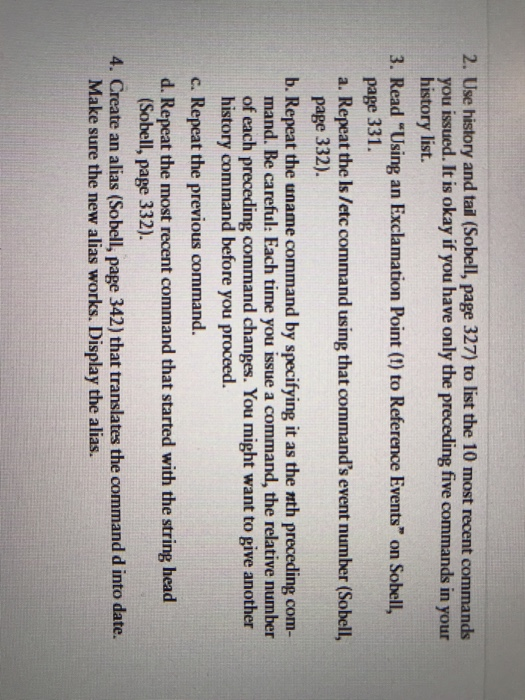
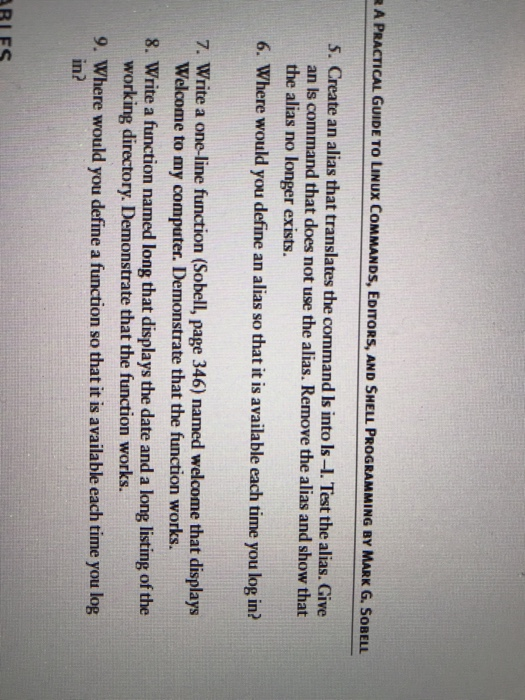
2. Use history and tail (Sobell, page 327) to list the 10 most recent commands you issued. It is okay if you have only the preceding five commands in your history list. 3. Read "Using an Exclamation Point (1) to Reference Events" on Sobell, page 331. a. Repeat the ls /etc command using that command's event number (Sobell, page 332). b. Repeat the uname command by specifying it as the nth preceding com- mand. Be careful: Each time you issue a command, the relative number of each preceding command changes. You might want to give another history command before you proceed. c. Repeat the previous command d. Repeat the most recent command that started with the string head (Sobell, page 332). 4. Create an alias (Sobell, page 342) that translates the command d into date. Make sure the new alias works. Display the alias. A PRACTICAL GUIDE TO LiNUX COMMANDS, EDITORS, AND SHELL PROGRAMMING BY MARK G. SOBELL 5. Create an alias that translates the command Is into ls-1. Test the alias. Give an ls command that does not use the alias. Remove the alias and show that the alias no longer exists. 6. Where would you define an alias so that it is available each time you log in? 7. Write a one-line function (Sobell, page 346) named welcome that displays 8. Write a function named long that displays the date and a long listing of the 9. Where would you define a function so that it is available each time you log Welcome to my computer. Demonstrate that the function works. working directory. Demonstrate that the function works. in? RLES
Step by Step Solution
There are 3 Steps involved in it

Get step-by-step solutions from verified subject matter experts
 Study Help