







Question: please do a scientific question for this lab (standing on a force plate, zeroing the scale, jumping and landing on the scale: one landing rigid(straight
please do a scientific question for this lab (standing on a force plate, zeroing the scale, jumping and landing on the scale: one landing rigid(straight legs) one landing gentle (bent knees).
the picture is the majority of the procedure, the rest says: in such a way that you cut the maximum force by at least half from your rigid-knee landing. This may take a few tries to learn how you need to land. How low can you get your maximum force relative to your rigid-knee landing (i.e. measure the maximum force during landing for both bent- and rigid-knee landings and calculate ????,?????????,?????)?you
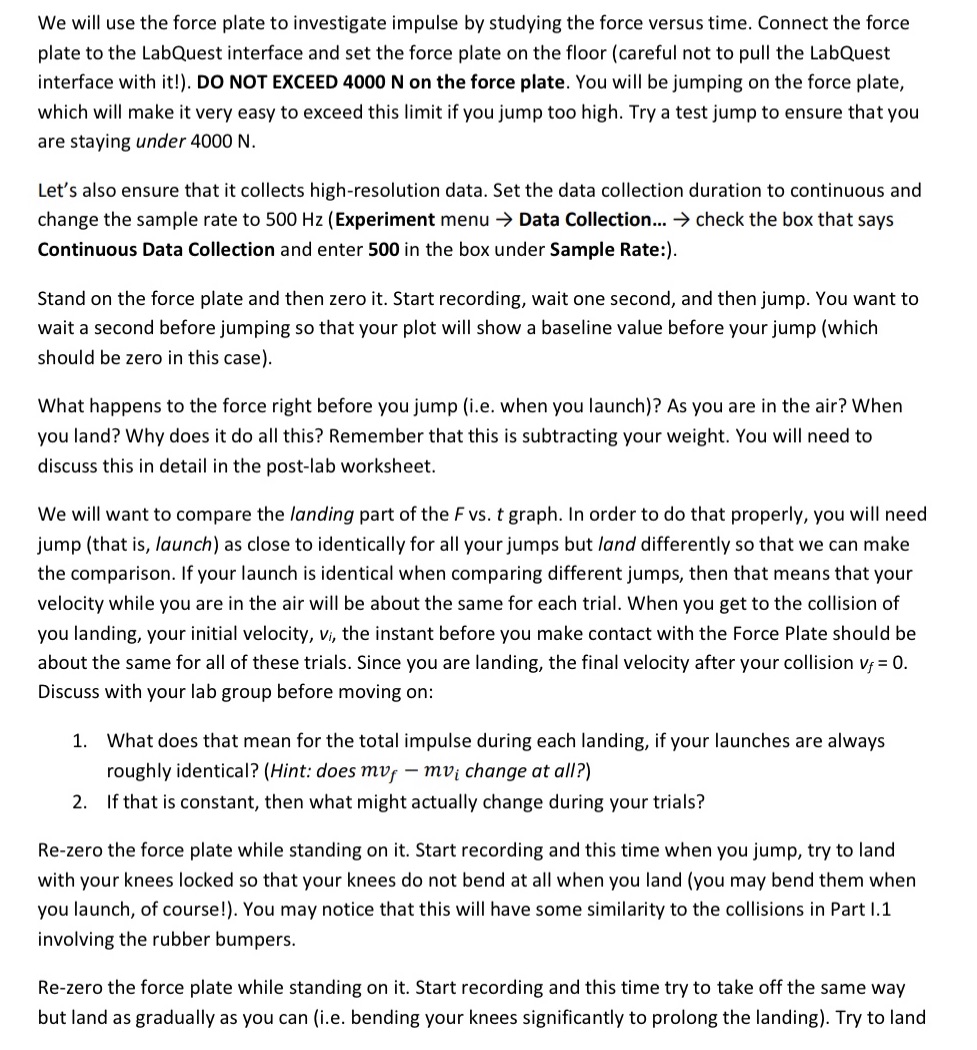
We will use the force plate to investigate impulse by studying the force versus time. Connect the force plate to the LabQuest interface and set the force plate on the floor [careful not to pull the LabQuest interface with it!). DO NOT EXCEED 4000 N on the force plate. You will be jumping on the force plate, which will make it very easy to exceed this limit if you jump too high. Try a test jump to ensure that you are staying under 4000 N. Let's also ensure that it collects highwresolution data. Set the data collection duration to continuous and change the sample rate to 500 Hz (Experiment menu -) Data Collection... > check the box that says Continuous Data Collection and enter 500 in the box under Sample Rate:). Stand on the force plate and than zero it. Start recording, wait one second, and then jump. You want to wait a second before jumping so that your plot will show a baseline value before yourjump (which should be zero in this case}. What happens to the force right before you jump (i.e. when you launch}? As you are in the air? When you land? Why does it do all this? Remember that this is subtracting your weight. You will need to discuss this in detail in the post-lab worksheet. We will want to compare the landing part ofthe F vs. tgraph. In order to do that properly, you will need jump (that is, launch) as close to identically for all your jumps but lend differently so that we can make the comparison. If your launch is identical when comparing different jumps, then that means that your velocity while you are in the air will be about the same for each trial. When you get to the collision of you landing, your initial velocity, v.-, the instant before you make contact with the Force Plate should be about the same for all of these trials. Since you are landing, the final velocity after your collision vy = 0. Discuss with your lab group before moving on: 1. What does that mean for the total impulse during each landing, if your launches are always roughly identical? (Hint: does mu; - may change at oii?) 2. Ifthat is constant, then what might actually change during your trials? Fla-zero the force plate while standing on it. Start recording and this time when you jump, try to land with your knees locked so that your knees do not bend at all when you land {you may bend them when you launch, of course!}. You may notice that this will have some similarity to the collisions in Part |.1 involving the rubber bumpers. Re-zero the force plate while standing on it. Start recording and this time try to take off the same way but land as gradually as you can (i.e. bending your knees signicantly to prolong the landing). Try to land
Step by Step Solution
There are 3 Steps involved in it

Get step-by-step solutions from verified subject matter experts
 Study Help