







Question: Please do it carefully, this is the 2nd time I am asking this questions, in the first time they got 5 out of 10 How
Please do it carefully, this is the 2nd time I am asking this questions, in the first time they got 5 out of 10
How Do These Teams Perform?
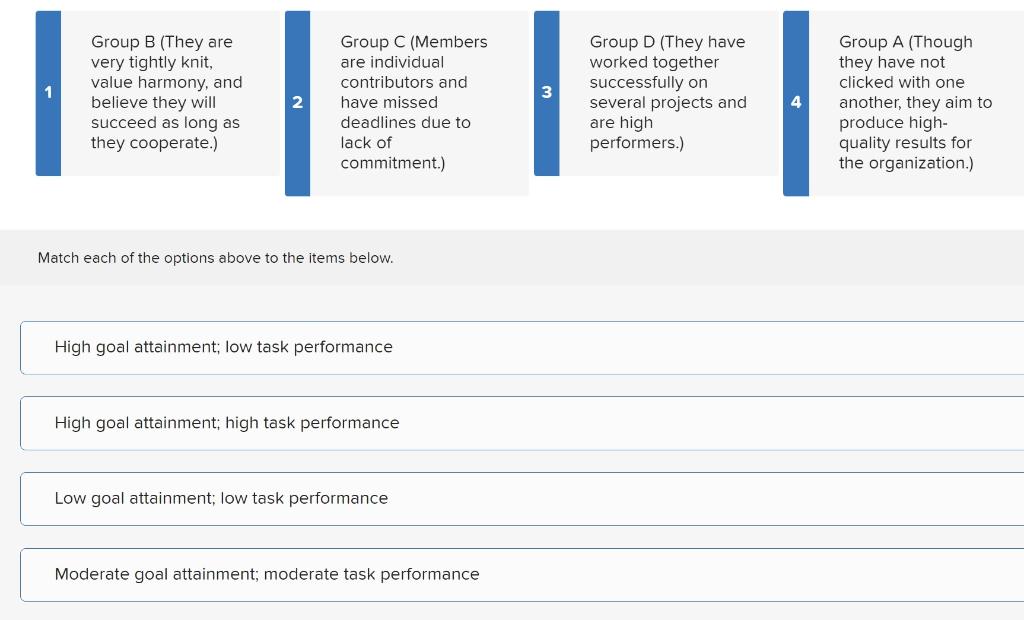
Some groups are better than others at ensuring that their members behave the way the group prefers. Cohesive groups are more effective than noncohesive groups at norm enforcement. But do they have norms of high or low performance? The highest performance occurs when a cohesive team has high-performance norms. But if a highly cohesive group has low-performance norms, that group will have the worst performance. In the group's eyes, however, it will have succeeded in achieving its goal of poor performance. Noncohesive groups with high-performance norms can be effective from the company's standpoint. However, they won't be as productive as they would be if they were more cohesive. Noncohesive groups with low-performance norms perform poorly, but they will not ruin things for management as effectively as can cohesive groups with low-performance norms.
Read about each group below:
Group A: The members of Group A aim to produce high-quality results for the organization. Despite the fact that the members have never really "clicked" with one another, they know that if each member does his or her own part, the team will achieve its goals.
Group B: The members of Group B are very tightly knit and believe they have the best and the brightest members of the organization. They highly value group harmony and believe that as long as they cooperate with one another, they will succeed.
Group C: Group C is a cross-functional product development team whose members are essentially individual contributors. They have struggled to merge their diverse talents and approaches and have missed deadlines due to the team's lack of commitment to the overall project.
Group D: The members of Group D have worked together successfully on several projects and are friends both inside and outside of work. They are also high performers who pride themselves on superior goal accomplishment.
The goal of this activity is to consider different groups and identify their norms for performance and their cohesiveness in efforts to project their likely productivity.
This activity is important because managers need to build teams that are cohesive and have high-performance norms.
From the information in the mini-case, match each group's goal attainment and task performance.
Step by Step Solution
There are 3 Steps involved in it

Get step-by-step solutions from verified subject matter experts
 Study Help