







Question: Please, do not copy and paste the exist answer already here because it is incorrect. There is no more information An invertebrate hemoglobin is found,
Please, do not copy and paste the exist answer already here because it is incorrect.
There is no more information
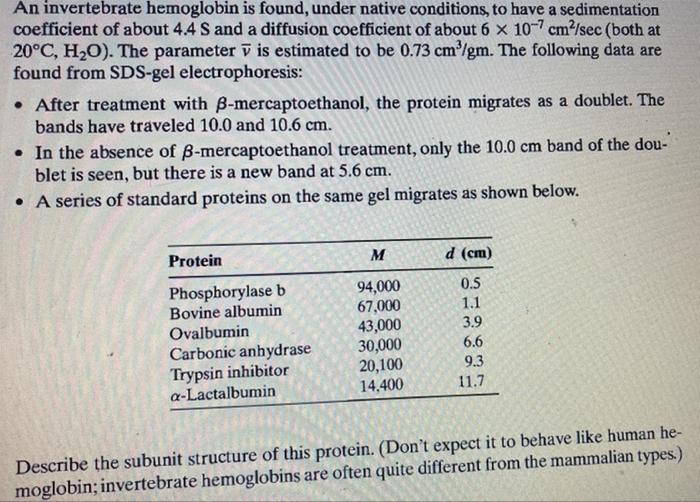
An invertebrate hemoglobin is found, under native conditions, to have a sedimentation coefficient of about 4.4 S and a diffusion coefficient of about 6 x 10⁻⁷cm/sec (both at 20C, H20). The parameter 5 is estimated to be 0.73 cm/gm. The following data are found from SDS-gel electrophoresis: After treatment with B-mercaptoethanol, the protein migrates as a doublet. The bands have traveled 10.0 and 10.6 cm. In the absence of B-mercaptoethanol treatment, only the 10.0 cm band of the dou- blet is seen, but there is a new band at 5.6 cm. A series of standard proteins on the same gel migrates as shown below. Protein d (cm) Phosphorylase b Bovine albumin Ovalbumin Carbonic anhydrase Trypsin inhibitor a-Lactalbumin 94,000 67,000 43,000 30,000 20,100 14,400 0.5 1.1 3.9 6.6 9.3 11.7 Describe the subunit structure of this protein. (Don't expect it to behave like human he- moglobin; invertebrate hemoglobins are often quite different from the mammalian types.)
Step by Step Solution
There are 3 Steps involved in it

Get step-by-step solutions from verified subject matter experts
 Study Help