







Question: please do not write a paper just bullet point the key things that the questions ask such as whats the role of digitization and information
please do not write a paper just bullet point the key things that the questions ask such as whats the role of digitization and information in enabling... ( also did not post all of the paper so just bullet point the ones you can would be greatly appreciated
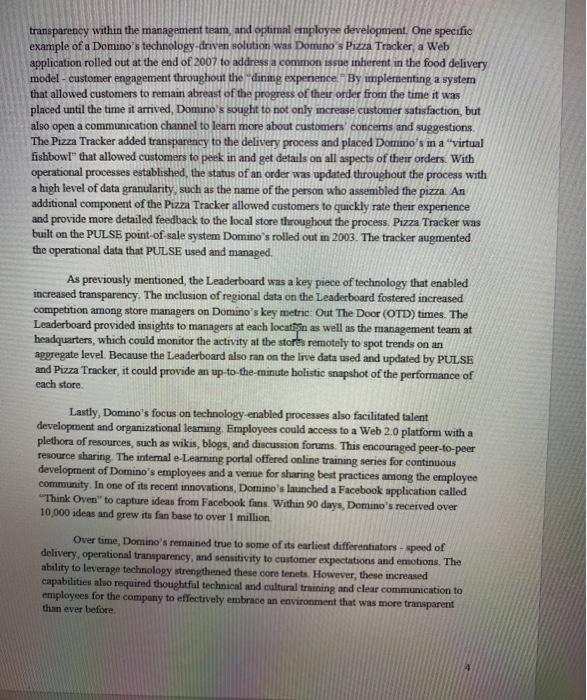
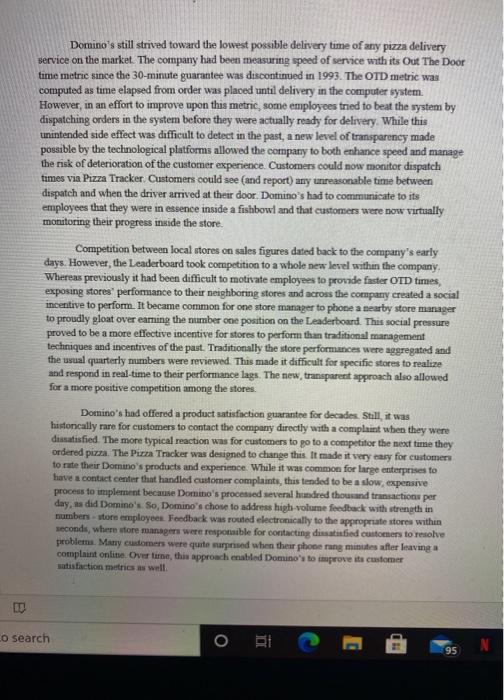
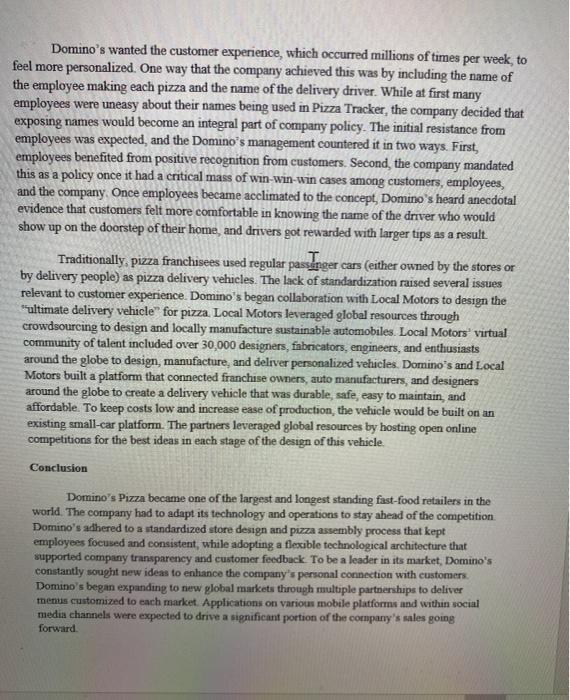
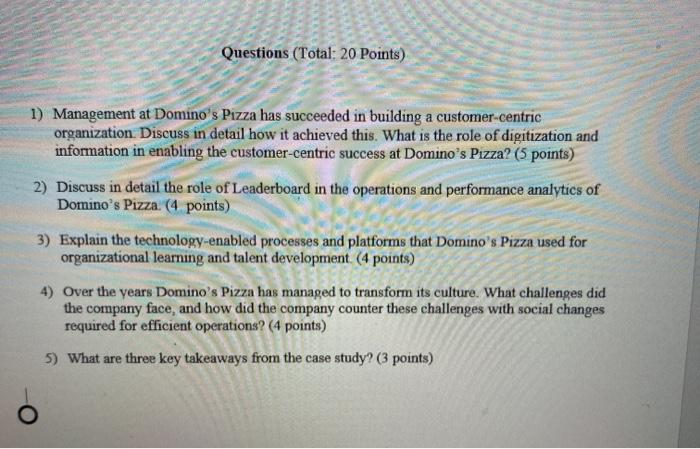
transparency within the management team, and optimal employee development. One specific example of a Domino's technology-driven solution was Domino's Pizza Tracker a Web application rolled out at the end of 2007 to address a common issue inherent in the food delivery model - customer engagement throughout the dinng experience "By implementing a system that allowed customers to remain abreast of the progress of their order from the time it was placed until the time it arrived, Domino's sought to not only increase customer satisfaction, but also open a communication channel to learn more about customers concerns and suggestions The Pizza Tracker added transparency to the delivery process and placed Domino's in a "virtual fishbowl that allowed customers to peek and get details on all aspects of their orders. With operational processes established, the status of an order was updated throughout the process with a high level of data granularity, such as the name of the person who assembled the pizza. An additional component of the Pizza Tracker allowed customers to quickly rate their expenence and provide more detailed feedback to the local store throughout the process. Pizza Tracker was built on the PULSE point-of-sale system Domino's rolled out in 2003. The tracker augmented the operational data that PULSE used and managed As previously mentioned the Leaderboard was a key piece of technology that enabled increased transparency. The inclusion of regional data on the Leaderboard fostered increased competition among store managers on Domino's key metrie: Out The Door (OTD) times. The Leaderboard provided insights to managers at each location as well as the management team at headquarters, which could monitor the activity at the stores remotely to spot trends on in aggregate level. Because the Leaderboard also ran on the live data used and updated by PULSE and Pizza Tracker, it could provide an up-to-the-minute holistic snapshot of the performance of each store Lastly, Domino's focus on technology enabled processes also facilitated talent development and organizational learning. Employees could access to a Web 2.0 platform with a plethora of resources, such as wikis, blogs, and discussion forums. This encouraged peer-to-peer resource sharing The internal e-Learning portal offered online training series for continuous development of Domino's employees and a venue for sharing best practices among the employee community. In one of its recent innovations, Domino's launched a Facebook application called "Think Oven" to capture ideas from Facebook fans. Within 90 days, Domino's received over 10,000 ideas and grew its fan base to over 1 million Over time, Domino's remained true to some of its earliest differentiators - speed of delivery, operational transparency, and sensitivity to customer expectations and emotions. The ability to leverage technology strengthened these core tenets. However, these increased capabilities also required thoughtful technical and cultural training and clear communication to employees for the company to effectively embrace an environment that was more transparent than ever before Domino's still strived toward the lowest possible delivery time of any pizza delivery service on the market. The company had been measuring speed of service with its Out The Door time metric since the 30-minute guarantee was discontinued in 1993. The OTD metric was computed as time elapsed from order was placed until delivery in the computer system. However, in an effort to improve upon this metric, some employees tried to beat the system by dispatching orders in the system before they were actually ready for delivery. While this unintended side effect was difficult to detect in the past, a new level of transparency made possible by the technological platforms allowed the company to both enhance speed and manage the risk of deterioration of the customer experience. Customers could now monitor dispatch times via Pizza Tracker Customers could see and report) any unreasonable time between dispatch and when the driver arrived at their door Domino's had to communicate to its employees that they were in essence inside a fishbowl and that customers were now virtually monitoring their progress inside the store. Competition between local stores on sales figures dated back to the company's early days. However, the Leaderboard took competition to a whole new level within the company Whereas previously it had been difficult to motivate employees to provide faster OTD times, exposing stores performance to their neighboring stores and across the company created a social incentive to perform. It became common for one store manager to phone a nearby store manager to proudly gloat over earning the number one position on the Leaderboard. This social pressure proved to be a more effective incentive for stores to perform than traditional management techniques and incentives of the past. Traditionally the store performances were aggregated and the usual quarterly numbers were reviewed. This made it difficult for specific stores to realize and respond in real-time to their performance lags. The new transparent approach also allowed for a more positive competition among the stores Domino's had offered a product satisfaction guarantee for decades. Still, it was historically rare for customers to contact the company directly with a complaint when they were dissatisfied. The more typical reaction was for customers to go to a competitor the next time they ordered pizza, The Pizza Tracker was designed to change this. It made it very easy for customers to rate their Domino's products and experience While it was common for large enterprises to have a contact center that handled customer complaints, this tended to be a slow, expensive process to implement because Domino's processed several hundred thousand transactions per day, as did Domino's. So, Domino's chose to address high-volume feedback with strength in numbers-store employees Feedback was routed electronically to the appropriate stores within seconds, where store managers were responsible for contacting dissatisfied customers to resolve problem. Many customers were quite surprised when their phone rang minutes after leaving a complaint online. Over time, this approach enabled Domino's to improve its customer satisfaction metrics as well o search o 95 Domino's wanted the customer experience, which occurred millions of times per week, to feel more personalized. One way that the company achieved this was by including the name of the employee making each pizza and the name of the delivery driver. While at first many employees were uneasy about their names being used in Pizza Tracker, the company decided that exposing names would become an integral part of company policy. The initial resistance from employees was expected, and the Domino's management countered it in two ways. First, employees benefited from positive recognition from customers. Second, the company mandated this as a policy once it had a critical mass of win-win-win cases among customers, employees, and the company. Once employees became acclimated to the concept, Domino's heard anecdotal evidence that customers felt more comfortable in knowing the name of the driver who would show up on the doorstep of their home, and drivers got rewarded with larger tips as a result Traditionally, pizza franchisees used regular passenger cars (either owned by the stores or by delivery people) as pizza delivery vehicles. The lack of standardization raised several issues relevant to customer experience. Domino's began collaboration with Local Motors to design the "ultimate delivery vehicle for pizza. Local Motors leveraged global resources through crowdsourcing to design and locally manufacture sustainable automobiles. Local Motors virtual community of talent included over 30,000 designers, fabricators, engineers, and enthusiasts around the globe to design, manufacture, and deliver personalized vehicles. Domino's and Local Motors built a platform that connected franchise owners, auto manufacturers, and designers around the globe to create a delivery vehicle that was durable, safe, easy to maintain and affordable. To keep costs low and increase ease of production, the vehicle would be built on an existing small-car platform. The partners leveraged global resources by hosting open online competitions for the best ideas in each stage of the design of this vehicle. Conclusion Domino's Pizza became one of the largest and longest standing fast-food retailers in the world. The company had to adapt its technology and operations to stay ahead of the competition Domino's adhered to a standardized store design and pizza assembly process that kept employees focused and consistent, while adopting a flexible technological architecture that supported company transparency and customer feedback. To be a leader in its market, Domino's constantly sought new ideas to enhance the company's personal connection with customers. Domino's began expanding to new global markets through multiple partnerships to deliver menus customized to each market. Applications on various mobile platforms and within social media channels were expected to drive a significant portion of the company's sales going forward Questions (Total: 20 Points) 1) Management at Domino's Pizza has succeeded in building a customer-centric organization. Discuss in detail how it achieved this. What is the role of digitization and information in enabling the customer-centric success at Domino's Pizza? (5 points) 2) Discuss in detail the role of Leaderboard in the operations and performance analytics of Domino's Pizza. (4 points) 3) Explain the technology-enabled processes and platforms that Domino's Pizza used for organizational learning and talent development (4 points) 4) Over the years Domino's Pizza has managed to transform its culture. What challenges did the company face, and how did the company counter these challenges with social changes required for efficient operations? (4 points) 5) What are three key takeaways from the case study? (3 points) Step by Step Solution
There are 3 Steps involved in it
1 Expert Approved Answer
Step: 1 Unlock

Question Has Been Solved by an Expert!
Get step-by-step solutions from verified subject matter experts
Step: 2 Unlock
Step: 3 Unlock
 Study Help