







Question: please do not write a paper just bullet point the key things such as whats the tole of digitization and information in enabling... ( also
please do not write a paper just bullet point the key things such as whats the tole of digitization and information in enabling... ( also did nkt oost all of the paper ao just bullet point the ones you can would be greatly appreciated
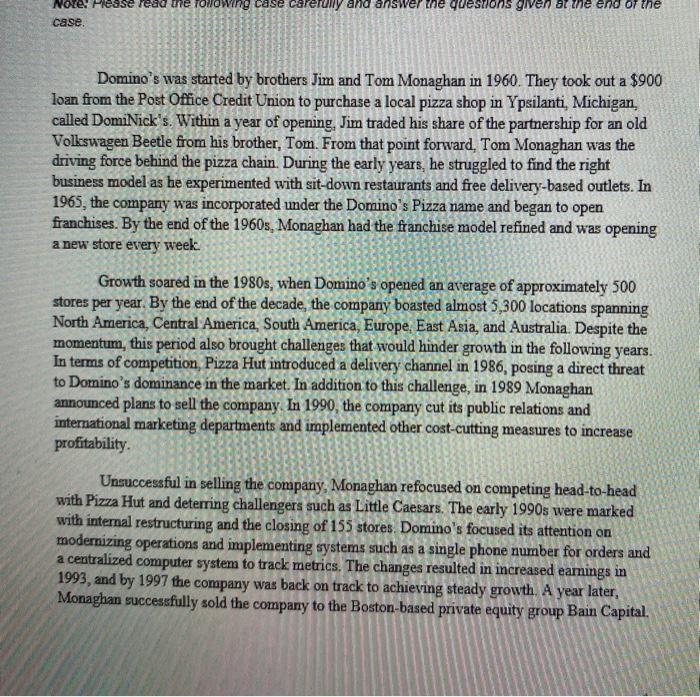
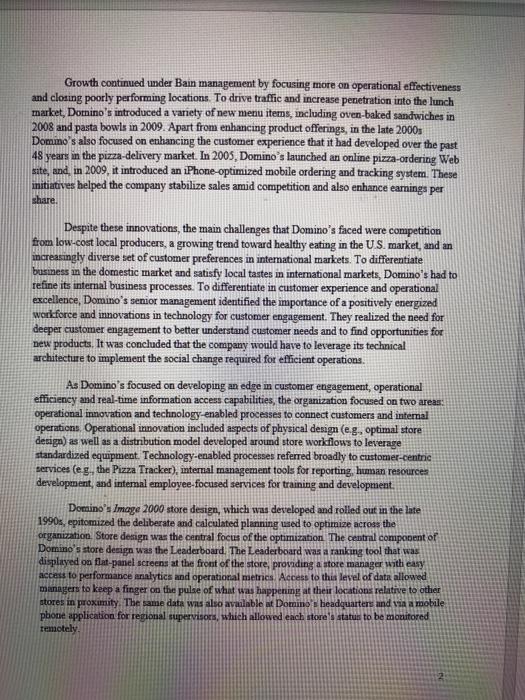
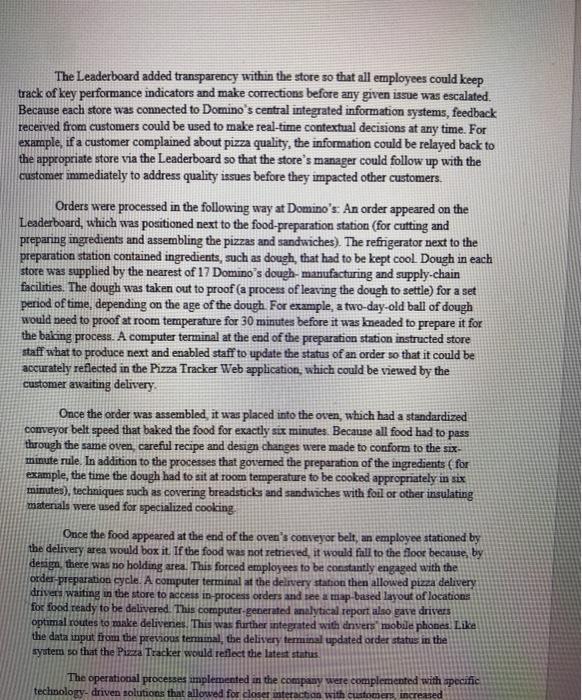
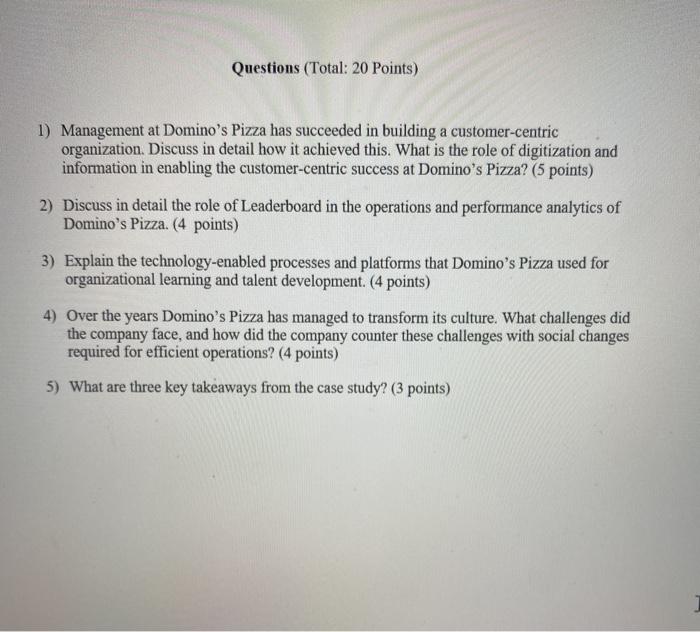
case carefully and answer the questions given at end of the Nove Please read the case. Domino's was started by brothers Jim and Tom Monaghan in 1960. They took out a $900 loan from the Post Office Credit Union to purchase a local pizza shop in Ypsilanti , Michigan, called DomiNick's. Within a year of opening, Jim traded his share of the partnership for an old Volkswagen Beetle from his brother, Tom. From that point forward, Tom Monaghan was the driving force behind the pizza chain. During the early years, he struggled to find the right business model as he experimented with sit-down restaurants and free delivery-based outlets. In 1965, the company was incorporated under the Domino's Pizza name and began to open franchises. By the end of the 1960s, Monaghan had the franchise model refined and was opening a new store every week. Growth soared in the 1980s, when Domino's opened an average of approximately 500 stores per year. By the end of the decade, the company boasted almost 5,300 locations spanning North America, Central America, South America, Europe, East Asia, and Australia. Despite the momentum, this period also brought challenges that would hinder growth in the following years. In terms of competition, Pizza Hut introduced a delivery channel in 1986, posing a direct threat to Domino's dominance in the market. In addition to this challenge, in 1989 Monaghan announced plans to sell the company. In 1990, the company cut its public relations and international marketing departments and implemented other cost-cutting measures to increase profitability Unsuccessful in selling the company, Monaghan refocused on competing head-to-head with Pizza Hut and deterring challengers such as Little Caesars. The early 1990s were marked with internal restructuring and the closing of 155 stores. Domino's focused its attention on modernizing operations and implementing systems such as a single phone number for orders and a centralized computer system to track metrics. The changes resulted in increased earnings in 1993, and by 1997 the company was back on track to achieving steady growth. A year later, Monaghan successfully sold the company to the Boston-based private equity group Bain Capital. Growth continued under Bain management by focusing more on operational effectiveness and closing poorly performing locations. To drive traffic and increase penetration into the lunch market, Domino's introduced a variety of new menu items, including oven-baked sandwiches in 2008 and pasta bowls in 2009. Apart from enhancing product offerings, in the late 2000s Domino's also focused on enhancing the customer experience that it had developed over the past 48 years in the pizza-delivery market. In 2005, Domino's launched an online pizza-ordering Web site, and, in 2009, it introduced an iPhone-optimized mobile ordering and tracking systera. These initiatives helped the company stabilize sales amid competition and also enhance earnings per share. Despite these innovations, the main challenges that Domino's faced were competition from low-cost local producers, a growing trend toward healthy eating in the US market, and an increasingly diverse set of customer preferences in international markets. To differentiate business in the domestic market and satisfy local tastes in international markets, Domino's had to refine its internal business processes. To differentiate in customer experience and operational excellence, Domino's senior management identified the importance of a positively energized workforce and innovations in technology for customer engagement. They realized the need for deeper customer engagement to better understand customer needs and to find opportunities for new products. It was concluded that the company would have to leverage its technical architecture to implement the social change required for efficient operations As Domino's focused on developing an edge in customer engagement, operational efficiency and real-time information access capabilities, the organization focused on two areas: operational innovation and technology enabled processes to connect customers and internal operations Operational innovation included aspects of physical design (eg, optimal store design) as well as a distribution model developed around store workflows to leverage standardized equipment. Technology-enabled processes referred broadly to customer-centric services (eg the Pizza Tracker), internal management tools for reporting, human resources development, and internal employee-focused services for training and development. Domino's Image 2000 store design, which was developed and rolled out in the late 1990s, epitomized the deliberate and calculated planning used to optimize across the organization Store design was the central focus of the optimization. The central component of Domino's store design was the Leaderboard. The Leaderboard was a ranking tool that was displayed on flat-panel screens at the front of the store, providing a store manager with easy access to performance analytics and operational metrics Access to this level of data allowed managers to keep a finger on the pulse of what was happening at the locations relative to other stores in proximity. The same data was also available at Domino's headquarters and via a mobile phone application for regional supervisors, which allowed each store's status to be monitored remotely The Leaderboard added transparency within the store so that all employees could keep track of key performance indicators and make corrections before any given issue was escalated. Because each store was connected to Domino's central integrated information systems, feedback received from customers could be used to make real-time contextual decisions at any time. For example, if a customer complained about pizza quality, the information could be relayed back to the appropriate store via the Leaderboard so that the store's manager could follow up with the customer immediately to address quality issues before they impacted other customers. Orders were processed in the following way at Domino's: An order appeared on the Leaderboard, which was positioned next to the food-preparation station (for cutting and preparing ingredients and assembling the pizzas and sandwiches). The refrigerator next to the preparation station contained ingredients, such as dough, that had to be kept cool. Dough in each store was supplied by the nearest of 17 Domino's dough-manufacturing and supply-chain facilities. The dough was taken out to proof (a process of leaving the dough to settle) for a set period of time, depending on the age of the dough. For example, a two-day-old ball of dough would need to proof at room temperature for 30 minutes before it was kneaded to prepare it for the baking process. A computer terminal at the end of the preparation station instructed store staff what to produce next and enabled staff to update the status of an order so that it could be accurately reflected in the Pizza Tracker Web application, which could be viewed by the customer awaiting delivery Once the order was assembled it was placed into the oven, which had a standardized conveyor belt speed that baked the food for exactly six minutes. Because all food had to pass through the same oven careful recipe and design changes were made to conform to the six- minute rule. In addition to the processes that govemed the preparation of the ingredients for example, the time the dough had to sit at room temperature to be cooked appropriately in six minutes), techniques such as covering breadsticks and sandwiches with foil or other insulating materials were used for specialized cooking. Once the food appeared at the end of the oven's conveyor belt, an employee stationed by the delivery area would box it. If the food was not retrieved, it would fall to the floor because, by design, there was no holding area. This forced employees to be constantly engaged with the order-preparation cycle. A computer terminal at the delivery station then allowed pizza delivery drivers waiting in the store to access in process orders and see a map based layout of locations for food ready to be delivered. This computer generated analytical report also gave drivers optimal routes to make delivenes. This was further integrated with dnvers mobile phones. Like the data input from the previous terminal, the delivery terminal updated order status in the system so that the Pizza Tracker would reflect the latest status The operational processes implemented in the company were complemented with specific technology-driven solutions that allowed for closet interaction with customers increased Questions (Total: 20 Points) 1) Management at Domino's Pizza has succeeded in building a customer-centric organization. Discuss in detail how it achieved this. What is the role of digitization and information in enabling the customer-centric success at Domino's Pizza? (5 points) 2) Discuss in detail the role of Leaderboard in the operations and performance analytics of Domino's Pizza. (4 points) 3) Explain the technology-enabled processes and platforms that Domino's Pizza used for organizational learning and talent development. (4 points) 4) Over the years Domino's Pizza has managed to transform its culture. What challenges did the company face, and how did the company counter these challenges with social changes required for efficient operations? (4 points) 5) What are three key takeaways from the case study? (3 points) Step by Step Solution
There are 3 Steps involved in it
1 Expert Approved Answer
Step: 1 Unlock

Question Has Been Solved by an Expert!
Get step-by-step solutions from verified subject matter experts
Step: 2 Unlock
Step: 3 Unlock
 Study Help