







Question: Please EXPLAIN and solve EACH / ALL part(s) in Question #4 ! DOUBLE CHECK YOUR WORK AND ANSWER(S) . PLEASE NEATLY SHOW ALL WORK, EXPLANATIONS
Please EXPLAIN and solve EACH/ALL part(s) in Question #4!
DOUBLE CHECK YOUR WORK AND ANSWER(S).
PLEASE NEATLY SHOW ALL WORK, EXPLANATIONS, & CALCULATIONS STEP-BY-STEP USING PEN AND PAPER! I AM NEW TO CHEMISTRY! I AM A COMPLETE NEWBIE!
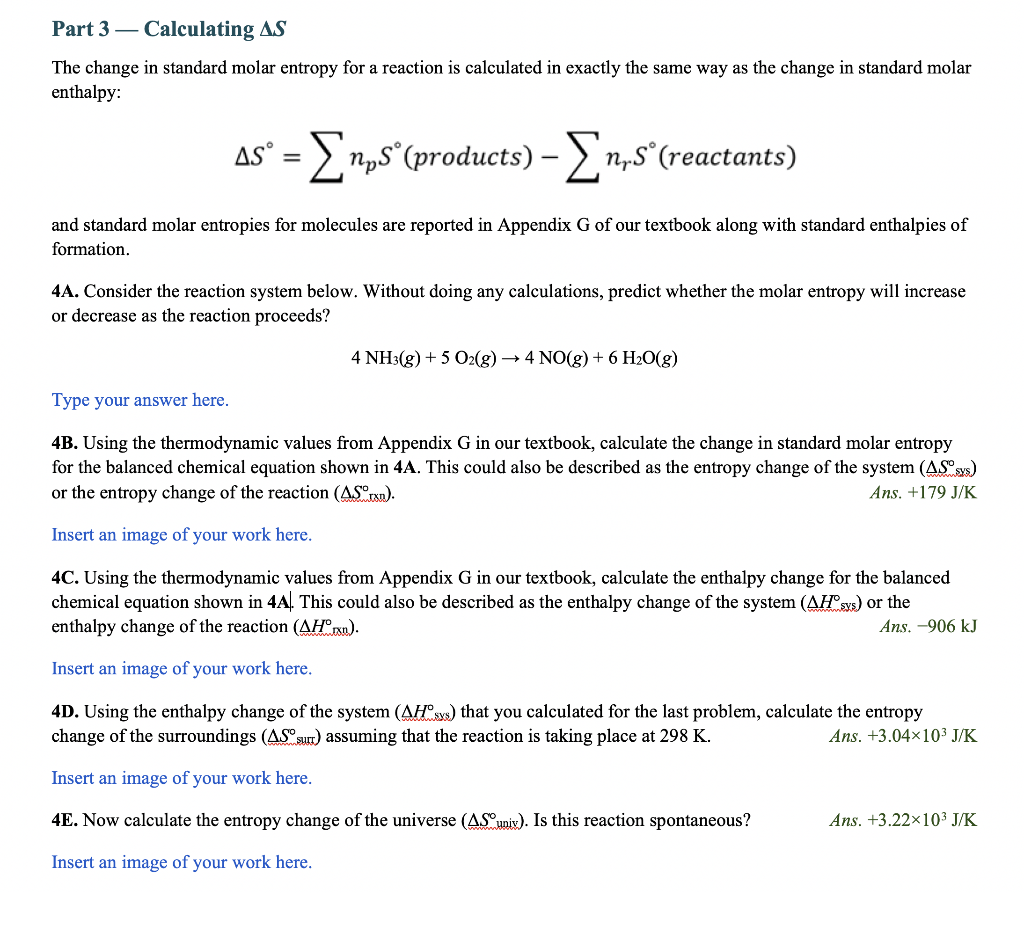





Part 3 - Calculating S The change in standard molar entropy for a reaction is calculated in exactly the same way as the change in standard molar enthalpy: S=npS(products)nrS(reactants) and standard molar entropies for molecules are reported in Appendix G of our textbook along with standard enthalpies of formation. 4A. Consider the reaction system below. Without doing any calculations, predict whether the molar entropy will increase or decrease as the reaction proceeds? 4NH3(g)+5O2(g)4NO(g)+6H2O(g) Type your answer here. 4B. Using the thermodynamic values from Appendix G in our textbook, calculate the change in standard molar entropy for the balanced chemical equation shown in 4A. This could also be described as the entropy change of the system ( S sys ) or the entropy change of the reaction (Snxn). Ans. +179J/K Insert an image of your work here. 4C. Using the thermodynamic values from Appendix G in our textbook, calculate the enthalpy change for the balanced chemical equation shown in 4A. This could also be described as the enthalpy change of the system (H sys ) or the enthalpy change of the reaction (Hxn). Ans.906kJ Insert an image of your work here. 4D. Using the enthalpy change of the system (H syss ) that you calculated for the last problem, calculate the entropy change of the surroundings (S sur ) assuming that the reaction is taking place at 298K. Ans.+3.04103J/K Insert an image of your work here. 4E. Now calculate the entropy change of the universe (S univ ). Is this reaction spontaneous? Ans.+3.22103J/K Insert an image of your work here. Standard Thermodynamic Properties for Selected Substances NH3(g) 45.9 16.5 192.8 \begin{tabular}{l|l|l|l} O2(g) & 0 & 0 & 205.2 \end{tabular} \begin{tabular}{|l|l|l|l|} \hline NO(g) & 90.25 & 87.6 & 210.8 \\ \hline \end{tabular} \begin{tabular}{l|l|l|l} H2O(g) & 241.82 & 228.59 & 188.8 \end{tabular}
Step by Step Solution
There are 3 Steps involved in it

Get step-by-step solutions from verified subject matter experts
 Study Help