







Question: please explain simple and easy way as much as you can Discussion Post - Performance Management at CRB, Inc. Available on Thursday, February 4, 2021
please explain simple and easy way as much as you can
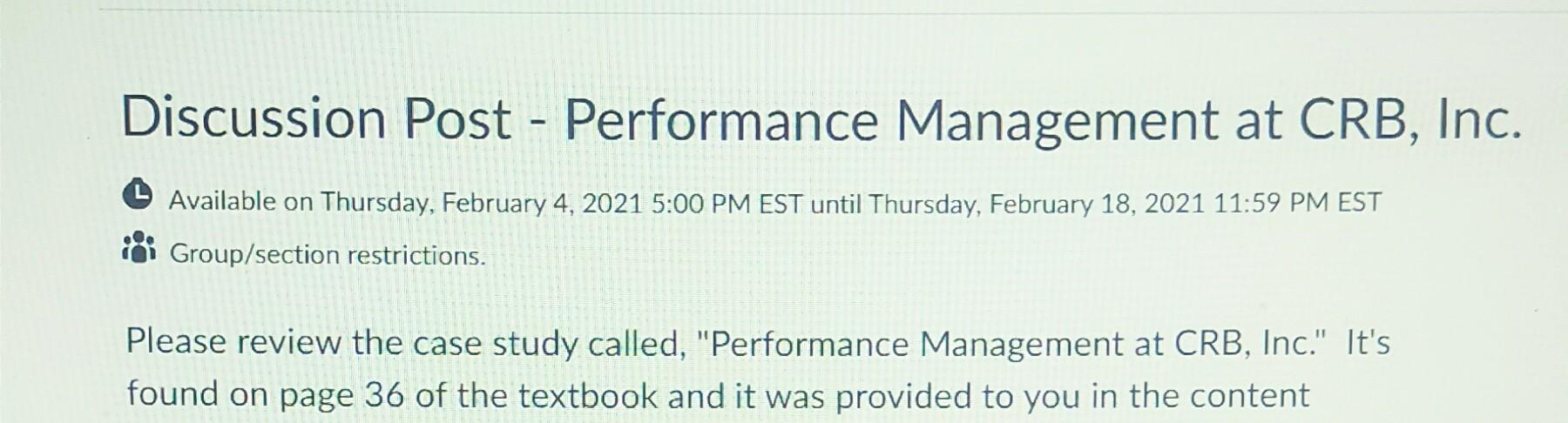
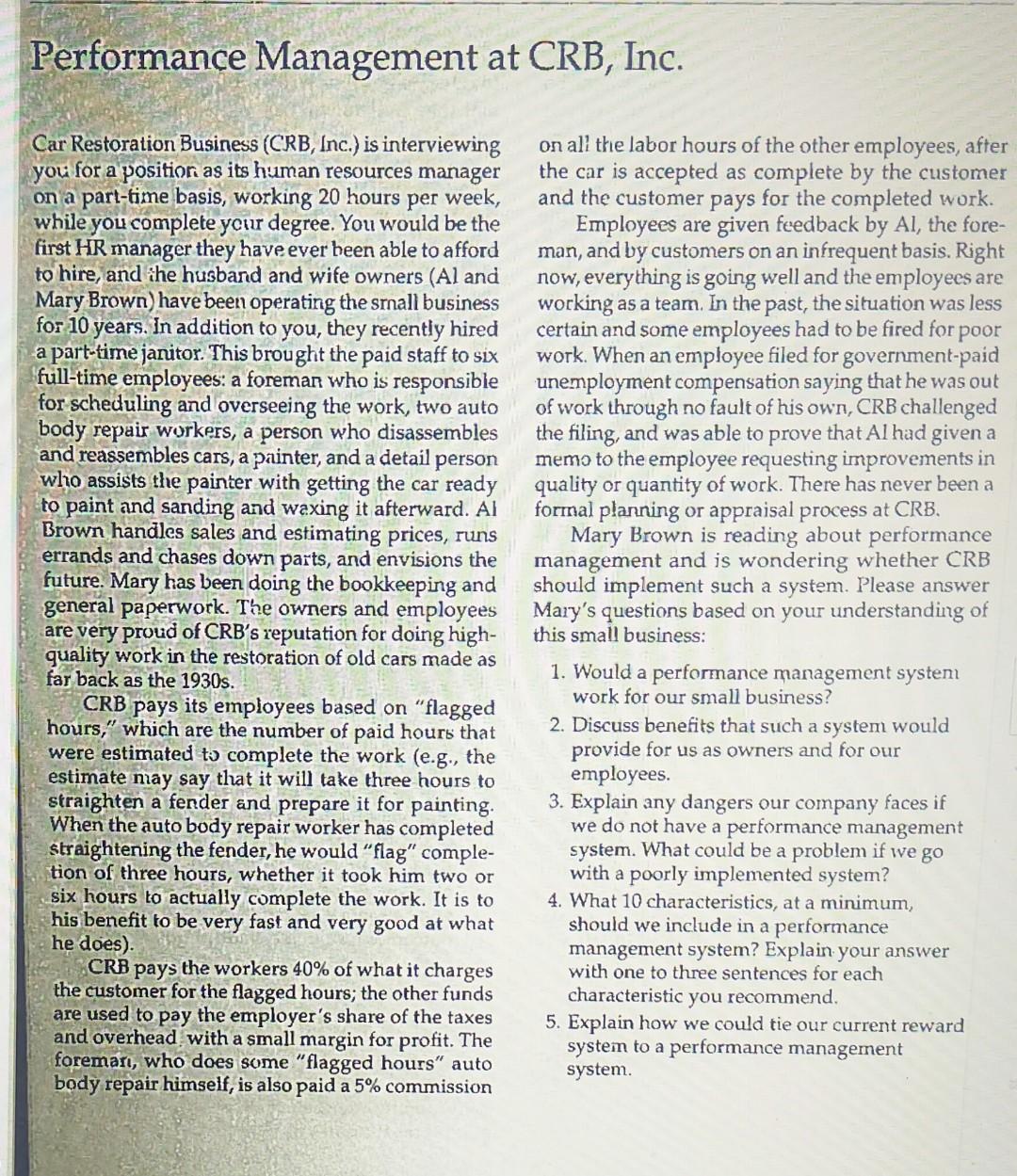
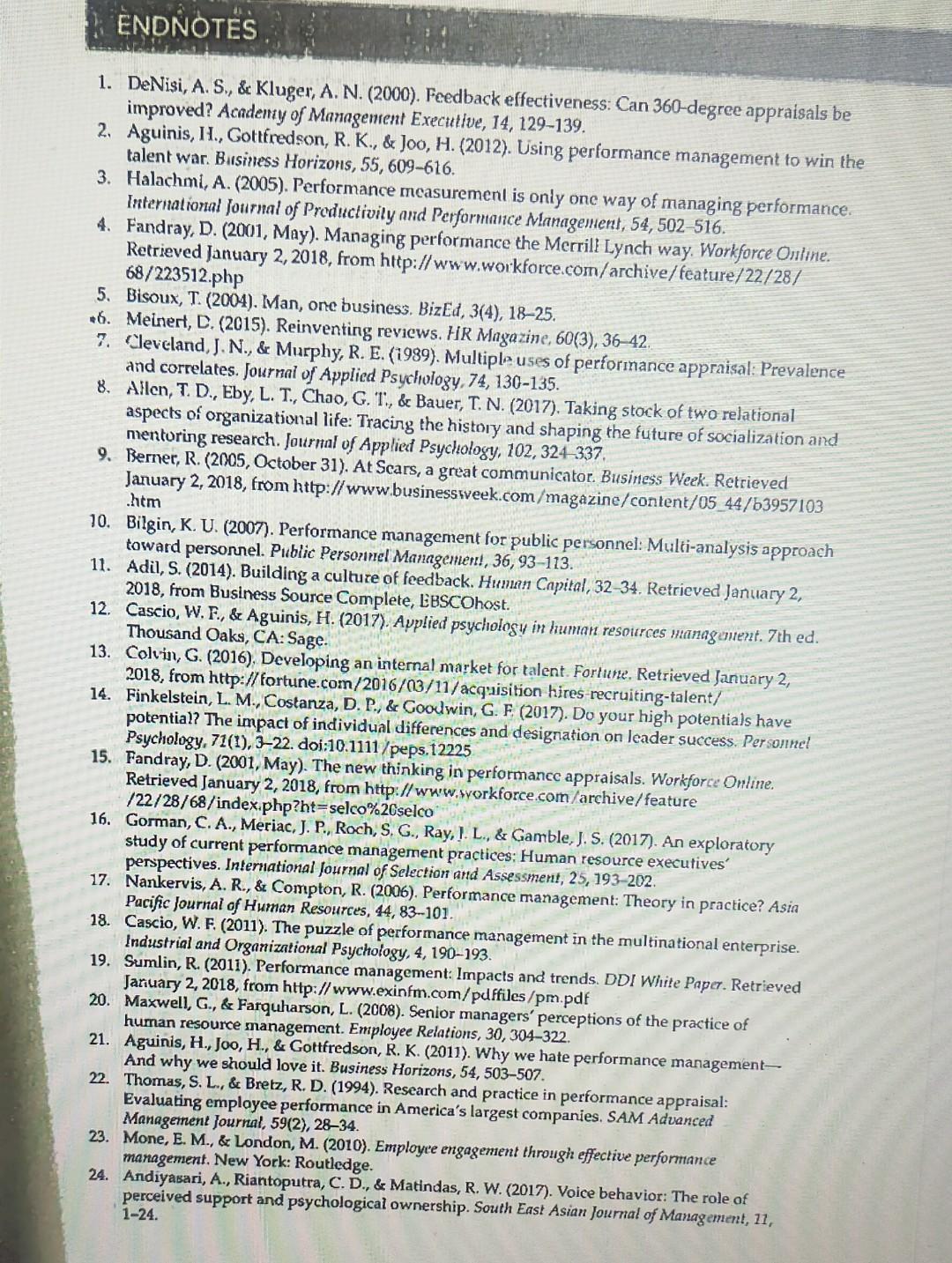
Discussion Post - Performance Management at CRB, Inc. Available on Thursday, February 4, 2021 5:00 PM EST until Thursday, February 18, 2021 11:59 PM EST Group/section restrictions. Please review the case study called, "Performance Management at CRB, Inc." It's found on page 36 of the textbook and it was provided to you in the content Performance Management at CRB, Inc. Car Restoration Business (CRB, Inc.) is interviewing you for a position as its human resources manager on a part-time basis, working 20 hours per week, while you complete your degree. You would be the first HR manager they have ever been able to afford to hire, and the husband and wife owners (Al and Mary Brown) have been operating the small business for 10 years. In addition to you, they recently hired a part-time janitor. This brought the paid staff to six full-time employees: a foreman who is responsible for scheduling and overseeing the work, two auto body repair workers, a person who disassembles and reassembles cars, a painter, and a detail person who assists the painter with getting the car ready to paint and sanding and waxing it afterward. Al Brown handles sales and estimating prices, runs errands and chases down parts, and envisions the future. Mary has been doing the bookkeeping and general paperwork. The owners and employees are very proud of CRB's reputation for doing high- quality work in the restoration of old cars made as far back as the 1930s. CRB pays its employees based on "flagged hours," which are the number of paid hours that were estimated to complete the work (e.g., the estimate may say that it will take three hours to straighten a fender and prepare it for painting. When the auto body repair worker has completed straightening the fender, he would "flag" comple- tion of three hours, whether it took him two or six hours to actually complete the work. It is to his benefit to be very fast and very good at what he does). CRB pays the workers 40% of what it charges the customer for the flagged hours; the other funds are used to pay the employer's share of the taxes and overhead with a small margin for profit. The foremari, who does some "flagged hours" auto body repair himself, is also paid a 5% commission on all the labor hours of the other employees, after the car is accepted as complete by the customer and the customer pays for the completed work. Employees are given feedback by Al, the fore- man, and by customers on an infrequent basis. Right now, everything is going well and the employees are working as a team. In the past, the situation was less certain and some employees had to be fired for poor work. When an employee filed for government-paid unemployment compensation saying that he was out of work through no fault of his own, CRB challenged the filing, and was able to prove that Al had given a memo to the employee requesting improvements in quality or quantity of work. There has never been a formal planning or appraisal process at CRB. Mary Brown is reading about performance management and is wondering whether CRB should implement such a system. Please answer Mary's questions based on your understanding of this small business: 1. Would a performance management system work for our small business? 2. Discuss benefits that such a system would provide for us as owners and for our employees. 3. Explain any dangers our company faces if we do not have a performance management system. What could be a problem if we go with a poorly implemented system? 4. What 10 characteristics, at a minimum, should we include in a performance management system? Explain your answer with one to three sentences for each characteristic you recommend. 5. Explain how we could tie our current reward system to a performance management system. ENDNOTES 1. DeNisi, A.S., & Kluger, A. N. (2000). Feedback effectiveness: Can 360-degree appraisals be improved? Academy of Management Executive, 14, 129-139. 2. Aguinis, 11., Gottfredson, R. K., & Joo, H. (2012). Using performance management to win the talent war. Business Horizons, 55, 609-616. 3. Halachmi, A. (2005). Performance measurement is only one way of managing performance. International Journal of Productivity and Performance Management, 54, 502-516. 4. Fandray, D. (2001, May). Managing performance the Merrill Lynch way. Workforce Online. Retrieved January 2, 2018, from http://www.workforce.com/archive/feature/22/28/ 68/223512.php 5. Bisoux, T. (2004). Man, one business. BizEd, 3(4), 18-25. 6. Meinert, D. (2015). Reinventing reviews. HR Magazine, 60(3), 36-42. 7. Cleveland, J. N., & Murphy, R. E. (1989). Multiple uses of performance appraisal: Prevalence and correlates. Journal of Applied Psychology, 74, 130-135. 8. Allen, T. D., Eby, L. T., Chao, G. T., &c Bauer, T. N. (2017). Taking stock of two relational aspects of organizational life: Tracing the history and shaping the future of socialization and mentoring research. Journal of Applied Psychology, 102, 324-337 9. Berner, R. (2005, October 31). At Scars, a great communicator. Business Week. Retrieved January 2, 2018, from http://www.businessweek.com/magazine/content/05_44/b3957103 .htm 10. Bilgin, K. U. (2007). Performance management for public personnel: Multi-analysis approach toward personnel. Public Persorinel Management, 36, 93-113. 11. Adil, S. (2014). Building a culture of feedback. Human Capital, 32-34. Retrieved January 2, 2018, from Business Source Complete, EBSCOhost. 12. Cascio, W.F., & Aguinis, H. (2017). Applied psychology in human resources management. 7th ed. Thousand Oaks, CA: Sage. 13. Colvin, G. (2016), Developing an internal market for talent. Fortune. Retrieved January 2, 2018, from http:// fortune.com/2016/03/11/acqaisition hires recruiting-talent/ 14. Finkelstein, L. M., Costanza, D. P., & Goodwin, G. F (2017). Do your high potentials have potential? The impact of individual differences and designation on leader success. Personnel Psychology, 71(1), 3-22. doi:10.1111 /peps.12225 15. Fandray, D. (2001, May). The new thinking in performancc appraisals. Workforce Online. Retrieved January 2, 2018, from http://www.workforce.com/archive/feature /22/28/68/index.php?ht=selco%2Cselco 16. Gorman, C. A., Meriac, J. P., Roch, S. G., Ray, I. L., & Gamble, J. S. (2017). An exploratory study of current performance management practices: Human resource executives' perspectives. International Journal of Selection and Assessment, 25, 193-202. 17. Nankervis, A. R., & Compton, R. (2006). Performance management: Theory in practice? Asia Pacific Journal of Human Resources, 44, 83-101. 18. Cascio, W. F. (2011). The puzzle of performance management in the multinational enterprise. Industrial and Organizational Psychology, 4, 190-193. 19. Sumlin, R. (2011). Performance management: Impacts and trends. DDI White Paper. Retrieved January 2, 2018, from http://www.exinfm.com/pdffiles/pm.pdf 20. Maxwell, G., & Farquharson, L. (2008). Senior managers' perceptions of the practice of human resource management. Employee Relations, 30,304-322. 21. Aguinis, H., Joo, H., & Gottfredson, R. K. (2011). Why we hate performance management- And why we should love it. Business Horizons, 54, 503-507. 22. Thomas, S. L., & Bretz, R. D. (1994). Research and practice in performance appraisal: Evaluating employee performance in America's largest companies. SAM Advanced Management Journal, 59(2), 2834. 23. Mone, E. M., & London, M. (2010). Employee engagement through effective performance management. New York: Routledge. 24. Andiyasari, A., Riantoputra, C. D., & Matindas, R. W. (2017). Voice behavior: The role of perceived support and psychological ownership. South East Asian Journal of Management, 11, 1-24Step by Step Solution
There are 3 Steps involved in it
1 Expert Approved Answer
Step: 1 Unlock

Question Has Been Solved by an Expert!
Get step-by-step solutions from verified subject matter experts
Step: 2 Unlock
Step: 3 Unlock
 Study Help