



Question: plz explain fully as much as you can in easy and simple way Discussion Post - Performance Management at CRB, Inc. Available on Thursday, February
plz explain fully as much as you can in easy and simple way
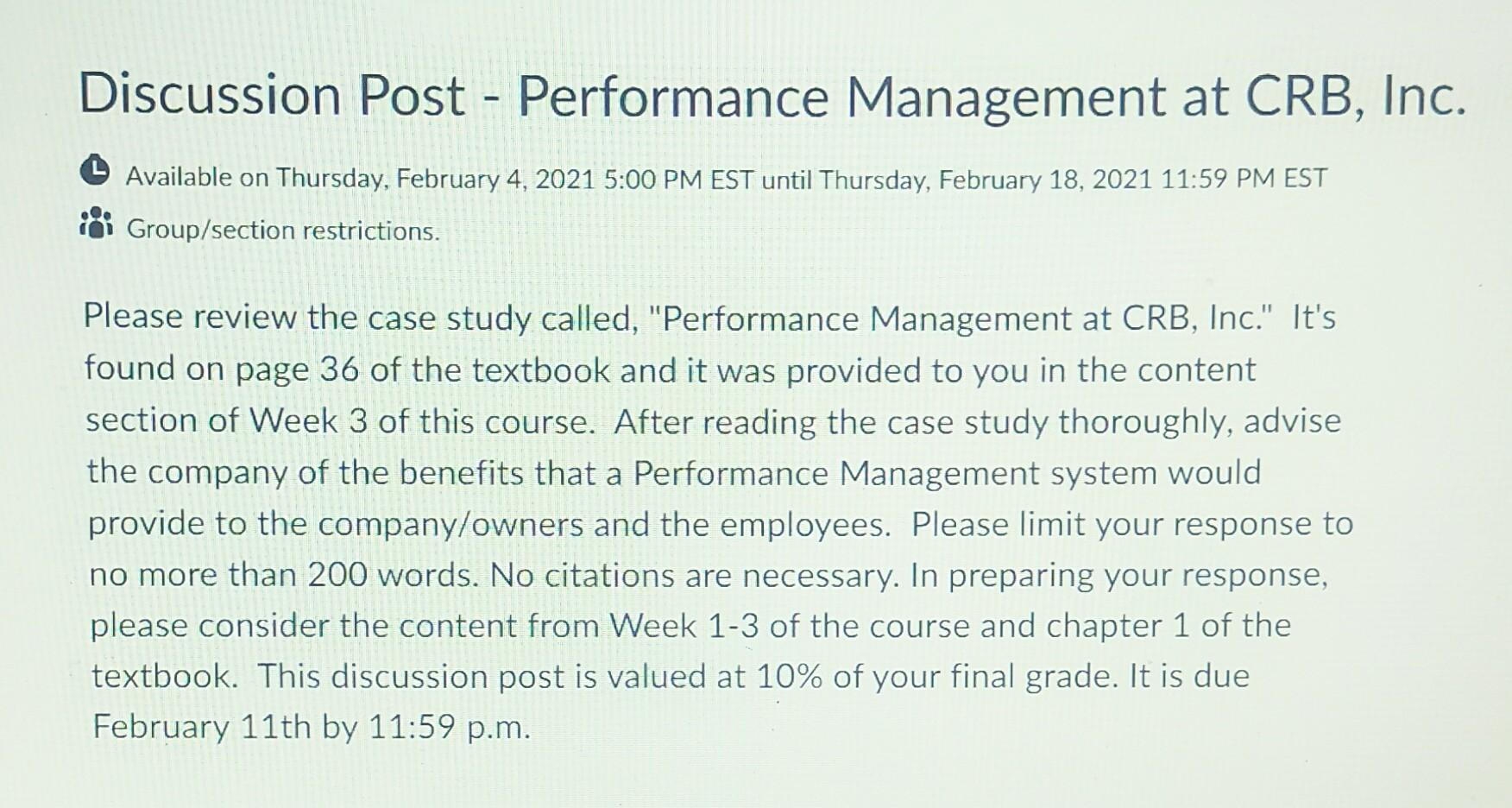
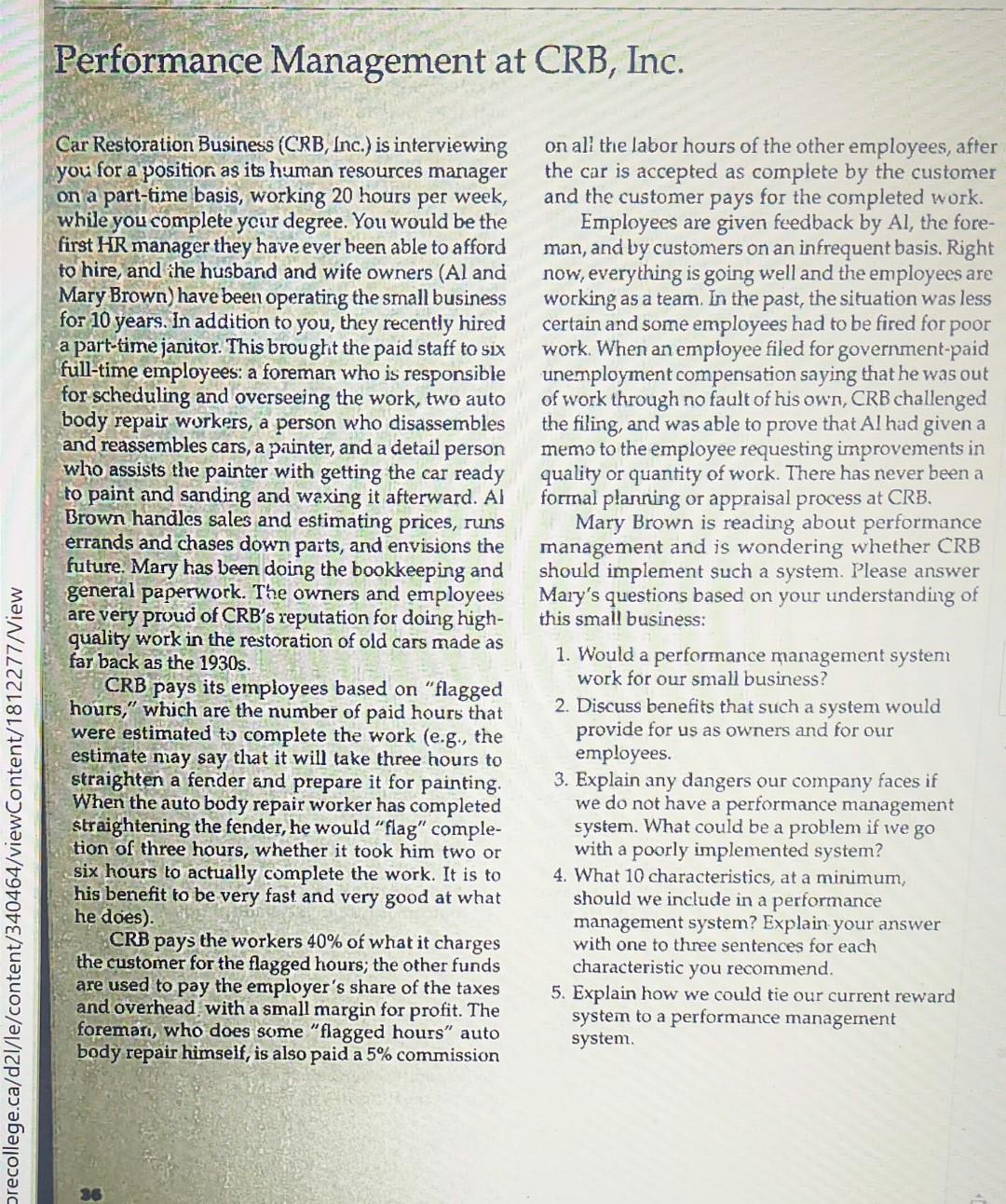
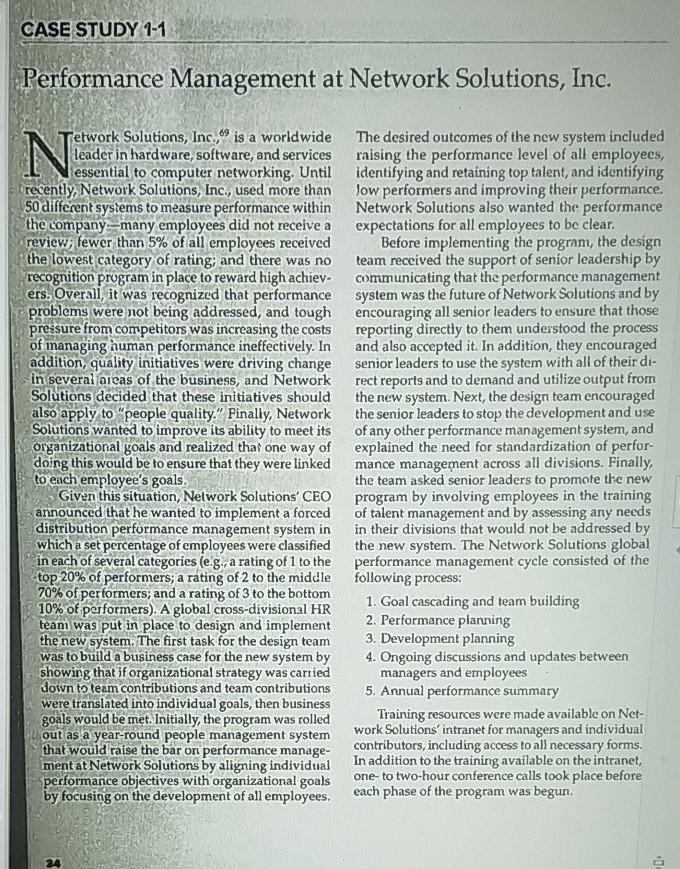
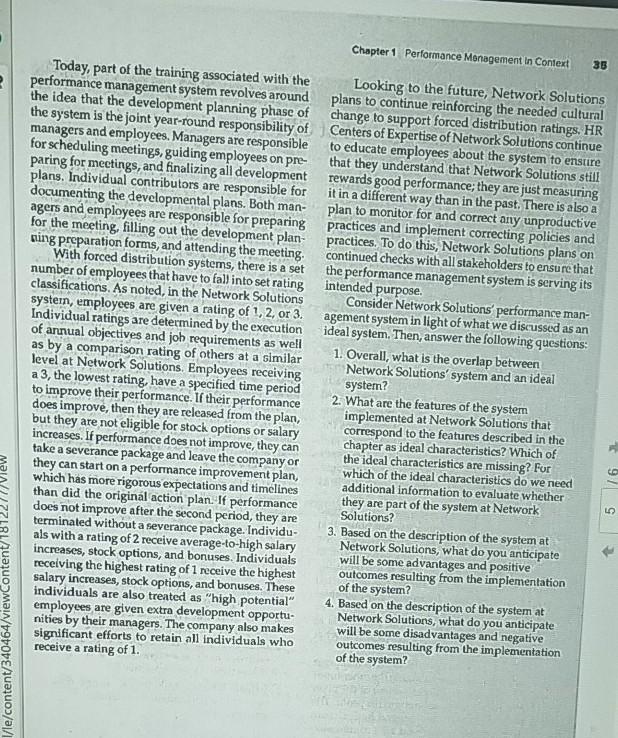
Discussion Post - Performance Management at CRB, Inc. Available on Thursday, February 4, 2021 5:00 PM EST until Thursday, February 18, 2021 11:59 PM EST Group/section restrictions. Please review the case study called, "Performance Management at CRB, Inc." It's found on page 36 of the textbook and it was provided to you in the content section of Week 3 of this course. After reading the case study thoroughly, advise the company of the benefits that a Performance Management system would provide to the company/owners and the employees. Please limit your response to no more than 200 words. No citations are necessary. In preparing your response, please consider the content from Week 1-3 of the course and chapter 1 of the textbook. This discussion post is valued at 10% of your final grade. It is due February 11th by 11:59 p.m. Performance Management at CRB, Inc. precollege.ca/d21/le/content/340464/viewContent/1812277/View Car Restoration Business (CRB, Inc.) is interviewing you for a position as its human resources manager on a part-time basis, working 20 hours per week, while you complete your degree. You would be the first HR manager they have ever been able to afford to hire, and the husband and wife owners (Al and Mary Brown) have been operating the small business for 10 years. In addition to you, they recently hired a part-time janitor. This brought the paid staff to six full-time employees: a foreman who is responsible for scheduling and overseeing the work, two auto body repair workers, a person who disassembles and reassembles cars, a painter, and a detail person who assists the painter with getting the car ready to paint and sanding and waxing it afterward. Al Brown handles sales and estimating prices, runs errands and chases down parts, and envisions the future. Mary has been doing the bookkeeping and general paperwork. The owners and employees are very proud of CRB's reputation for doing high- quality work in the restoration of old cars made as far back as the 1930s. CRB pays its employees based on "flagged hours," which are the number of paid hours that were estimated to complete the work (e.g., the estimate may say that it will take three hours to straighten a fender and prepare it for painting. When the auto body repair worker has completed straightening the fender, he would "flag" comple- tion of three hours, whether it took him two or six hours to actually complete the work. It is to his benefit to be very fast and very good at what he does). CRB pays the workers 40% of what it charges the customer for the flagged hours; the other funds are used to pay the employer's share of the taxes and overhead with a small margin for profit. The foreman, who does some "flagged hours" auto body repair himself, is also paid a 5% commission on all the labor hours of the other employees, after the car is accepted as complete by the customer and the customer pays for the completed work. Employees are given feedback by Al, the fore- man, and by customers on an infrequent basis. Right now, everything is going well and the employees are working as a team. In the past, the situation was less certain and some employees had to be fired for poor work. When an employee filed for government-paid unemployment compensation saying that he was out of work through no fault of his own, CRB challenged the filing, and was able to prove that Al had given a memo to the employee requesting improvements in quality or quantity of work. There has never been a formal planning or appraisal process at CRB. Mary Brown is reading about performance management and is wondering whether CRB should implement such a system. Please answer Mary's questions based on your understanding of this small business: 1. Would a performance management system work for our small business? 2. Discuss benefits that such a system would provide for us as owners and for our employees. 3. Explain any dangers our company faces if we do not have a performance management system. What could be a problem if we go with a poorly implemented system? 4. What 10 characteristics, at a minimum, should we include in a performance management system? Explain your answer with one to three sentences for each characteristic you recommend. 5. Explain how we could tie our current reward system to a performance management system ENDNOTES 1. DeNisi, A. S, & Kluger, A. N. (2000). Feedback effectiveness: Can 360-degree appraisals be improved? Academy of Management Executive, 14, 129-139. 2. Aguinis, 11., Gottfredson, R. K., & Joo, H. (2012). Using performance management to win the talent war. Business Horizons, 55, 609-616. 3. Halachmi, A. (2005). Performance measurement is only one way of managing performance. International Journal of Productivity and Performance Management, 54, 502-516. 4. Fandray, D. (2001, May). Managing performance the Merrill Lynch way. Workforce Online. Retrieved January 2, 2018, from http://www.workforce.com/archive/feature/22/28/ 68/223512.php 5. Bisoux, T. (2004). Man, one business. BizEd, 3(4), 18-25. 6. Meinert, D. (2015). Reinventing reviews. HR Magazine, 60(3), 36 42 7. Cleveland, J. N., & Murphy, R. E. (1989). Multiple uses of performance appraisal: Prevalence and correlates. Journal of Applied Psychology, 74, 130-135. 8. Allen, T. D., Eby, L. T., Chao, G. T, & Bauer, T. N. (2017). Taking stock of two relational aspects of organizational life: Tracing the history and shaping the future of socialization and mentoring research. Journal of Applied Psychology, 102,324337. 9. Berner, R. (2005, October 31). At Scars, a great communicator. Business Week. Retrieved January 2, 2018, from http://www.businessweek.com/magazine/content/05_44/b3957103 .htm 10. Bilgin, K. U. (2007). Performance management for public personnel: Multi-analysis approach toward personnel. Public Personnel Management, 36, 93-113. 11. Adil, S. (2014). Building a culture of feedback. Human Capital, 32-34. Retrieved January 2, 2018, from Business Source Complete, EBSCOhost. 12. Cascio, W.F., & Aguinis, H. (2017). Applied psychology in human resources management. 7th ed. Thousand Oaks, CA: Sage. 13. Colvin, G. (2016), Developing an internal market for talent Fortune. Retrieved January 2, 2018, from http://fortune.com/2016/03/11/acqaisition hires recruiting-talent/ 14. Finkelstein, L. M., Costanza, D. P., & Goodwin, G. F. (2017). Do your high potentials have potential? The impact of individual differences and designation on leader success. Personnel Psychology, 71(1), 3-22. doi:10.1111/peps.12225 15. Fandray, D. (2001, May). The new thinking in performance appraisals. Workforce Online. Retrieved January 2, 2018, from http://www.workforce.com/archive/feature /22/28/68/index.php?ht=selco%20selco 16. Gorman, C.A., Meriac, J. P., Roch, S.G., Ray, I. L., & Gamble, J. S. (2017). An exploratory study of current performance management practices: Human resource executives' perspectives. International Journal of Selection and Assessment, 25, 193-202. 17. Nankervis, A. R., & Compton, R. (2006). Performance management: Theory in practice? Asia Pacific Journal of Human Resources, 44, 83-101. 18. Cascio, W.F. (2011). The puzzle of performance management in the multinational enterprise. Industrial and Organizational Psychology, 4, 190-193. 19. Sumlin, R. (2011). Performance management: Impacts and trends. DDI White Paper. Retrieved Jariuary 2, 2018, from http://www.exinfm.com/pdffiles/pm.pdf 20. Maxwell, G., & Farquharson, L. (2008). Senior managers' perceptions of the practice of human resource management. Employee Relations, 30, 304-322. 21. Aguinis, H., Joo, H., & Gottfredson, R. K. (2011). Why we hate performance management- And why we should love it. Business Horizons, 54, 503-507 22. Thomas, S. L., & Bretz, R. D. (1994). Research and practice in performance appraisal: Evaluating employee performance in America's largest companies. SAM Advanced Management Journal, 59(2), 2834. 23. Mone, E. M., & London, M. (2010). Employee engagement through effective performance management. New York: Routledge. 24. Andiyasari, A., Riantoputra, C. D., & Matindas, R. W. (2017). Voice behavior: The role of perceived support and psychological ownership. South East Asian Journal of Management, 11, 1-24. CASE STUDY 1-1 Performance Management at Network Solutions, Inc. N retwork Solutions, Inc.,69 is a worldwide The desired outcomes of the new system included leader in hardware, software, and services raising the performance level of all employees, essential to computer networking. Until identifying and retaining top talent, and identifying recently, Network Solutions, Inc., used more than Jow performers and improving their performance. 50 different systems to measure performance within Network Solutions also wanted the performance the company -many employees did not receive a expectations for all employees to be clear. review, fewer than 5% of all employees received Before implementing the program, the design the lowest category of rating, and there was no team received the support of senior leadership by recognition program in place to reward high achiev- communicating that the performance management ers. Overall, it was recognized that performance system was the future of Network Solutions and by problems were not being addressed, and tough encouraging all senior leaders to ensure that those pressure from competitors was increasing the costs reporting directly to them understood the process of managing human performance ineffectively. In and also accepted it. In addition, they encouraged addition, quality initiatives were driving change senior leaders to use the system with all of their di- in several areas of the business, and Network rect reports and to demand and utilize output from Solutions decided that these initiatives should the new system. Next, the design team encouraged also apply to "people quality." Finally, Network the senior leaders to stop the development and use Solutions wanted to improve its ability to meet its of any other performance management system, and organizational goals and realized that one way of explained the need for standardization of perfor- doing this would be to ensure that they were linked mance management across all divisions. Finally, to each employee's goals. the team asked senior leaders to promote the new Given this situation, Nelwork Solutions CEO program by involving employees in the training announced that he wanted to implement a forced of talent management and by assessing any needs distribution performance management system in in their divisions that would not be addressed by which a set percentage of employees were classified the new system. The Network Solutions global in each of several categories (eg., a rating of 1 to the performance management cycle consisted of the top 20% of performers; a rating of 2 to the middle following process: 70% of performers; and a rating of 3 to the bottom 10% of performers). A global cross-divisional HR 1. Goal cascading and team building team was put in place to design and implement 2. Performance planning the new system. The first task for the design team 3. Development planning was to build a business case for the new system by 4. Ongoing discussions and updates between showing that if organizational strategy was carried managers and employees down to team contributions and team contributions 5. Annual performance summary were translated into individual goals, then business goals would be met. Initially, the program was rolled Training resources were made available on Net- out as a year-round people management system work Solutions intranet for managers and individual that would raise the bar on performance manage- contributors, including access to all necessary forms. ment at Network Solutions by aligning individual In addition to the training available on the intranet, performance objectives with organizational goals one to two-hour conference calls took place before by focusing on the development of all employees. each phase of the program was begun. 24 00 Chapter 1 Performance Management in Context 35 Today, part of the training associated with the Looking to the future, Network Solutions performance management system revolves around plans to continue reinforcing the needed cultural the idea that the development planning phase of change to support forced distribution ratings, HR the system is the joint year-round responsibility of Centers of Expertise of Network Solutions continue managers and employees, Managers are responsible to educate employees about the system to ensure for scheduling meetings, guiding employees on pre- that they understand that Network Solutions still paring for meetings, and finalizing all development rewards good performance; they are just measuring plans. Individual contributors are responsible for it in a different way than in the past. There is also a documenting the developmental plans. Both man- plan to monitor for and correct any unproductive agers and employees are responsible for preparing practices and implement correcting policies and for the meeting, filling out the development plan- practices. To do this, Network Solutions plans on ning preparation forms, and attending the meeting. continued checks with all stakeholders to ensure that With forced distribution systems, there is a set the performance management system is serving its number of employees that have to fall into set rating intended purpose. classifications. As noted, in the Network Solutions Consider Network Solutions performance man- system, employees are given a rating of 1, 2 or 3. agement system in light of what we discussed as an Individual ratings are determined by the execution ideal system. Then, answer the following questions: of annual objectives and job requirements as well as by a comparison rating of others at a similar 1. Overall, what is the overlap between level at Network Solutions. Employees receiving Network Solutions' system and an ideal a 3, the lowest rating, have a specified time period system? to improve their performance. If their performance 2. What are the features of the system does improve, then they are released from the plan, implemented at Network Solutions that but they are not eligible for stock options or salary correspond to the features described in the increases. If performance does not improve, they can chapter as ideal characteristics? Which of take a severance package and leave the company or the ideal characteristics are missing? Fur they can start on a performance improvement plan, which of the ideal characteristics do we need which has more rigorous expectations and timelines additional information to evaluate whether than did the original action plan. If performance they are part of the system at Network does not improve after the second period, they are Solutions? terminated without a severance package. Individu- 3. Based on the description of the system at als with a rating of 2 receive average-to-high salary Network Solutions, what do you anticipate increases, stock options, and bonuses. Individuals will be some advantages and positive receiving the highest rating of 1 receive the highest outcomes resulting from the implementation salary increases, stock options, and bonuses. These of the system? individuals are also treated as "high potential" 4. Based on the description of the system at employees are given extra development opportu- Network Solutions, what do you anticipate nities by their managers. The company also makes will be some disadvantages and negative significant efforts to retain all individuals who outcomes resulting from the implementation receive a rating of 1. of the system? 5 /le/content/340464/viewContent/1812277/Step by Step Solution
There are 3 Steps involved in it
1 Expert Approved Answer
Step: 1 Unlock

Question Has Been Solved by an Expert!
Get step-by-step solutions from verified subject matter experts
Step: 2 Unlock
Step: 3 Unlock