







Question: Please explain the answer below in detail and step by step. As im so confuse how fork ( ) , magic ( ) work and
Please explain the answer below in detail and step by step. As im so confuse how forkmagic work and how to get the output.Thank you!
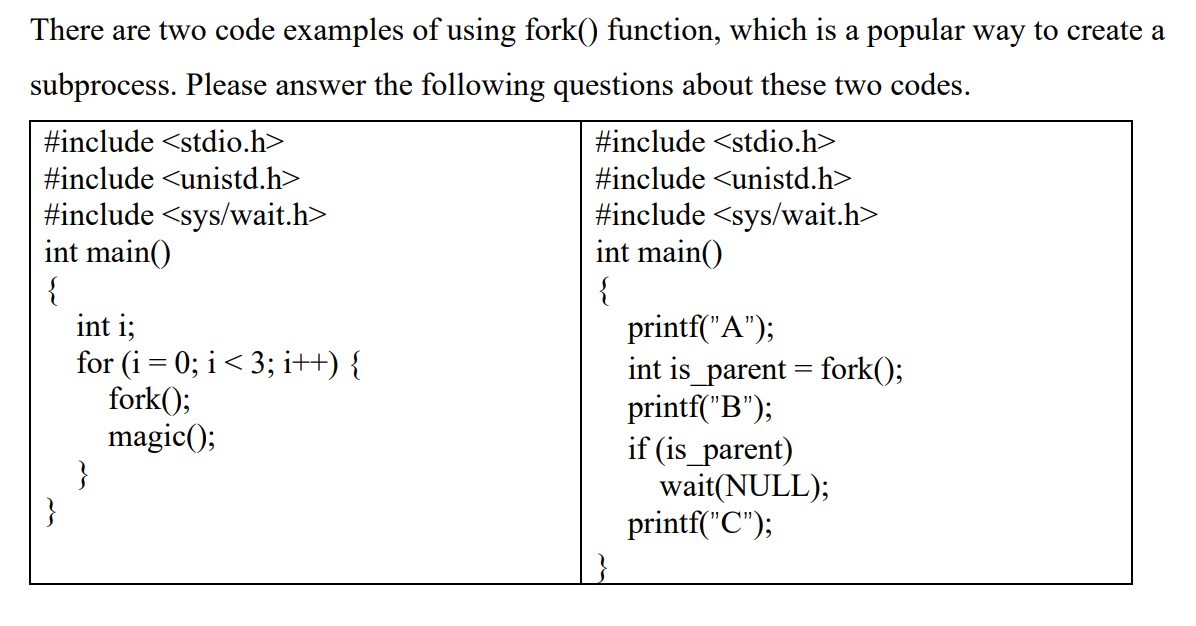
There are two code examples of using fork function, which is a popular way to create a
subprocess. Please answer the following questions about these two codes.
Question:b In the left code example, how many times will the function magic be executed. How many
subprocesses will be created. Please explain the detailed calculation steps.
Answer: times. subprocesses are created.
Solution :
The total number of executions of the function magic can be calculated as following,
For the main process, the function magic will be executed for times, and there are sub
processes being created during i which can be named as main main main
For the sub process main the function magic will be executed for times, and there are
sub processes being created during i which can be named as main main
For the sub process main the function magic will be executed for times, and there is
sub process being created during i which can be named as main
For the sub process main the function magic will be executed for time, and no sub
processes will be created.
For the sub process main the function magic will be executed for times, and there
are sub process being created during i which can be named as main
For the sub process main the function magic will be executed for time, and no sub
processes will be created.
For the sub process main the function magic will be executed for time, and no sub
processes will be created.
For the sub process main the function magic will be executed for times, and no
sub processes will be created.
Thus, in a total, there are times executions of the function magic
Solution : Let the total number of executions of the function magic with loop number i be
Fi we have FiFi F so
FF
FF
FF
thus the answer is
Question:What is the possible output of the right code example? If there are multiple possible outputs,
please list them all.
Answer:
Two possible answers. ABBCC or ABCBC.
Step by Step Solution
There are 3 Steps involved in it
1 Expert Approved Answer
Step: 1 Unlock

Question Has Been Solved by an Expert!
Get step-by-step solutions from verified subject matter experts
Step: 2 Unlock
Step: 3 Unlock
 Study Help