Question: please fast Item 1 In the case below, the original source material is given along with a sample of student work. Determine the type of
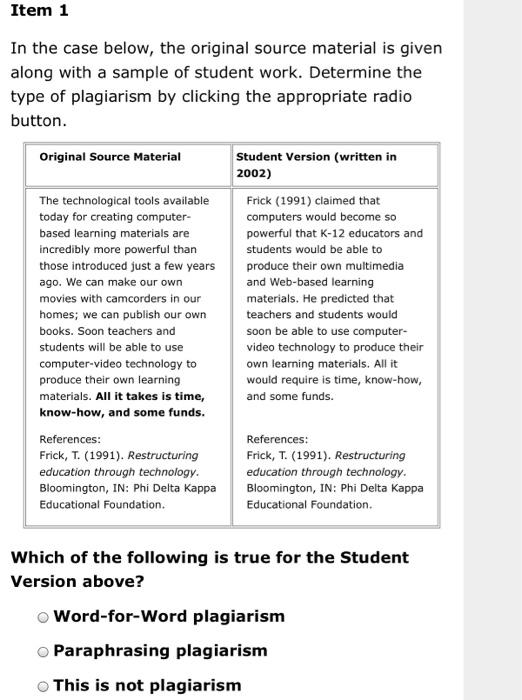
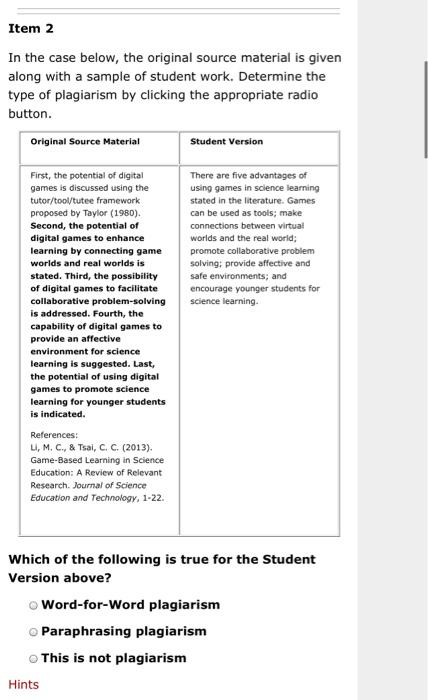
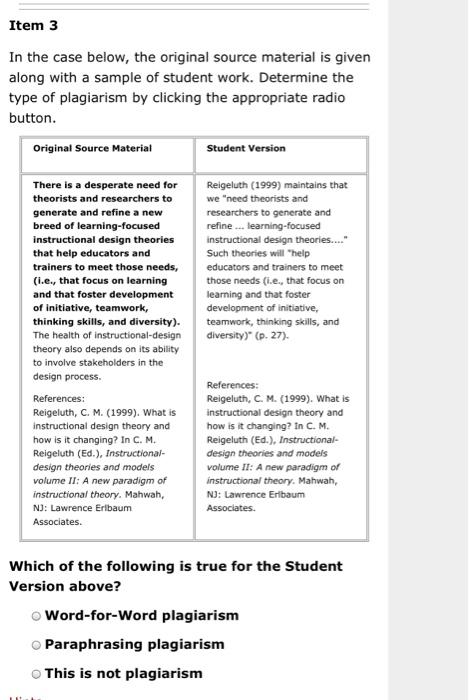
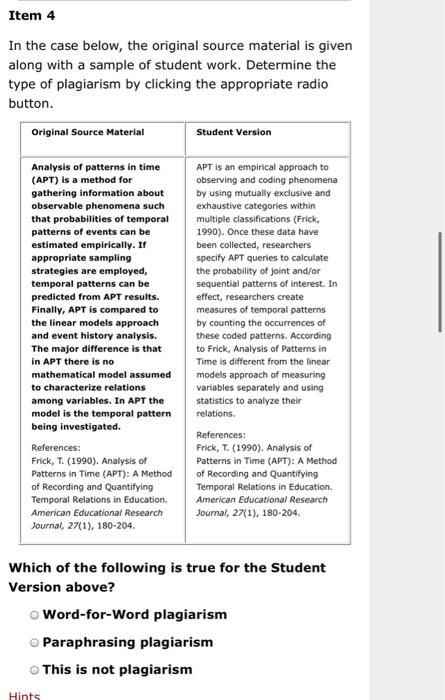
Item 1 In the case below, the original source material is given along with a sample of student work. Determine the type of plagiarism by clicking the appropriate radio button. Original Source Material The technological tools available today for creating computer- based learning materials are incredibly more powerful than those introduced just a few years ago. We can make our own movies with camcorders in our homes; we can publish our own books. Soon teachers and students will be able to use computer-video technology to produce their own learning materials. All it takes is time, know-how, and some funds. References: Frick, T. (1991). Restructuring education through technology. Bloomington, IN: Phi Delta Kappa Educational Foundation. Student Version (written in 2002) Frick (1991) claimed that computers would become so powerful that K-12 educators and students would be able to produce their own multimedia and Web-based learning materials. He predicted that teachers and students would soon be able to use computer- video technology to produce their own learning materials. All it would require is time, know-how, and some funds. References: Frick, T. (1991). Restructuring education through technology. Bloomington, IN: Phi Delta Kappa Educational Foundation. Which of the following is true for the Student Version above? Word-for-Word plagiarism Paraphrasing plagiarism This is not plagiarism Item 2 In the case below, the original source material is given along with a sample of student work. Determine the type of plagiarism by clicking the appropriate radio button. Original Source Material Student Version There are five advantages of using games in science learning stated in the literature. Games can be used as tools; make connections between virtual worlds and the real world; promote collaborative problem solving: provide affective and safe environments; and encourage younger students for science learning. First, the potential of digital games is discussed using the tutor/tool/tutee framework proposed by Taylor (1980). Second, the potential of digital games to enhance learning by connecting game worlds and real worlds is stated. Third, the possibility of digital games to facilitate collaborative problem-solving is addressed. Fourth, the capability of digital games to provide an affective environment for science learning is suggested. Last, the potential of using digital games to promote science learning for younger students is indicated. References: L, M, C., & Tsai, C C. (2013). Game-Based Learning in Science Education: A Review of Relevant Research. Journal of Science Education and Technology, 1-22. Which of the following is true for the Student Version above? Word-for-Word plagiarism Paraphrasing plagiarism This is not plagiarism Hints Item 3 In the case below, the original source material is given along with a sample of student work. Determine the type of plagiarism by clicking the appropriate radio button. Original Source Material Student Version Reigeluth (1999) maintains that we "need theorists and researchers to generate and refine learning-focused instructional design theories...." Such theories will help educators and trainers to meet those needs (i.e., that focus on learning and that foster development of initiative, teamwork, thinking skills, and diversity)" (p. 27). There is a desperate need for theorists and researchers to generate and refine a new breed of learning-focused instructional design theories that help educators and trainers to meet those needs, (i.e., that focus on learning and that foster development of initiative, teamwork, thinking skills, and diversity). The health of instructional-design theory also depends on its ability to involve stakeholders in the design process. References: Reigeluth, C. M. (1999). What is instructional design theory and how is it changing? In C. M. Reigeluth (Ed.), Instructional- design theories and models volume II: A new paradigm of instructional theory. Mahwah, NJ: Lawrence Erlbaum Associates. References: Reigeluth, C.M. (1999). What is instructional design theory and how is it changing in C.M. Reigeluth (Ed.), Instructional- design theories and models volume II: A new paradigm of instructional theory. Mahwah, NJ: Lawrence Erlbaum Associates. Which of the following is true for the Student Version above? Word-for-Word plagiarism Paraphrasing plagiarism This is not plagiarism Item 4 In the case below, the original source material is given along with a sample of student work. Determine the type of plagiarism by clicking the appropriate radio button. Original Source Material Student Version Analysis of patterns in time (APT) is a method for gathering Information about observable phenomena such that probabilities of temporal patterns of events can be estimated empirically. If appropriate sampling strategies are employed, temporal patterns can be predicted from APT results. Finally, APT is compared to the linear models approach and event history analysis. The major difference is that in APT there is no mathematical model assumed to characterize relations among variables. In APT the model is the temporal pattern being investigated. References: Frick, T. (1990). Analysis of Patterns in Time (APT): A Method of Recording and Quantifying Temporal Relations in Education. American Educational Research Journal, 27(1), 180-204. APT is an empirical approach to observing and coding phenomena by using mutually exclusive and exhaustive categories within multiple classifications (Frick, 1990). Once these data have been collected, researchers specify APT queries to calculate the probability of joint and/or sequential patterns of interest. In effect, researchers create measures of temporal patterns by counting the occurrences of these coded patterns. According to Frick, Analysis of Patterns in Time is different from the linear models approach of measuring variables separately and using statistics to analyze their relations References: Frick, T. (1990). Analysis of Patterns in Time (APT): A Method of Recording and Quantifying Temporal Relations in Education. American Educational Research Journal, 27(1), 180-204. Which of the following is true for the Student Version above? Word-for-Word plagiarism Paraphrasing plagiarism This is not plagiarism Hints Item 5 In the case below, the original source material is given along with a sample of student work. Determine the type of plagiarism by clicking the appropriate radio button. Original Source Material Student Version Complex Foaming is the integration of knowledge, skills and attitudes; coordinating qualitatively different constituent skills and often transferring what was learned in school or training to daily life and work. There are many examples of theoretical design models that have been developed to promote complex learning: cognitive apprenticeship, collaborative problem solving, constructivism and constructivist learning environments, learning by doing. multiple approaches to understanding, star legacy, as well as the subject of this contribution, the four- Component Instructional Design model. Van Memienboer and Kirschner (2007) indicated that complex learning involves the learning of how to complete authentic tasks which require the use and integration of knowledge and skills from multiple domains. Complex learning tasks have no single correct method of completion but instead a range of methods that result in the completion of the task at varying degrees of appeal, efficiency, and effectiveness. They further state that complex learning involves "the integration of knowledge, skills and attitudes; coordinating qualitatively different constituent skills, and often transferring what was learned ... to daily life and work (4) References: van Merrienboer, J. J. G. & Kirschner, P. A. K. (2007). Ten steps to complex learning: A systematic approach to four component instructional design Lawrence Erlbaum Associates. Inc., Mahwah, NJ. References: van Merrienboer, J. J. G. & Kirschner, P.A.K. (2007). Ten steps to complex learning: A systematic approach to four- component instructional design Lawrence Erlbaum Associates, Inc. Mahwah, NJ. Which of the following is true for the Student Version above? Word-for-Word plagiarism Paraphrasing plagiarism This is not plagiarism Hints