







Question: Please fill out the skeleton code below(in bold). The prompt and header file are also below. /* stack.c: Stack application. */ #include #include #include #include
Please fill out the skeleton code below(in bold). The prompt and header file are also below.
/* stack.c: Stack application. */
#include
#include
#include
#include "dynArray.h"
/* ***************************************************************
Using stack to check for unbalanced parentheses.
***************************************************************** */
/* Returns the next character of the string, once reaches end return '0' (zero)
param: s pointer to a string
pre: s is not null
*/
char nextChar(char* s)
{
static int i = -1;
char c;
++i;
c = *(s+i);
if ( c == '\0' )
return '\0';
else
return c;
}
/* Checks whether the (), {}, and [] are balanced or not
param: s pointer to a string
pre: s is not null
post:
*/
int isBalanced(char* s)
{
/* FIXME: You will write this function */
return 0;
}
int main(int argc, char* argv[]){
char* s=argv[1];
int res;
res = isBalanced(s);
if (res)
printf("The string %s is balanced ",s);
else
printf("The string %s is not balanced ",s);
return 0;
}
/* dynamicArray_a1.h : Dynamic Array implementation. */
#ifndef DYNAMIC_ARRAY_INCLUDED
#define DYNAMIC_ARRAY_INCLUDED 1
#ifndef __TYPE
#define __TYPE
# define TYPE char
# define TYPE_SIZE sizeof(int)
# endif
# ifndef LT
# define LT(A, B) ((A)
# endif
# ifndef EQ
# define EQ(A, B) ((A) == (B))
# endif
typedef struct DynArr DynArr;
/* Dynamic Array Functions */
void initDynArr(DynArr *v, int capacity);
DynArr *newDynArr(int cap);
void freeDynArr(DynArr *v);
void deleteDynArr(DynArr *v);
int sizeDynArr(DynArr *v);
void addDynArr(DynArr *v, TYPE val);
TYPE getDynArr(DynArr *v, int pos);
void putDynArr(DynArr *v, int pos, TYPE val);
void swapDynArr(DynArr *v, int i, int j);
void removeAtDynArr(DynArr *v, int idx);
/* Stack interface. */
int isEmptyDynArr(DynArr *v);
void pushDynArr(DynArr *v, TYPE val);
TYPE topDynArr(DynArr *v);
void popDynArr(DynArr *v);
/* Bag Interface */
/* Note addDynArr is already declared above*/
int containsDynArr(DynArr *v, TYPE val);
void removeDynArr(DynArr *v, TYPE val);
#endif
*********************************************************************************************************************************
#include
#include
#include "dynArray.h"
struct DynArr
{
TYPE *data; /* pointer to the data array */
int size; /* Number of elements in the array */
int capacity; /* capacity ofthe array */
};
/* ************************************************************************
Dynamic Array Functions
************************************************************************ */
/* Initialize (including allocation of data array) dynamic array.
param: v pointer to the dynamic array
param: cap capacity of the dynamic array
pre: v is not null
post: internal data array can hold cap elements
post: v->data is not null
*/
void initDynArr(DynArr *v, int capacity)
{
assert(capacity > 0);
assert(v!= 0);
v->data = (TYPE *) malloc(sizeof(TYPE) * capacity);
assert(v->data != 0);
v->size = 0;
v->capacity = capacity;
}
/* Allocate and initialize dynamic array.
param: cap desired capacity for the dyn array
pre: none
post: none
ret: a non-null pointer to a dynArr of cap capacity
and 0 elements in it.
*/
DynArr* newDynArr(int cap)
{
assert(cap > 0);
DynArr *r = (DynArr *)malloc(sizeof( DynArr));
assert(r != 0);
initDynArr(r,cap);
return r;
}
/* Deallocate data array in dynamic array.
param: v pointer to the dynamic array
pre: none
post: d.data points to null
post: size and capacity are 0
post: the memory used by v->data is freed
*/
void freeDynArr(DynArr *v)
{
if(v->data != 0)
{
free(v->data); /* free the space on the heap */
v->data = 0; /* make it point to null */
}
v->size = 0;
v->capacity = 0;
}
/* Deallocate data array and the dynamic array ure.
param: v pointer to the dynamic array
pre: none
post: the memory used by v->data is freed
post: the memory used by d is freed
*/
void deleteDynArr(DynArr *v)
{
freeDynArr(v);
free(v);
}
/* Resizes the underlying array to be the size cap
param: v pointer to the dynamic array
param: cap the new desired capacity
pre: v is not null
post: v has capacity newCap
*/
void _dynArrSetCapacity(DynArr *v, int newCap)
{
TYPE *temp = malloc(TYPE_SIZE * newCap);
int i;
/* FIXME: You will write this function */
assert(v != 0);
//copy the values into new array
for(i = 0; i
temp[i] = v->data[i];
free(v->data); // free old memory
v->data = temp; //update the array to point to new allocated memory
v->capacity = newCap; //update capacity
}
/* Get the size of the dynamic array
param: v pointer to the dynamic array
pre: v is not null
post: none
ret: the size of the dynamic array
*/
int sizeDynArr(DynArr *v)
{
return v->size;
}
/* Adds an element to the end of the dynamic array
param: v pointer to the dynamic array
param: val the value to add to the end of the dynamic array
pre: the dynArry is not null
post: size increases by 1
post: if reached capacity, capacity is doubled
post: val is in the last utilized position in the array
*/
void addDynArr(DynArr *v, TYPE val)
{
/* FIXME: You will write this function */
assert(v != 0);
if(sizeDynArr(v) == v->capacity) //if no more space, increase capacity to double of its value
{
_dynArrSetCapacity(v, 2 * v->capacity);
}
v->data[v->size] = val;
v->size++;
}
/* Get an element from the dynamic array from a specified position
param: v pointer to the dynamic array
param: pos integer index to get the element from
pre: v is not null
pre: v is not empty
pre: pos = 0
post: no changes to the dyn Array
ret: value stored at index pos
*/
TYPE getDynArr(DynArr *v, int pos)
{
/* FIXME: You will write this function */
/* FIXME: you must change this return value */
assert(v != 0 && !isEmptyDynArr(v));
assert(pos >= 0 && pos
return v->data[pos];
}
/* Put an item into the dynamic array at the specified location,
overwriting the element that was there
param: v pointer to the dynamic array
param: pos the index to put the value into
param: val the value to insert
pre: v is not null
pre: v is not empty
pre: pos >= 0 and pos
post: index pos contains new value, val
*/
void putDynArr(DynArr *v, int pos, TYPE val)
{
/* FIXME: You will write this function */
assert(v != 0 && !isEmptyDynArr(v));
assert(pos >= 0 && pos
v->data[pos] = val; //put the val in pos overwriting old value
}
/* Swap two specified elements in the dynamic array
param: v pointer to the dynamic array
param: i,j the elements to be swapped
pre: v is not null
pre: v is not empty
pre: i, j >= 0 and i,j
post: index i now holds the value at j and index j now holds the value at i
*/
void swapDynArr(DynArr *v, int i, int j)
{
/* FIXME: You will write this function */
assert(v != 0 && !isEmptyDynArr(v));
assert(i>=0 && j >= 0 && i
TYPE temp = v->data[i];
v->data[i] = v->data[j];
v->data[j] = temp;
}
/* Remove the element at the specified location from the array,
shifts other elements back one to fill the gap
param: v pointer to the dynamic array
param: idx location of element to remove
pre: v is not null
pre: v is not empty
pre: idx = 0
post: the element at idx is removed
post: the elements past idx are moved back one
*/
void removeAtDynArr(DynArr *v, int idx)
{
int i;
/* FIXME: You will write this function */
assert(v != 0 && !isEmptyDynArr(v));
assert(idx >= 0 && idx
//more all elements back by 1 position starting from idx
for(i = idx; i
v->data[i] = v->data[i+1];
//reduce the size
v->size--;
}
/* ************************************************************************
Stack Interface Functions
************************************************************************ */
/* Returns boolean (encoded in an int) demonstrating whether or not the
dynamic array stack has an item on it.
param: v pointer to the dynamic array
pre: the dynArr is not null
post: none
ret: 1 if empty, otherwise 0
*/
int isEmptyDynArr(DynArr *v)
{
/* FIXME: You will write this function */
assert(v != 0);
/* FIXME: You will change this return value*/
if(sizeDynArr(v) == 0)
return 1;
else
return 0;
}
/* Push an element onto the top of the stack
param: v pointer to the dynamic array
param: val the value to push onto the stack
pre: v is not null
post: size increases by 1
if reached capacity, capacity is doubled
val is on the top of the stack
*/
void pushDynArr(DynArr *v, TYPE val)
{
/* FIXME: You will write this function */
assert(v != 0);
addDynArr(v, val);
}
/* Returns the element at the top of the stack
param: v pointer to the dynamic array
pre: v is not null
pre: v is not empty
post: no changes to the stack
*/
TYPE topDynArr(DynArr *v)
{
/* FIXME: You will write this function */
assert(v != 0 && !isEmptyDynArr(v));
/* FIXME: You will change this return value*/
return v->data[sizeDynArr(v) - 1];
}
/* Removes the element on top of the stack
param: v pointer to the dynamic array
pre: v is not null
pre: v is not empty
post: size is decremented by 1
the top has been removed
*/
void popDynArr(DynArr *v)
{
/* FIXME: You will write this function */
assert(v != 0 && !isEmptyDynArr(v));
removeAtDynArr(v, sizeDynArr(v) - 1);
}
/* ************************************************************************
Bag Interface Functions
************************************************************************ */
/* Returns boolean (encoded as an int) demonstrating whether or not
the specified value is in the collection
true = 1
false = 0
param: v pointer to the dynamic array
param: val the value to look for in the bag
pre: v is not null
pre: v is not empty
post: no changes to the bag
*/
int containsDynArr(DynArr *v, TYPE val)
{
int i;
/* FIXME: You will write this function */
assert(v != 0 && !isEmptyDynArr(v));
/* FIXME: You will change this return value */
for( i = 0; i
{
if(EQ(val, v->data[i])) //found the val
return 1;
}
return 0;//did not find
}
/* Removes the first occurrence of the specified value from the collection
if it occurs
param: v pointer to the dynamic array
param: val the value to remove from the array
pre: v is not null
pre: v is not empty
post: val has been removed
post: size of the bag is reduced by 1
*/
void removeDynArr(DynArr *v, TYPE val)
{
int i;
assert(v != 0 && !isEmptyDynArr(v));
/* FIXME: You will write this function */
for(i = 0; i
{
if(EQ(val, v->data[i]))
{
removeAtDynArr(v, i); // remove the element at index i
break;
}
}
}
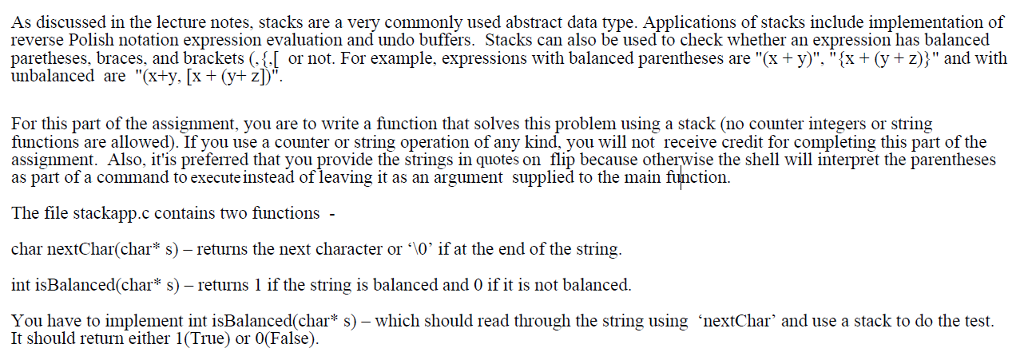
As discussed in the lecture notes, stacks are a very commonly used abstract data type. Applications of stacks include implementation of reverse Polish notation expression evaluation and undo buffers. Stacks can also be used to check whether an expression has balanced paretheses braces, and brackets ( or not. For example, expressions with balanced parentheses are "(x+ y)". "x+ (y+ z)}" and with unbalanced are "(xty. [x + (V+z)" For this part of the assignment, you are to write a function that solves this problem using a stack (no counter integers or string functions are allowed). If you use a counter or string operation of any kind, you will not receive credit for completing this part of the assignment. Also, it's preferred that you provide the strings in quotes on flip because otherwise the shell will interpret the parentheses as part of a command to execute instead of leaving it as an argument supplied to the main fiunction The file stackapp.c contains two functions - char nextChar(char* s)-returns the next character or o, if at the end of the string. int isBalanced(char* s)-returns I if the string is balanced and O if it is not balanced You have to implement int isBalanced(char* s)-which should read through the string using nextChar, and use a stack to do the test. It should return either 1Te) or O(False)
Step by Step Solution
There are 3 Steps involved in it

Get step-by-step solutions from verified subject matter experts
 Study Help