







Question: PLEASE FOLLOW ALL STEPS, and I only need the answer no explanation is needed. Please put the exact answer choice that's given with question #
PLEASE FOLLOW ALL STEPS, and I only need the answer no explanation is needed. Please put the exact answer choice that's given with question # and part.
5.
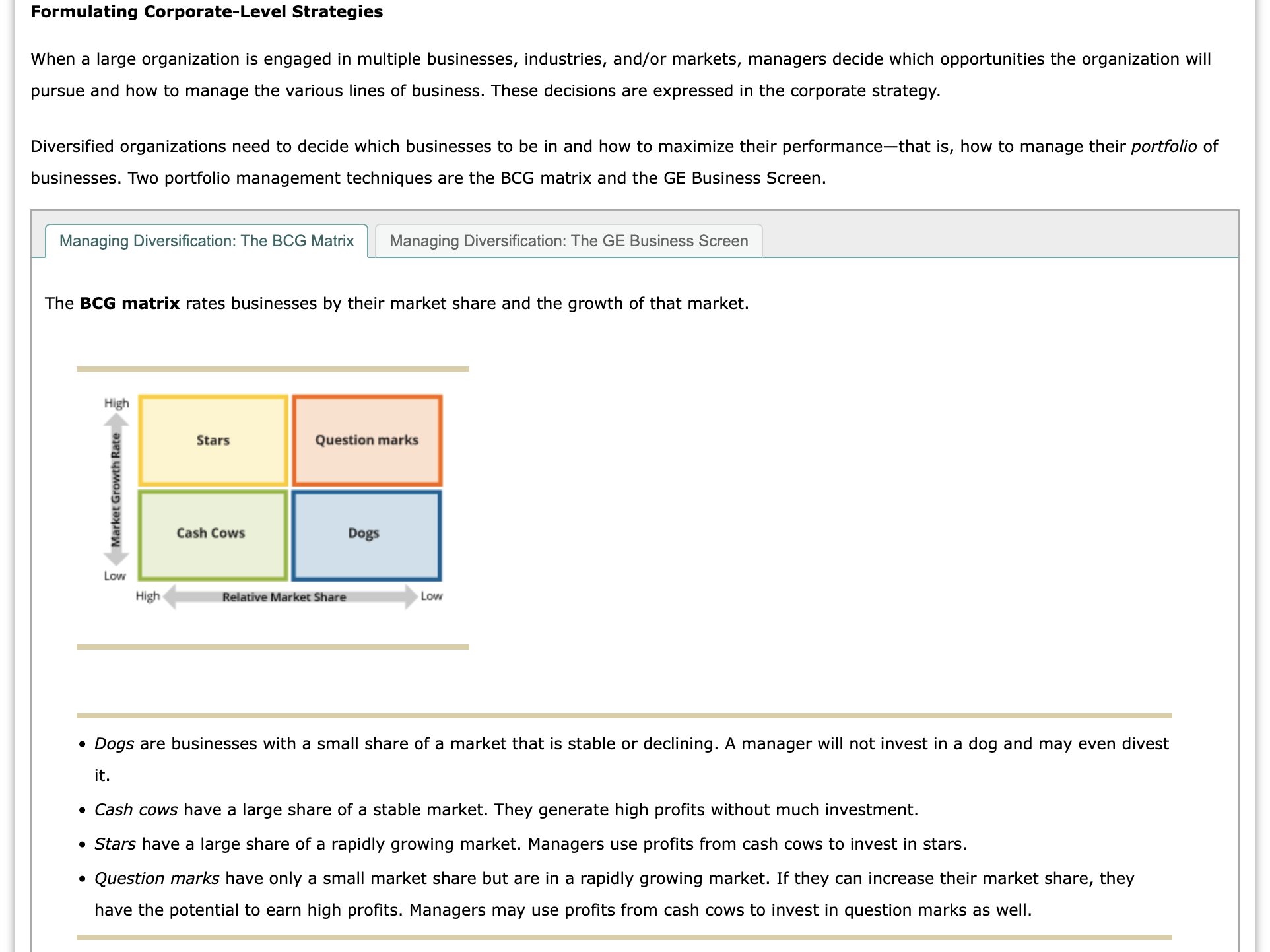
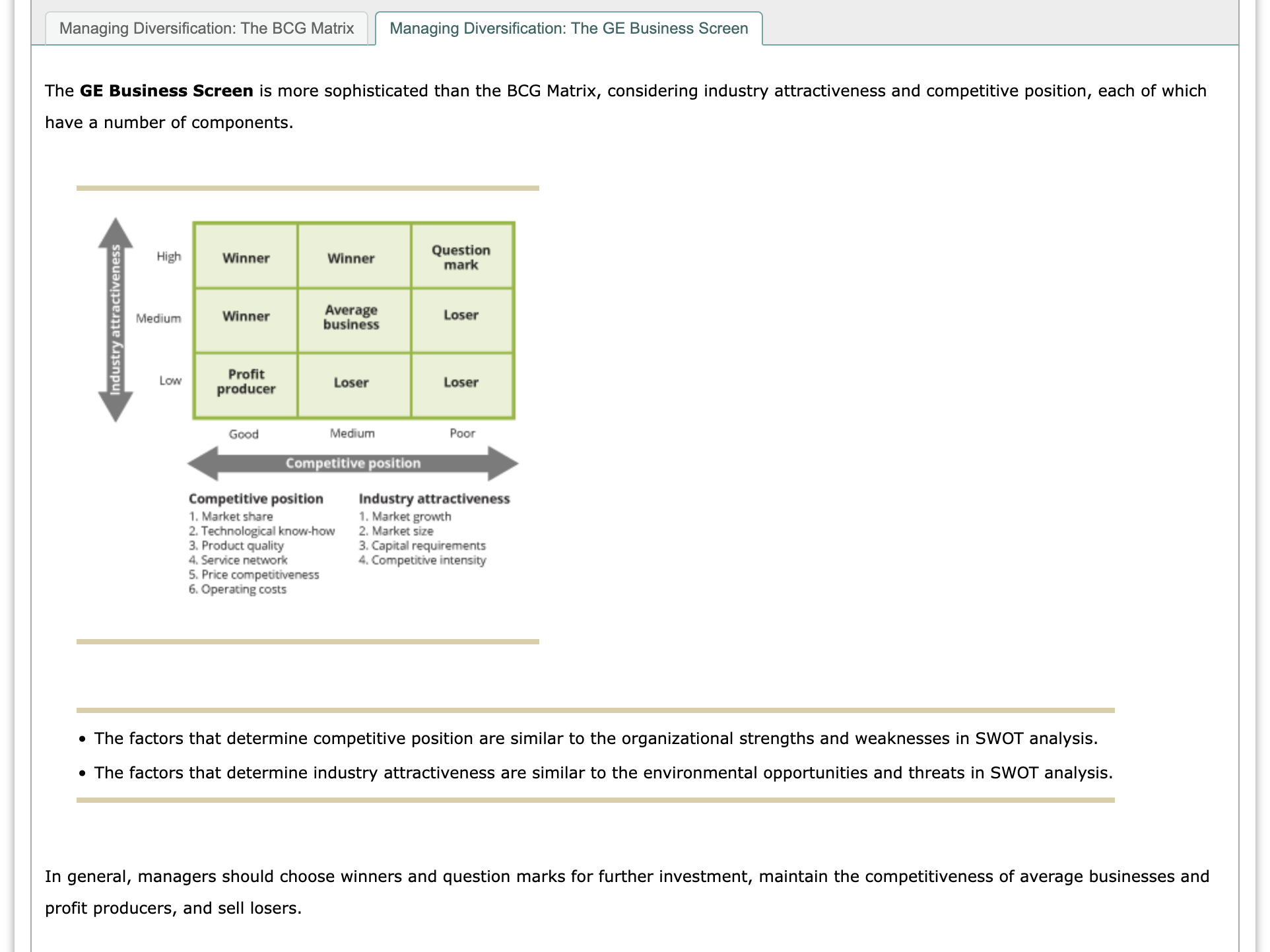
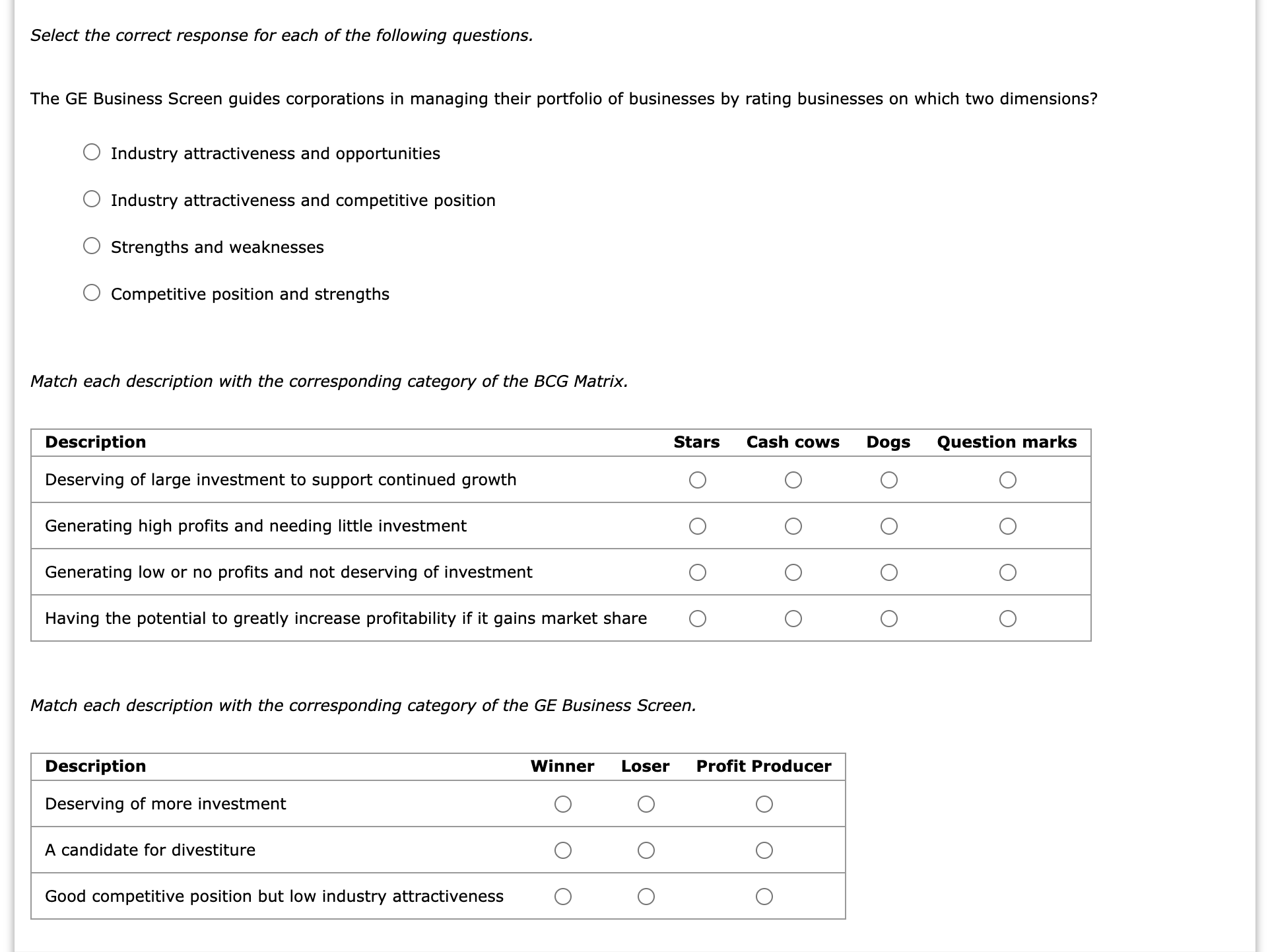
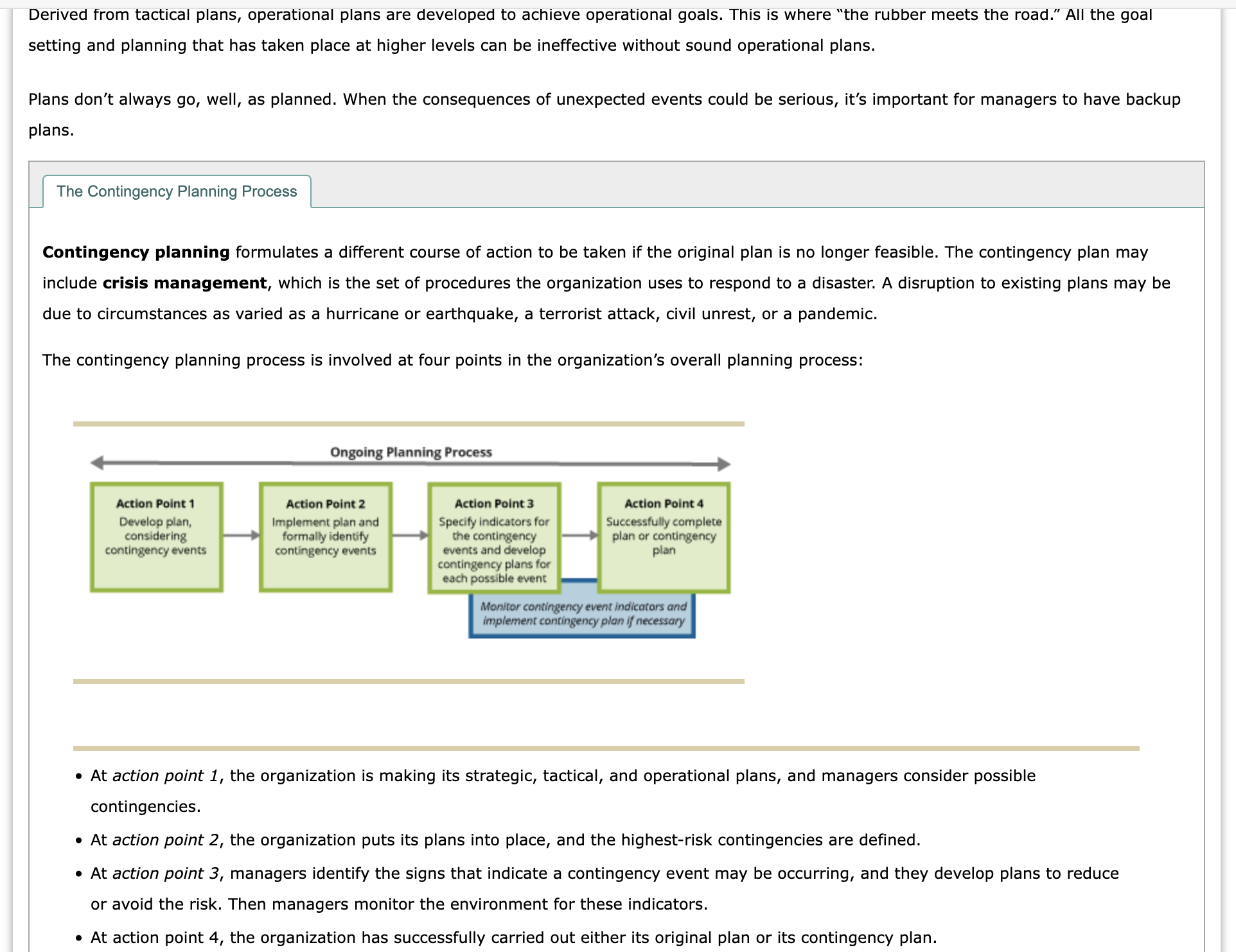
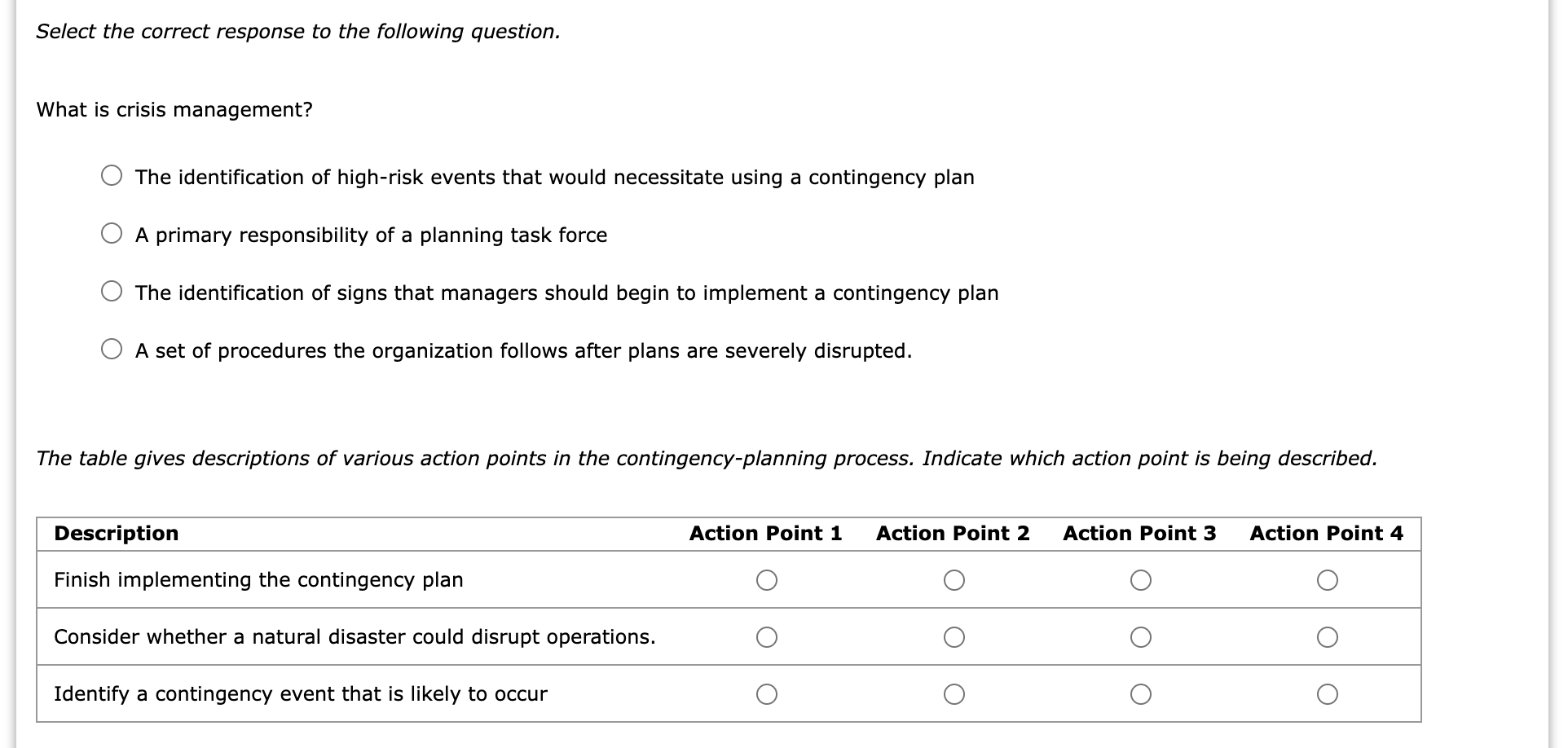
Formulating Corporate-Level Strategies When a large organization is engaged in multiple businesses, industries, and/or markets, managers decide which opportunities the organization will pursue and how to manage the various lines of business. These decisions are expressed in the corporate strategy. Diversified organizations need to decide which businesses to be in and how to maximize their performancethat is, how to manage their portfolio of businesses. Two portfolio management techniques are the BCG matrix and the GE Business Screen. Managing Diversification: The BCG Matrix Managing Diversification: The GE Business Screen The BCG matrix rates businesses by their market share and the growth of that market. man 5 Stars Question marks i G 'n' f 5 Cash Cows Dogs LCM High Relative Market Share Low - Dogs are businesses with a small share of a market that is stable or declining. A manager will not invest in a dog and may even divest it. . Cash cows have a large share of a stable market. They generate high profits without much investment. - Stars have a large share ofa rapidly growing market. Managers use prots from cash cows to invest in stars. 0 Question marks have only a small market share but are in a rapidly growing market. If they can increase their market share, they have the potential to earn high profits. Managers may use profits from cash cows to invest in question marks as well. Managing Diversification: The BCG Matrix Managing Diversification: The GE Business Screen The GE Business Screen is more sophisticated than the BCG Matrix, considering industry attractiveness and competitive position, each of which have a number of components. High Question Winner Winner mark Average Industry attractiveness Medium Winner Loser business Low Profit Loser Loser producer Good Medium Poor Competitive position Competitive position Industry attractiveness 1. Market share 1. Market growth 2. Technological know-how 2. Market size 3. Product quality 3. Capital requirements 4. Service network 4. Competitive intensity 5. Price competitiveness 6. Operating costs . The factors that determine competitive position are similar to the organizational strengths and weaknesses in SWOT analysis. . The factors that determine industry attractiveness are similar to the environmental opportunities and threats in SWOT analysis. In general, managers should choose winners and question marks for further investment, maintain the competitiveness of average businesses and profit producers, and sell losers.Select the correct response for each of the following questions. The GE Business Screen guides corporations in managing their portfolio of businesses by rating businesses on which two dimensions? O Industry attractiveness and opportunities O Industry attractiveness and competitive position O Strengths and weaknesses O Competitive position and strengths Match each description with the corresponding category of the ECG Matrix. Description Stars Cash cows Dogs Question marks Deserving of large investment to support continued growth O O O O Generating high profits and needing little investment Generating low or no profits and not deserving of investment GOO GOO GOO 000 Having the potential to greatly increase profitability if it gains market share Match each description with the corresponding category of the GE Business Screen. Description Winner Loser Profit Producer Deserving of more investment 0 O O A candidate for divestiture O O O Good competitive position but low industry attractiveness O Derived from tactical plans, operational plans are developed to achieve operational goals. This is where "the rubber meets the road." All the goal setting and planning that has taken place at higher levels can be ineffective without sound operational plans. Plans don't always go, well, as planned. When the consequences of unexpected events could be serious, it's important for managers to have backup plans. The Contingency Planning Process Contingency planning formulates a different course of action to be taken if the original plan is no longer feasible. The contingency plan may include crisis management, which is the set of procedures the organization uses to respond to a disaster. A disruption to existing plans may be due to circumstances as varied as a hurricane or earthquake, a terrorist attack, civil unrest, or a pandemic. The contingency planning process is involved at four points in the organization's overall planning process: Ongoing Planning Process Action Point 1 Action Point 2 Action Point 3 Action Point 4 Develop plan, Implement plan and Specify indicators for Successfully complete considering formally identify the contingency plan or contingency contingency events contingency events events and develop plan contingency plans for each possible event Monitor contingency event indicators and implement contingency plan if necessary . At action point 1, the organization is making its strategic, tactical, and operational plans, and managers consider possible contingencies. At action point 2, the organization puts its plans into place, and the highest-risk contingencies are defined. . At action point 3, managers identify the signs that indicate a contingency event may be occurring, and they develop plans to reduce or avoid the risk. Then managers monitor the environment for these indicators. . At action point 4, the organization has successfully carried out either its original plan or its contingency plan.Select the correct response to the following question. What is crisis management? 0 The identification of highrisk events that would necessitate using a contingency plan 0 A primary responsibility of a planning task force 0 The identification of signs that managers should begin to implement a contingency plan 0 A set of procedures the organization follows after plans are severely disrupted. The table gives descriptions of various action points in the contingencyplanning process. Indicate which action point is being described. Description Action Point 1 Action Point 2 Action Point 3 Action Point 4 Finish implementing the contingency plan 0 O O O Consider whether a natural disaster could disrupt operations. 0 O O O Identify a contingency event that is likely to occur O O O O
Step by Step Solution
There are 3 Steps involved in it

Get step-by-step solutions from verified subject matter experts
 Study Help