







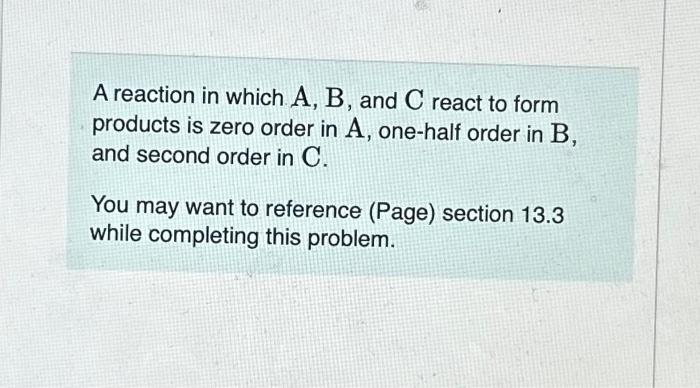
Question: please help!!!!! A reaction in which A,B, and C react to form products is zero order in A, one-half order in B, and second order
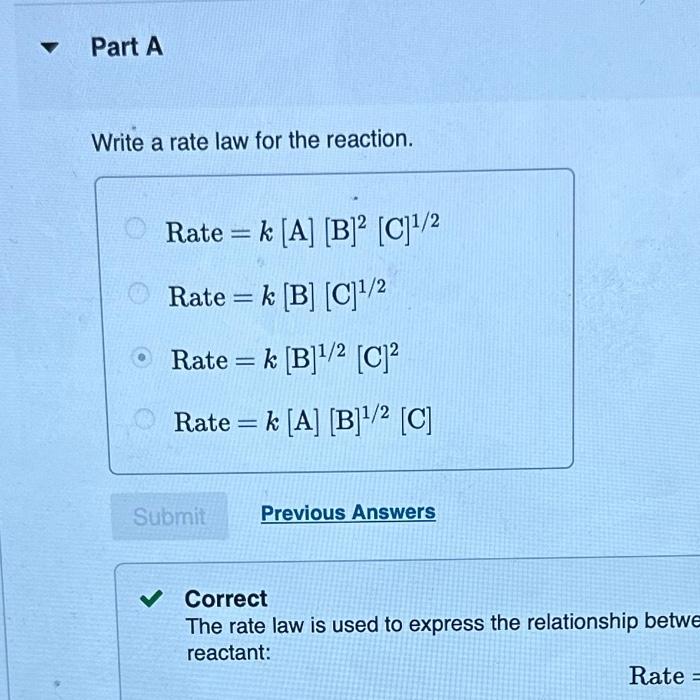
![completing this problem. Write a rate law for the reaction. Rate=k[A][B]2[C]1/2Rate=k[B][C]1/2Rate=k[B]1/2[C]2Rate=k[A][B]1/2[C] Correct](https://dsd5zvtm8ll6.cloudfront.net/si.experts.images/questions/2024/09/66f8f424860b3_46066f8f4242a968.jpg)
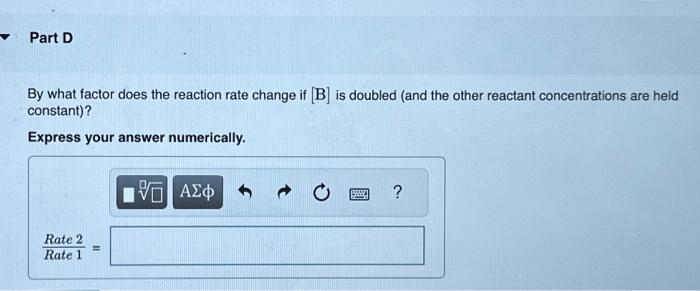
![what factor does the reaction rate change if [A] is doubled (and](https://dsd5zvtm8ll6.cloudfront.net/si.experts.images/questions/2024/09/66f8f4264d97f_46166f8f425df221.jpg)
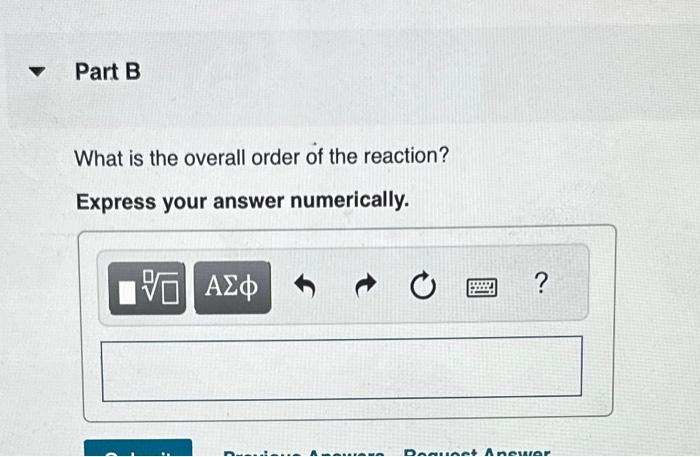
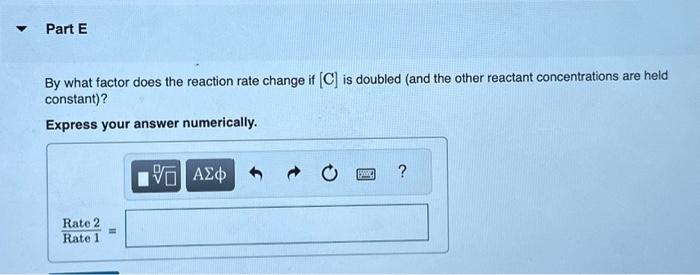
A reaction in which A,B, and C react to form products is zero order in A, one-half order in B, and second order in C. You may want to reference (Page) section 13.3 while completing this problem. Write a rate law for the reaction. Rate=k[A][B]2[C]1/2Rate=k[B][C]1/2Rate=k[B]1/2[C]2Rate=k[A][B]1/2[C] Correct The rate law is used to express the relationship betwe reactant: What is the overall order of the reaction? Express your answer numerically. By what factor does the reaction rate change if [A] is doubled (and the other reactant concentrations are held constant)? Express your answer numerically. By what factor does the reaction rate change if [B] is doubled (and the other reactant concentrations are held constant)? Express your answer numerically. By what factor does the reaction rate change if [C] is doubled (and the other reactant concentrations are held constant)? Express your answer numerically. By what factor does the reaction rate change if the concentrations of all three reactants are doubled? Express your answer numerically
Step by Step Solution
There are 3 Steps involved in it

Get step-by-step solutions from verified subject matter experts
 Study Help