







Question: Please help answer as i am not able to solve this my self This company YPSI trailer is planning to attempt to move to a
Please help answer as i am not able to solve this my self
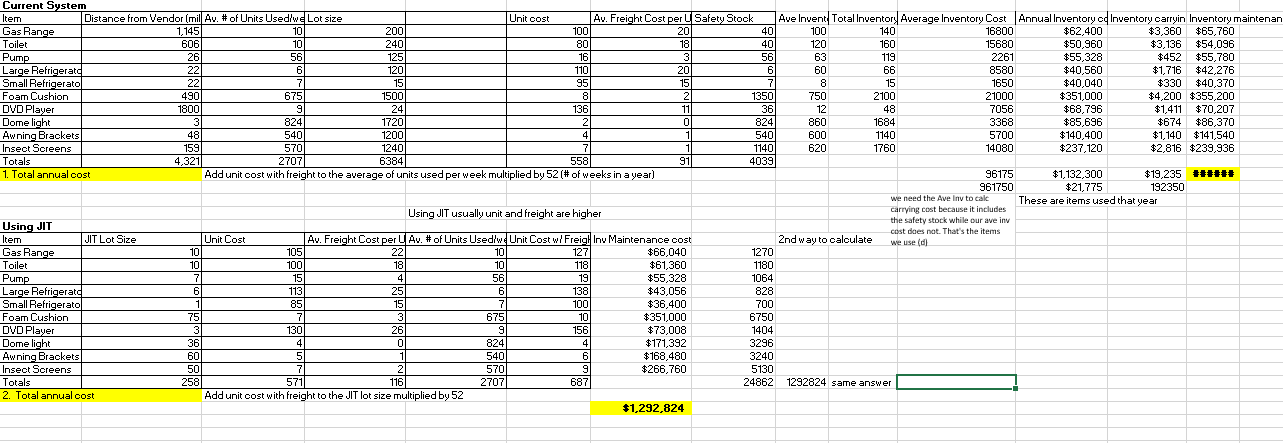
This company YPSI trailer is planning to attempt to move to a JIT system. NOTE: I've filled in most of the excel sheet. For many of the columns you should be able to see the formula I used. Regarding JIT you can see that I calculated total cost 2 different ways. You can ignore one. I did that just to show that the math works out the same either way.
The main tenets of JIT are: 1. Minimize inventory 2. delivery of inputs should be frequent and small 3. suppliers should be treated as part of the production team. 4. Zero defect goal 5. Finished product has a very short lead time Inventory carrying costs are assumed to be 20% per yr on the average investment in inventory on hand (including acquisition and transport costs) Number of units currently kept in stock is calculated by: If the vendor is more than 500 miles away- a safety stock of 4 weeks material Vendors 100-500 miles away safety stock of 2 weeks of material is kept Closer sources safety stock of 1 week
Besides safety stock, the average inventory of any item is the current lot size divided by 2.
Regarding the excel sheet and the switch from a traditional system to JIT. A. How will this affect shipping prices, especially for those suppliers who are further away? B. What is the total annual cost of maintaining the current system? C. What would it be if they switched to JIT ( assuming no safety stock)? D. What other costs or benefits should they consider with JIT? E. What changes should occur between YPSI and their suppliers? F. If YPSI received a call from a competitor going out of business with a fabulous deal on a 5,000 trailer lights should they buy them? G. Is there a level of carrying costs at which the present system and JIT would have similar costs? If so what is it? How did you figure that out? Hint try using the excel sheet and changing the carrying cost percentage. In other words if you have to change carrying cost from 10% to 15% in order for the present system's total cost to equal JIT total costs then the answer would be "carrying costs would need to increase by 50% from 10 to 15 in order for the two systems to have equal costs"
Logically explain your answers and describe how you came to those conclusions.
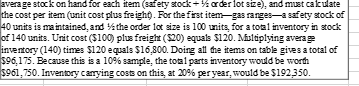
avera ge stock on hand for each item (safety stock +1/2 order lot size), and must cakculate the cost per item (unit cost plus fre igh. For the first item-gas ranges-a safety stock of 40 units is ma intained, and 1/2 the order lot size is 100 units, for a total inventory in stock of 140 units. Unit cost ($100) plus freight ($20) equals $120. Mhttiplying average invertory (140) times $120 equals $16,800. Doing atl the items on table gives a total of 596,175. Because this is a 10\% sample, the total parts inventory would be worth $961,750. Inventory canying costs on this, at 20% per year, would be $192,350
Step by Step Solution
There are 3 Steps involved in it

Get step-by-step solutions from verified subject matter experts
 Study Help