Question: PLEASE HELP ANSWER THOROUGHLY.. AND PLEASE DO NOT COPY FROM GOOGLE AND EXISTING ANSWERS IN CHEGG Incident 7.1 Promotions at OMG Old Money Group (OMG)
PLEASE HELP ANSWER THOROUGHLY.. AND PLEASE DO NOT COPY FROM GOOGLE AND EXISTING ANSWERS IN CHEGG
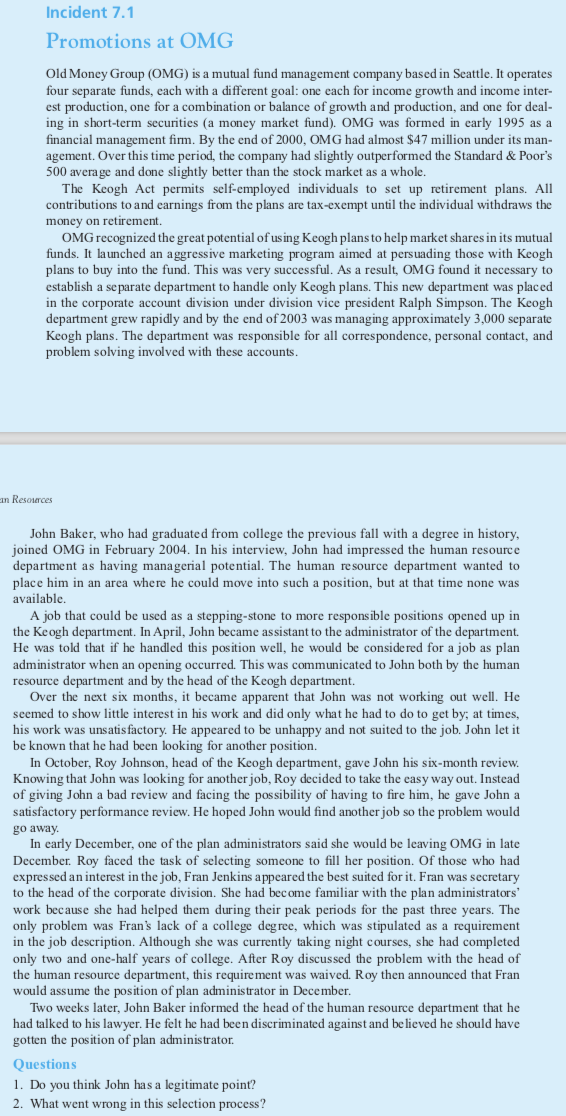
Incident 7.1 Promotions at OMG Old Money Group (OMG) is a mutual fund management company based in Seattle. It operates four separate funds, each with a different goal: one each for income growth and income inter- est production, one for a combination or balance of growth and production, and one for deal- ing in short-term securities (a money market fund). OMG was formed in early 1995 as a financial management firm. By the end of 2000, OMG had almost $47 million under its man- agement. Over this time period, the company had slightly outperformed the Standard & Poor's 500 average and done slightly better than the stock market as a whole. The Keogh Act permits self-employed individuals to set up retirement plans. All contributions to and earnings from the plans are tax-exempt until the individual withdraws the money on retirement OMG recognized the great potential of using Keogh plans to help market shares in its mutual funds. It launched an aggressive marketing program aimed at persuading those with Keogh plans to buy into the fund. This was very successful. As a result, OMG found it necessary to establish a separate department to handle only Keogh plans. This new department was placed in the corporate account division under division vice president Ralph Simpson. The Keogh department grew rapidly and by the end of 2003 was managing approximately 3,000 separate Keogh plans. The department was responsible for all correspondence, personal contact, and problem solving involved with these accounts. in Resources esource department seemed John Baker, who had graduated from college the previous fall with a degree in history, joined OMG in February 2004. In his interview, John had impressed the human resource department as having managerial potential. The human resource department wanted to place him in an area where he could move into such a position, but at that time none was available A job that could be used as a stepping-stone to more responsible positions opened up in the Keogh department. In April, John became assistant to the administrator of the department He was told that if he handled this position well, he would be considered for a job as plan administrator when an opening occurred. This was communicated to John both by the human and by the head of the Keogh department. Over the next six months, it became apparent that John was not working out well. He to show little interest in his work and did only what he had to do to get by; at times, his work was unsatisfactory. He appeared to be unhappy and not suited to the job. John let it be known that he had been looking for another position. In October, Roy Johnson, head of the Keogh department, gave John his six-month review. Knowing that John was looking for another job, Roy decided to take the easy way out. Instead of giving John a bad review and facing the possibility of having to fire him, he gave John a satisfactory performance review. He hoped John would find another job so the problem would go away In early December, one of the plan administrators said she would be leaving OMG in late December. Roy faced the task of selecting someone to fill her position. Of those who had expressed an interest in the job, Fran Jenkins appeared the best suited for it. Fran was secretary to the head of the corporate division. She had become familiar with the plan administrators work because she had helped them during their peak periods for the past three years. The only problem was Fran's lack of a college degree, which was stipulated as a requirement in the job description. Although she was currently taking night courses, she had completed only two and one-half years of college. After Roy discussed the problem with the head of the human resource department, this requirement was waived. Roy then announced that Fran would assume the position of plan administrator in December. Two weeks later, John Baker informed the head of the human resource department that he had talked to his lawyer. He felt he had been discriminated against and believed he should have gotten the position of plan administrator. Questions 1. Do you think John has a legitimate point? 2. What went wrong in this selection process









 Study Help