





Question: PLEASE HELP ANSWER THOROUGHLY.. AND PLEASE DO NOT COPY FROM GOOGLE OR EXISTING ANSWERS IN CHEGG Implementing On-the-Job Training The first-year training program for professional

PLEASE HELP ANSWER THOROUGHLY.. AND PLEASE DO NOT COPY FROM GOOGLE OR EXISTING ANSWERS IN CHEGGPLEASE HELP ANSWER THOROUGHLY.. AND PLEASE DO NOT
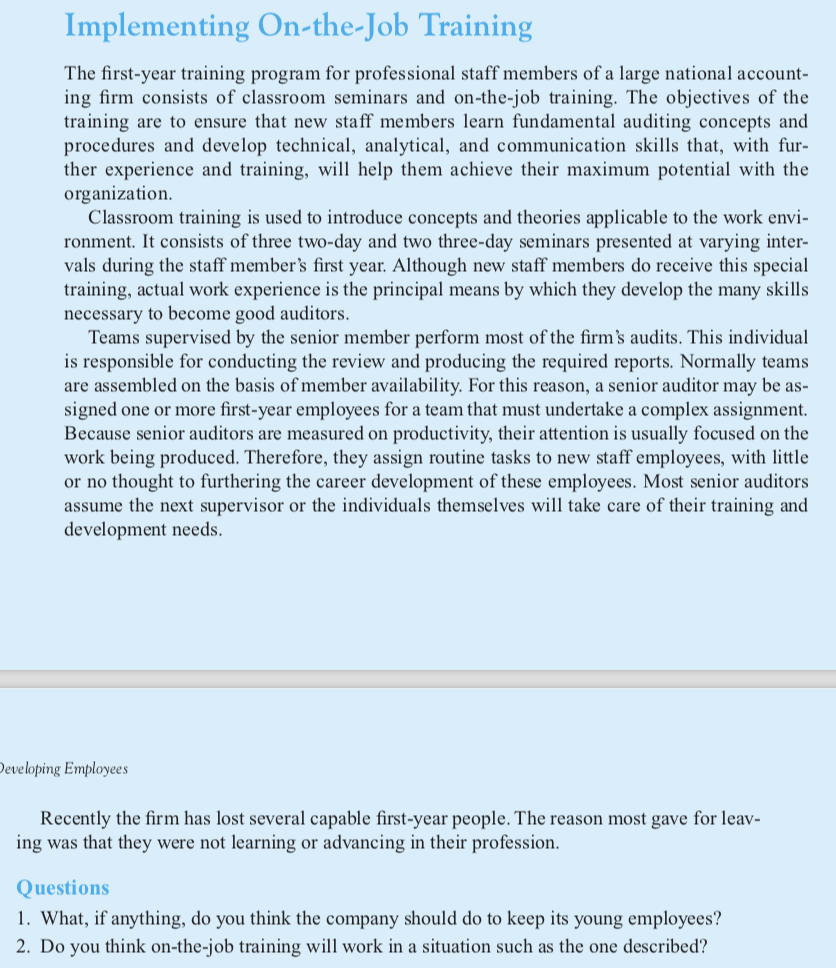
Implementing On-the-Job Training The first-year training program for professional staff members of a large national account- ing firm consists of classroom seminars and on-the-job training. The objectives of the training are to ensure that new staff members learn fundamental auditing concepts and procedures and develop technical, analytical, and communication skills that, with fur- ther experience and training, will help them achieve their maximum potential with the organization. Classroom training is used to introduce concepts and theories applicable to the work envi- ronment. It consists of three two-day and two three-day seminars presented at varying inter- vals during the staff member's first year. Although new staff members do receive this special training, actual work experience is the principal means by which they develop the many skills necessary to become good auditors. Teams supervised by the senior member perform most of the firm's audits. This individual is responsible for conducting the review and producing the required reports. Normally teams are assembled on the basis of member availability. For this reason, a senior auditor may be as- signed one or more first-year employees for a team that must undertake a complex assignment. Because senior auditors are measured on productivity, their attention is usually focused on the work being produced. Therefore, they assign routine tasks to new staff employees, with little or no thought to furthering the career development of these employees. Most senior auditors assume the next supervisor or the individuals themselves will take care of their training and development needs. Developing Employees Recently the firm has lost several capable first-year people. The reason most gave for leav- ing was that they were not learning or advancing in their profession. Questions 1. What, if anything, do you think the company should do to keep its young employees? 2. Do you think on-the-job training will work in a situation such as the one described

Step by Step Solution

There are 3 Steps involved in it

1 Expert Approved Answer
Step: 1 Unlock blur-text-image

Question Has Been Solved by an Expert!

Get step-by-step solutions from verified subject matter experts

Step: 2 Unlock
Step: 3 Unlock

Students Have Also Explored These Related General Management Questions!