Question: Please help create general ERD diagram with crows feet notation FOR PARTS ONLY AFFECTING INVENTORY I. Background Natural by Design, Inc. (NBD) is a partnership
Please help create general ERD diagram with crows feet notation FOR PARTS ONLY AFFECTING INVENTORY 
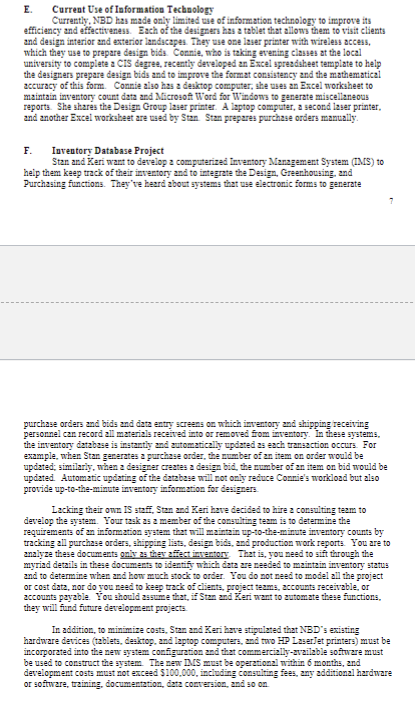
I. Background Natural by Design, Inc. (NBD) is a partnership that designs and develops interior and exterior landscapes for hotels, restaurants, condominiums, and private estates. In their designs, they use a mixture of commonly available plants, flowers, and shrubs; imported rare and exotic plants, pottery; and other materials. NBD employs thirty people and has gross sales of $4.1 million with a before-tax profit of $750,000. Keri Yamaguchi and Stan Fenton own the partnership equally. Keri, a designer, manages the artistic side of the business -- including supervising the design activity and job production and selecting vendors. Stan is the general manager who purchases inventory and supervises the sales and financial activities. A. Acquiring Projects To acquire projects, the NBD salespeople call upon potential customers and identify project opportunities. Once the salespeople identify a real prospect, they introduce one or more of NBD's five designers to the client. The designers meet with the client, determine the client's needs, and then develop a design on a tablet computer, including formal sketches and blueprints. The designers also prepare a written Design Bid (see Figure IMS-1) that contains a general description of the project, a list of plants and materials, and a detailed listing of both material and labor costs. The design bid and tablet designed sketches are reviewed with the customer, adjusted as needed, and then approved (or rejected). If approved, the project is turned over to the Production staff for implementation. Accounts Receivable then follows up for payment. Usually, customers are slow to approve a design, but, once they do approve it, they want near immediate implementation. Because NBD's procurement process is very slow, the designers have learned to work only with plants and materials that are in inventory or that will very soon be in inventory. Except for very large and specialized jobs, the designers do not have the luxury of selecting plants that are not already on order or in inventory. B. Managing Inventory Effective inventory management is critical to NBD's success. They must have appropriate plants and other materials available when needed; however, because their inventory is expensive to maintain, they do not want more inventory than necessary. But with order lead time averaging 5 to 6 weeks on some of their more exotic plants, they need to maintain sufficient stock to carry them until the ordered items are delivered. 2 The Design Group keeps inventory records to facilitate the effective use of inventory. Specifically, for each plant type, they maintain data about the plant type, size, average net cost, list price, quantity in stock, quantity in stock and on bid, quantity on order, and quantity on order and on bid. The on-bid quantities are tracked so that designers know the quantity of uncommitted inventory available at a point in time. Similar information is maintained about pottery and decorative items, but only in stock and in stock/on bid quantities are maintained. For landscaping materials, only the description, unit, net and list prices, and quantity in stock are recorded. An excerpt of this inventory data is shown in Figure IMS-2. Inventory information is maintained as an Excel worksheet by the Design Group's administrative assistant, Connie Nguyen. Each day. Connie updates the numbers, prints the worksheet, and makes a copy for each designer. The designers work against the data on these copies in deciding which plants to include in their designs. There are a number of problems with this arrangement. First, designers work simultaneously, and sometimes they unknowingly use the same last items from inventory in their bids. They try to coordinate their activities to prevent this, but sometimes it is not possible. Second, if a design bid is rejected or changed to eliminate plants or other materials, these items should be placed back in inventory; that is. Connie should subtract them from the appropriate on- bid quantity total and add them to the in-stock or on-order quantity total. Sometimes designers forget to tell Connie about these changes. As a result, the number of items available to be used in bids is often larger than the records show. c. Purchasing and Maintaining Stock Items Stan Fenton is responsible for ordering stock, but because he lacks Keri's knowledge of plants, he relies on her expertise to select suppliers for all NBD's plant stock. Once a year Keri evaluates the price and quality of the plants and the quality of service provided by each plant supplier. She compiles this information into a report that lists the preferred and secondary supplier for each plant type: also listed are the total quantity of each plant type used by NBD in the previous 12 months and each supplier's order lead time, i.e., the average length of time between NBD's placing an order and receiving the corresponding shipment. (NBD does not need to maintain similar information for its other pottery and materials. These items are obtained from local suppliers who can usually deliver an order within 48 hours.) An excerpt from this report is shown in Figure IMS-3. Stan refers to this report when he is preparing a purchase order to determine what to order. He uses the annual sales quantity figure to determine the average sales per week of each plant: then he compares this figure to the current stock level, taking into consideration the time it will take to restock each plant type. For example, on June 12 he noted that the current stock levels of the 14-inch and 17-inch ficus were only 7 and 6, respectively. Given the information that, on average, NBD sells 4 of the 14-inch and 2 of the 17-inch plants each week and that the order lead time is 4 weeks. Stan rushed out an order for 20 of the 14-inch ficus and 12 of the 17- inch D. Tracking Inventory Transactions Each day, Connie receives a number of forms that she must compile to update the inventory report. At the end of each day, the designers give Connie a copy of any Design Bids they have prepared (see Figure IMS-1), which list the materials they plan to use. Connie adds these item quantities to the in stock on bid (IS/OB) or on order/on bid (00/OB) totals, as appropriate. Also, each day, Connie receives copies of purchase orders from Stan, which she uses to update quantity on order (COO) data, adding the order quantity for each plant to the QOO. (See Figure IMS-4 for a sample purchase order.) As orders are delivered. Connie receives copies of the shipping lists (see Figure IMS-5) from the Greenhousing Department and adds the quantities received to the QIS count and subtracts them from the 200 count. She also updates the ISOB and 00/OB quantities, shifting 00/OB quantities to IS OB as appropriate. For example, when the order of 3 laccospadix australasica palms is received. Connie updates the counts to indicate that QIS equals 6.IS/OB equals 4, and QO0 and 00/OB equal zero. In addition to updating inventory each time an order is placed a shipment arrives, or a designer includes an item in a bid, Connie also keeps track of the stock items removed from physical inventory. Overseeing the physical inventory is the responsibility of the Greenhousing Department, which also performs all shipping and receiving tasks as well as caring for the plants in inventory. As Production crews load plants and other materials from inventory onto their trucks each morning. Bill Johnson, the Greenhousing clerk fills out the Materials Used portion of NBD's Daily Work Report form (see Figure IMS-6), listing the description and quantity of items removed Bill signs the form and gives it to the Production crew. At the end of the day, each Production crew submits these forms to Connie. Connie subtracts the listed materials from her QIS and IS/OB totals. E. Current Use of Information Technology Currently, NBD has made only limited use of information technology to improve its efficiency and effectiveness. Each of the designers has a tablet that allows them to visit clients and design interior and exterior landscapes. They use one laser printer with wireless access, which they use to prepare design bids Connie, who is taking evening classes at the local university to complete a CIS degree, recently developed an Excel spreadsheet template to help the designers prepare design bids and to improve the format consistency and the mathematical accuracy of this form Connie also has a desktop computer, she was an Excel worksheet to maintain inventory court data and Microsoft Word for Windows to generate miscellaneous reports. She shares the Design Group laser printer. A laptop computer, a second laser printer, and another Excel worksheet are used by Stan Stan prepares purchase orders manually F. Inventory Database Project Stan and Keri want to develop a computerized Inventory Management System (IMS) to help them keep track of their inventory and to integrate the Design, Greenhousing, and Purchasing functions. They've heard about systems that use electronic forms to generate purchase orders and bids and data entry screens on which inventory and shipping receiving personnel can record all materials received into or removed from inventory in these systems. the inventory database is instantly and automatically updated as each transaction occurs. For example, when Star generates a purchase order, the number of an item on order would be updated: similarly, when a designer creates a design bid, the number of an item on bid would be updated Automatic updating of the database will not only reduce Connie's workload but also provide up-to-the-minute inventory information for designers Lacking their own IS staff, Stan and Keri have decided to hire a consulting team to develop the system. Your task as a member of the consulting team is to determine the requirements of an information system that will maintain up-to-the-minute inventory counts by tracking all purchase orders, shipping lists, dessen bids, and production work reports. You are to analyze these documents only as the act inventory That is, you need to sift through the myriad details in these documents to identify which data are needed to maintain inventory status and to determine when and how much stock to order. You do not need to model all the project or cost data, nor do you need to keep track of clients, project team accounts receivable, or accounts payable You should assume that, iStze and Keri want to automate these functions. they will find future development projects In addition, to minimize costs. Star and Keri hare stipuized that NBD's existing hardware devices (tablets, desktop and laptop computers and two HP LaserJet printers) must be incorporated into the new system con guration and that commercially-available software must be used to construct the system. The ser IIS must be operational within 6 months, and development costs must not exceed $100.000.inciding consulting fees any additional hardware or software, training, documentation, esta conversion, and so on I. Background Natural by Design, Inc. (NBD) is a partnership that designs and develops interior and exterior landscapes for hotels, restaurants, condominiums, and private estates. In their designs, they use a mixture of commonly available plants, flowers, and shrubs; imported rare and exotic plants, pottery; and other materials. NBD employs thirty people and has gross sales of $4.1 million with a before-tax profit of $750,000. Keri Yamaguchi and Stan Fenton own the partnership equally. Keri, a designer, manages the artistic side of the business -- including supervising the design activity and job production and selecting vendors. Stan is the general manager who purchases inventory and supervises the sales and financial activities. A. Acquiring Projects To acquire projects, the NBD salespeople call upon potential customers and identify project opportunities. Once the salespeople identify a real prospect, they introduce one or more of NBD's five designers to the client. The designers meet with the client, determine the client's needs, and then develop a design on a tablet computer, including formal sketches and blueprints. The designers also prepare a written Design Bid (see Figure IMS-1) that contains a general description of the project, a list of plants and materials, and a detailed listing of both material and labor costs. The design bid and tablet designed sketches are reviewed with the customer, adjusted as needed, and then approved (or rejected). If approved, the project is turned over to the Production staff for implementation. Accounts Receivable then follows up for payment. Usually, customers are slow to approve a design, but, once they do approve it, they want near immediate implementation. Because NBD's procurement process is very slow, the designers have learned to work only with plants and materials that are in inventory or that will very soon be in inventory. Except for very large and specialized jobs, the designers do not have the luxury of selecting plants that are not already on order or in inventory. B. Managing Inventory Effective inventory management is critical to NBD's success. They must have appropriate plants and other materials available when needed; however, because their inventory is expensive to maintain, they do not want more inventory than necessary. But with order lead time averaging 5 to 6 weeks on some of their more exotic plants, they need to maintain sufficient stock to carry them until the ordered items are delivered. 2 The Design Group keeps inventory records to facilitate the effective use of inventory. Specifically, for each plant type, they maintain data about the plant type, size, average net cost, list price, quantity in stock, quantity in stock and on bid, quantity on order, and quantity on order and on bid. The on-bid quantities are tracked so that designers know the quantity of uncommitted inventory available at a point in time. Similar information is maintained about pottery and decorative items, but only in stock and in stock/on bid quantities are maintained. For landscaping materials, only the description, unit, net and list prices, and quantity in stock are recorded. An excerpt of this inventory data is shown in Figure IMS-2. Inventory information is maintained as an Excel worksheet by the Design Group's administrative assistant, Connie Nguyen. Each day. Connie updates the numbers, prints the worksheet, and makes a copy for each designer. The designers work against the data on these copies in deciding which plants to include in their designs. There are a number of problems with this arrangement. First, designers work simultaneously, and sometimes they unknowingly use the same last items from inventory in their bids. They try to coordinate their activities to prevent this, but sometimes it is not possible. Second, if a design bid is rejected or changed to eliminate plants or other materials, these items should be placed back in inventory; that is. Connie should subtract them from the appropriate on- bid quantity total and add them to the in-stock or on-order quantity total. Sometimes designers forget to tell Connie about these changes. As a result, the number of items available to be used in bids is often larger than the records show. c. Purchasing and Maintaining Stock Items Stan Fenton is responsible for ordering stock, but because he lacks Keri's knowledge of plants, he relies on her expertise to select suppliers for all NBD's plant stock. Once a year Keri evaluates the price and quality of the plants and the quality of service provided by each plant supplier. She compiles this information into a report that lists the preferred and secondary supplier for each plant type: also listed are the total quantity of each plant type used by NBD in the previous 12 months and each supplier's order lead time, i.e., the average length of time between NBD's placing an order and receiving the corresponding shipment. (NBD does not need to maintain similar information for its other pottery and materials. These items are obtained from local suppliers who can usually deliver an order within 48 hours.) An excerpt from this report is shown in Figure IMS-3. Stan refers to this report when he is preparing a purchase order to determine what to order. He uses the annual sales quantity figure to determine the average sales per week of each plant: then he compares this figure to the current stock level, taking into consideration the time it will take to restock each plant type. For example, on June 12 he noted that the current stock levels of the 14-inch and 17-inch ficus were only 7 and 6, respectively. Given the information that, on average, NBD sells 4 of the 14-inch and 2 of the 17-inch plants each week and that the order lead time is 4 weeks. Stan rushed out an order for 20 of the 14-inch ficus and 12 of the 17- inch D. Tracking Inventory Transactions Each day, Connie receives a number of forms that she must compile to update the inventory report. At the end of each day, the designers give Connie a copy of any Design Bids they have prepared (see Figure IMS-1), which list the materials they plan to use. Connie adds these item quantities to the in stock on bid (IS/OB) or on order/on bid (00/OB) totals, as appropriate. Also, each day, Connie receives copies of purchase orders from Stan, which she uses to update quantity on order (COO) data, adding the order quantity for each plant to the QOO. (See Figure IMS-4 for a sample purchase order.) As orders are delivered. Connie receives copies of the shipping lists (see Figure IMS-5) from the Greenhousing Department and adds the quantities received to the QIS count and subtracts them from the 200 count. She also updates the ISOB and 00/OB quantities, shifting 00/OB quantities to IS OB as appropriate. For example, when the order of 3 laccospadix australasica palms is received. Connie updates the counts to indicate that QIS equals 6.IS/OB equals 4, and QO0 and 00/OB equal zero. In addition to updating inventory each time an order is placed a shipment arrives, or a designer includes an item in a bid, Connie also keeps track of the stock items removed from physical inventory. Overseeing the physical inventory is the responsibility of the Greenhousing Department, which also performs all shipping and receiving tasks as well as caring for the plants in inventory. As Production crews load plants and other materials from inventory onto their trucks each morning. Bill Johnson, the Greenhousing clerk fills out the Materials Used portion of NBD's Daily Work Report form (see Figure IMS-6), listing the description and quantity of items removed Bill signs the form and gives it to the Production crew. At the end of the day, each Production crew submits these forms to Connie. Connie subtracts the listed materials from her QIS and IS/OB totals. E. Current Use of Information Technology Currently, NBD has made only limited use of information technology to improve its efficiency and effectiveness. Each of the designers has a tablet that allows them to visit clients and design interior and exterior landscapes. They use one laser printer with wireless access, which they use to prepare design bids Connie, who is taking evening classes at the local university to complete a CIS degree, recently developed an Excel spreadsheet template to help the designers prepare design bids and to improve the format consistency and the mathematical accuracy of this form Connie also has a desktop computer, she was an Excel worksheet to maintain inventory court data and Microsoft Word for Windows to generate miscellaneous reports. She shares the Design Group laser printer. A laptop computer, a second laser printer, and another Excel worksheet are used by Stan Stan prepares purchase orders manually F. Inventory Database Project Stan and Keri want to develop a computerized Inventory Management System (IMS) to help them keep track of their inventory and to integrate the Design, Greenhousing, and Purchasing functions. They've heard about systems that use electronic forms to generate purchase orders and bids and data entry screens on which inventory and shipping receiving personnel can record all materials received into or removed from inventory in these systems. the inventory database is instantly and automatically updated as each transaction occurs. For example, when Star generates a purchase order, the number of an item on order would be updated: similarly, when a designer creates a design bid, the number of an item on bid would be updated Automatic updating of the database will not only reduce Connie's workload but also provide up-to-the-minute inventory information for designers Lacking their own IS staff, Stan and Keri have decided to hire a consulting team to develop the system. Your task as a member of the consulting team is to determine the requirements of an information system that will maintain up-to-the-minute inventory counts by tracking all purchase orders, shipping lists, dessen bids, and production work reports. You are to analyze these documents only as the act inventory That is, you need to sift through the myriad details in these documents to identify which data are needed to maintain inventory status and to determine when and how much stock to order. You do not need to model all the project or cost data, nor do you need to keep track of clients, project team accounts receivable, or accounts payable You should assume that, iStze and Keri want to automate these functions. they will find future development projects In addition, to minimize costs. Star and Keri hare stipuized that NBD's existing hardware devices (tablets, desktop and laptop computers and two HP LaserJet printers) must be incorporated into the new system con guration and that commercially-available software must be used to construct the system. The ser IIS must be operational within 6 months, and development costs must not exceed $100.000.inciding consulting fees any additional hardware or software, training, documentation, esta conversion, and so on









 Study Help