







Question: Please help... Data structure in C Problem 2 (Floating Point Number) Consider the following 8-bit floating point representation based on the IEEE floating point format:
Please help... Data structure in C
Problem 2 (Floating Point Number) Consider the following 8-bit floating point representation based on the IEEE floating point format: There is a sign bit in the most significant bit. The next 3 bits are the exponent. The exponent bias is 23-1 1= 3 The last 4 bits are the fraction. The representation encodes numbers of the form: V = (-1)2 * M * 2E, where M is the significant and E is the biased exponent. The rules are like those in the IEEE standard(normalized, denormalized, representation of 0, infinity, and NAN). FILL in the table below. Here are the instructions for each field: Binary: The 8-bit binary representation. M: The value of the significand. This should be a number number of the form x or x/y, where x is an integer, and y is an integral power of 2. Examples include 0, ,. E: The integer value of the exponent. Value: The numeric value represented in decimal. Note: you need not fill in entries marked with .
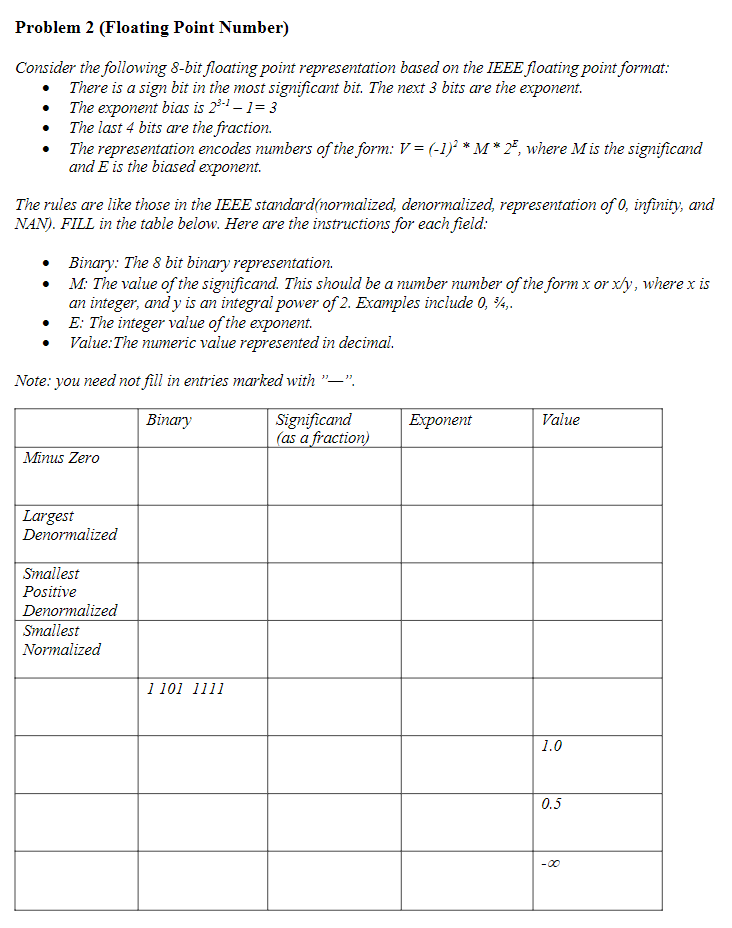
Problem 2 (Floating Point Number) Consider the following 8-bit floating point representation based on the IEEE floating point format: - There is a sign bit in the most significant bit. The next 3 bits are the exponent. - The exponent bias is 2311=3 - The last 4 bits are the fraction. - The representation encodes numbers of the form: V=(1)2M2E, where M is the significand and E is the biased exponent. The rules are like those in the IEEE standard(normalized, denormalized, representation of 0 , infinity, and NAN). FILL in the table below. Here are the instructions for each field: - Binary: The 8 bit binary representation. - M: The value of the significand. This should be a number number of the form x or x/y, where x is an integer, and y is an integral power of 2. Examples include 0,3/4, . - E: The integer value of the exponent. - Value:The numeric value represented in decimal. Note: you need not fill in entries marked with
Step by Step Solution
There are 3 Steps involved in it

Get step-by-step solutions from verified subject matter experts
 Study Help