







Question: please help in above question based on case study below.Thanks for any kind of help. Questions 1. Critically evaluate the reasons influencing ONGC's international expansion.
please help in above question based on case study below.Thanks for any kind of help.
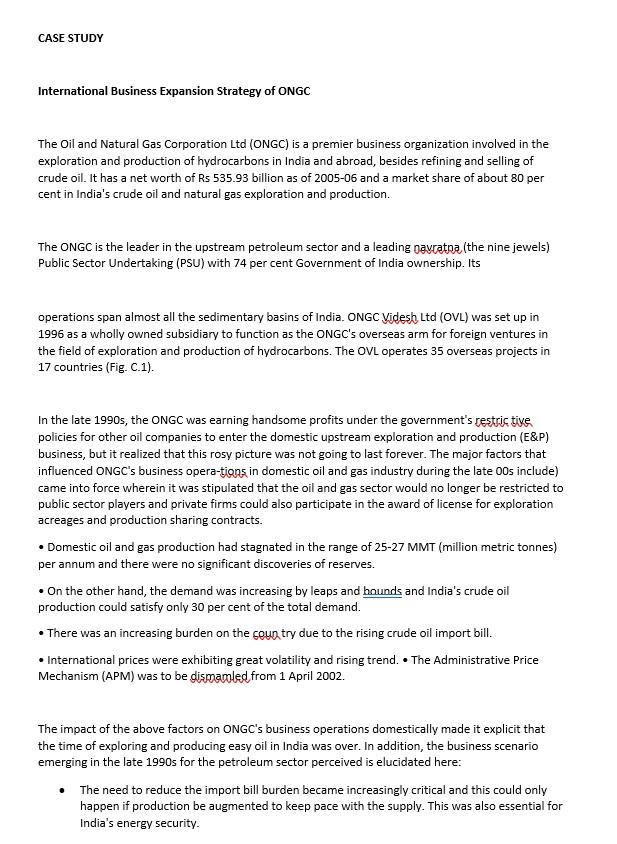
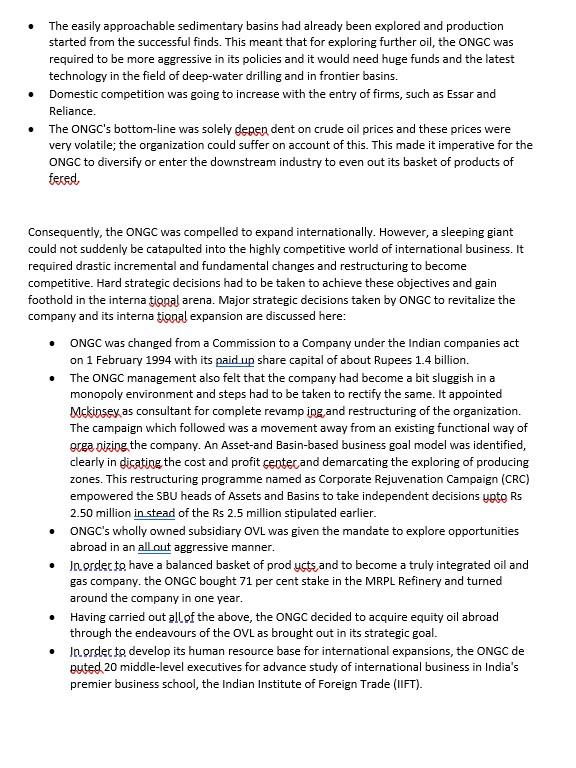
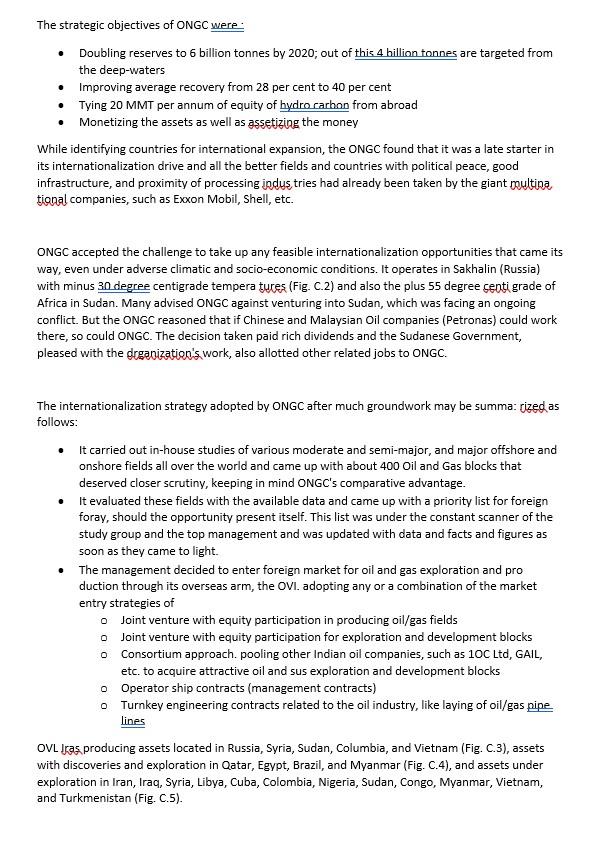
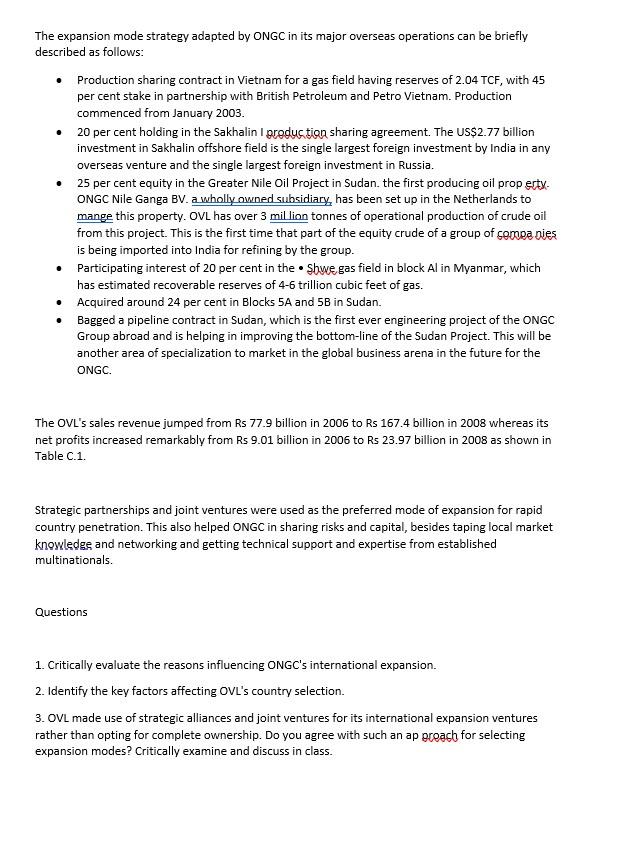
Questions 1. Critically evaluate the reasons influencing ONGC's international expansion. CASE STUDY International Business Expansion Strategy of ONGC The Oil and Natural Gas Corporation Ltd (ONGC) is a premier business organization involved in the exploration and production of hydrocarbons in India and abroad, besides refining and selling of crude oil. It has a net worth of Rs 535.93 billion as of 2005-06 and a market share of about 80 per cent in India's crude oil and natural gas exploration and production. The ONGC is the leader in the upstream petroleum sector and a leading davratna (the nine jewels) Public Sector Undertaking (PSU) with 74 per cent Government of India ownership. Its operations span almost all the sedimentary basins of India. ONGC Videsh Ltd (OVL) was set up in 1996 as a wholly owned subsidiary to function as the ONGC's overseas arm for foreign ventures in the field of exploration and production of hydrocarbons. The OVL operates 35 overseas projects in 17 countries (Fig. C.1). In the late 1990s, the ONGC was earning handsome profits under the government's restrictive policies for other oil companies to enter the domestic upstream exploration and production (E&P) business, but it realized that this rosy picture was not going to last forever. The major factors that influenced ONGC's business opera-tions in domestic oil and gas industry during the late Os include) came into force wherein it was stipulated that the oil and gas sector would no longer be restricted to public sector players and private firms could also participate in the award of license for exploration acreages and production sharing contracts. Domestic oil and gas production had stagnated in the range of 25-27 MMT (million metric tonnes) per annum and there were no significant discoveries of reserves. . On the other hand, the demand was increasing by leaps and bounds and India's crude oil production could satisfy only 30 per cent of the total demand. . There was an increasing burden on the country due to the rising crude oil import bill. International prices were exhibiting great volatility and rising trend. The Administrative Price Mechanism (APM) was to be dismanled from 1 April 2002. The impact of the above factors on ONGC's business operations domestically made it explicit that the time of exploring and producing easy oil in India was over. In addition, the business scenario emerging in the late 1990s for the petroleum sector perceived is elucidated here: The need to reduce the import bill burden became increasingly critical and this could only happen if production be augmented to keep pace with the supply. This was also essential for India's energy security. The easily approachable sedimentary basins had already been explored and production started from the successful finds. This meant that for exploring further oil, the ONGC was required to be more aggressive in its policies and it would need huge funds and the latest technology in the field of deep-water drilling and in frontier basins. Domestic competition was going to increase with the entry of firms, such as Essar and Reliance. The ONGC's bottom-line was solely dependent on crude oil prices and these prices were very volatile; the organization could suffer on account of this. This made it imperative for the ONGC to diversify or enter the downstream industry to even out its basket of products of fered Consequently, the ONGC was compelled to expand internationally. However, a sleeping giant could not suddenly be catapulted into the highly competitive world of international business. It required drastic incremental and fundamental changes and restructuring to become competitive. Hard strategic decisions had to be taken to achieve these objectives and gain foothold in the international arena. Major strategic decisions taken by ONGC to revitalize the company and its interna tional expansion are discussed here: ONGC was changed from a Commission to a Company under the Indian companies act on 1 February 1994 with its paid up share capital of about Rupees 1.4 billion. The ONGC management also felt that the company had become a bit sluggish in a monopoly environment and steps had to be taken to rectify the same. It appointed Mckinsex as consultant for complete revamping and restructuring of the organization. The campaign which followed was a movement away from an existing functional way of orga nizing the company. An Asset-and Basin-based business goal model was identified, clearly in dicating the cost and profit centec and demarcating the exploring of producing zones. This restructuring programme named as Corporate Rejuvenation Campaign (CRC) empowered the SBU heads of Assets and Basins to take independent decisions upto Rs 2.50 million instead of the Rs 2.5 million stipulated earlier. ONGC's wholly owned subsidiary OVL was given the mandate to explore opportunities abroad in an all out aggressive manner. In order to have a balanced basket of products and to become a truly integrated oil and gas company, the ONGC bought 71 per cent stake in the MRPL Refinery and turned around the company in one year. Having carried out all of the above, the ONGC decided to acquire equity oil abroad through the endeavours of the OVL as brought out in its strategic goal. In order to develop its human resource base for international expansions, the ONGC de puted 20 middle-level executives for advance study of international business in India's premier business school, the Indian Institute of Foreign Trade (IIFT). The strategic objectives of ONGC were: Doubling reserves to 6 billion tonnes by 2020; out of this 4 billion tonnes are targeted from the deep-waters Improving average recovery from 28 per cent to 40 per cent Tying 20 MMT per annum of equity of hydrocarbon from abroad Monetizing the assets as well as assetizing the money While identifying countries for international expansion, the ONGC found that it was a late starter in its internationalization drive and all the better fields and countries with political peace, good infrastructure, and proximity of processing industries had already been taken by the giant multina tional companies, such as Exxon Mobil, Shell, etc. ONGC accepted the challenge to take up any feasible internationalization opportunities that came its way, even under adverse climatic and socio-economic conditions. It operates in Sakhalin (Russia) with minus 30 degree centigrade temperatures (Fig. c.2) and also the plus 55 degree centi grade of Africa in Sudan. Many advised ONGC against venturing into Sudan, which was facing an ongoing conflict. But the ONGC reasoned that if Chinese and Malaysian oil companies (Petronas) could work there, so could ONGC. The decision taken paid rich dividends and the Sudanese Government, pleased with the drganization's work, also allotted other related jobs to ONGC. The internationalization strategy adopted by ONGC after much groundwork may be summa: rized as follows: It carried out in-house studies of various moderate and semi-major, and major offshore and onshore fields all over the world and came up with about 400 Oil and Gas blocks that deserved closer scrutiny, keeping in mind ONGC's comparative advantage. It evaluated these fields with the available data and came up with a priority list for foreign foray, should the opportunity present itself. This list was under the constant scanner of the study group and the top management and was updated with data and facts and figures as soon as they came to light. The management decided to enter foreign market for oil and gas exploration and pro duction through its overseas arm, the OVI. adopting any or a combination of the market entry strategies of o Joint venture with equity participation in producing oil/gas fields Joint venture with equity participation for exploration and development blocks o Consortium approach. pooling other Indian oil companies, such as 10C Ltd, GAIL, etc. to acquire attractive oil and sus exploration and development blocks o Operator ship contracts (management contracts) o Turnkey engineering contracts related to the oil industry, like laying of oil/gas pipe lines OVL Iras producing assets located in Russia, Syria, Sudan, Columbia, and Vietnam (Fig. C.3), assets with discoveries and exploration in Qatar, Egypt, Brazil, and Myanmar (Fig. C.4), and assets under exploration in Iran, Iraq, Syria, Libya, Cuba, Colombia, Nigeria, Sudan, Congo, Myanmar, Vietnam, and Turkmenistan (Fig. C.5). 0 The expansion mode strategy adapted by ONGC in its major overseas operations can be briefly described as follows: Production sharing contract in Vietnam for a gas field having reserves of 2.04 TCF, with 45 per cent stake in partnership with British Petroleum and Petro Vietnam. Production commenced from January 2003. 20 per cent holding in the Sakhalin I production sharing agreement. The US$2.77 billion investment in Sakhalin offshore field is the single largest foreign investment by India in any overseas venture and the single largest foreign investment in Russia. 25 per cent equity in the Greater Nile Oil Project in Sudan. the first producing oil property ONGC Nile Ganga BV. a wholly owned subsidiary has been set up in the Netherlands to mange this property. OVL has over 3 million tonnes of operational production of crude oil from this project. This is the first time that part of the equity crude of a group of companies is being imported into India for refining by the group. Participating interest of 20 per cent in the Shwe gas field in block Al in Myanmar, which has estimated recoverable reserves of 4-6 trillion cubic feet of gas. Acquired around 24 per cent in Blocks 5A and 5B in Sudan. Bagged a pipeline contract in Sudan, which is the first ever engineering project of the ONGC Group abroad and is helping in improving the bottom-line of the Sudan Project. This will be another area of specialization to market in the global business arena in the future for the ONGC. The OVL's sales revenue jumped from Rs 77.9 billion in 2006 to Rs 167.4 billion in 2008 whereas its net profits increased remarkably from Rs 9.01 billion in 2006 to Rs 23.97 billion in 2008 as shown in Table C.1. Strategic partnerships and joint ventures were used as the preferred mode of expansion for rapid country penetration. This also helped ONGC in sharing risks and capital, besides taping local market knowledge and networking and getting technical support and expertise from established multinationals. Questions 1. Critically evaluate the reasons influencing ONGC's international expansion. 2. Identify the key factors affecting OVL's country selection. 3. OVL made use of strategic alliances and joint ventures for its international expansion ventures rather than opting for complete ownership. Do you agree with such an ap ecoach for selecting expansion modes? Critically examine and discuss in class
Step by Step Solution
There are 3 Steps involved in it
1 Expert Approved Answer
Step: 1 Unlock

Question Has Been Solved by an Expert!
Get step-by-step solutions from verified subject matter experts
Step: 2 Unlock
Step: 3 Unlock
 Study Help