



Question: please help! less than 10 hours left! thank you! 4. Calculate the change in energy for each transition, nk=3,4,5,6 and nc=2. Show your work and
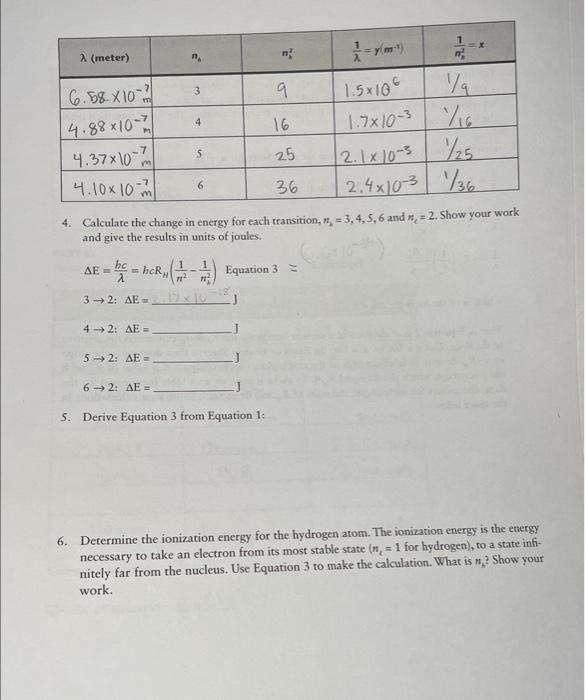
4. Calculate the change in energy for each transition, nk=3,4,5,6 and nc=2. Show your work and give the results in units of joules. E=bc=bcRH(n21n21)Equation3=32:E=3JJ42:E=52:E=62:E= 5. Derive Equation 3 from Equation 1: 6. Determine the ionization energy for the hydrogen atom. The ionization energy is the energy necessary to take an electron from its most stable state ( nc=1 for hydrogen), to a state infinitely far from the nucleus. Use Equation 3 to make the calculation. What is nh ? Show your work. 4. Calculate the change in energy for each transition, nk=3,4,5,6 and nc=2. Show your work and give the results in units of joules. E=bc=bcRH(n21n21)Equation3=32:E=3JJ42:E=52:E=62:E= 5. Derive Equation 3 from Equation 1: 6. Determine the ionization energy for the hydrogen atom. The ionization energy is the energy necessary to take an electron from its most stable state ( nc=1 for hydrogen), to a state infinitely far from the nucleus. Use Equation 3 to make the calculation. What is nh ? Show your work
Step by Step Solution
There are 3 Steps involved in it

Get step-by-step solutions from verified subject matter experts