



Question: please help me and give me the full answer At the end of June, the manager of the B.C. manufacturing factory was provided with the
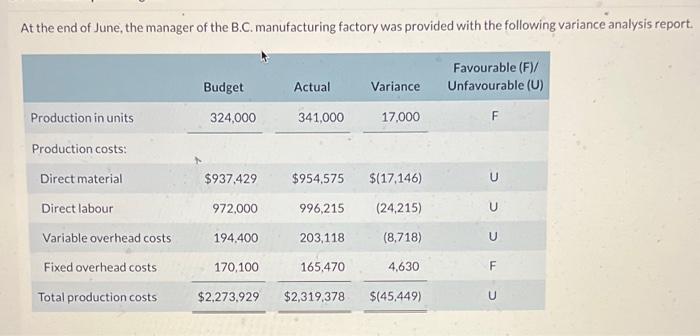
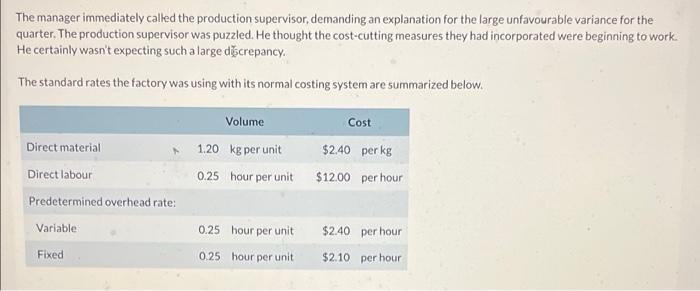
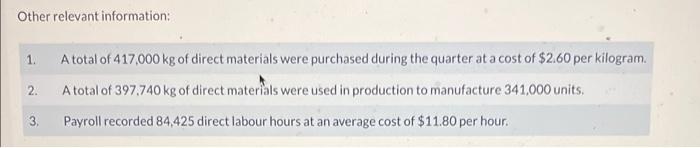
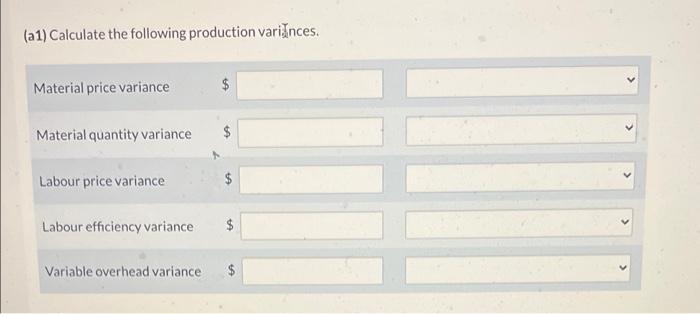
At the end of June, the manager of the B.C. manufacturing factory was provided with the following variance analysis report. Favourable (F)/ Unfavourable (U) Budget Actual Variance Production in units 324,000 341,000 17,000 F $937,429 $954,575 $(17,146) U Production costs: Direct material Direct labour Variable overhead costs Fixed overhead costs 972.000 996,215 (24,215) U 194.400 203.118 (8,718) 170,100 165,470 4,630 F Total production costs $2,273,929 $2,319,378 $145,449) The manager immediately called the production supervisor, demanding an explanation for the large unfavourable variance for the quarter. The production supervisor was puzzled. He thought the cost cutting measures they had incorporated were beginning to work He certainly wasn't expecting such a large discrepancy. The standard rates the factory was using with its normal costing system are summarized below. Volume 1.20 kg per unit 0.25 hour per unit Cost $2.40 per kg $12.00 per hour Direct material Direct labour Predetermined overhead rate: Variable 0.25 hour per unit $2.40 per ho Fixed 0.25 hour per unit $2.10 per hour Other relevant information: 1. 2. A total of 417,000 kg of direct materials were purchased during the quarter at a cost of $2.60 per kilogram A total of 397,740 kg of direct materials were used in production to manufacture 341,000 units, Payroll recorded 84,425 direct labour hours at an average cost of $11.80 per hour. 3 (a1) Calculate the following production variances. Material price variance $ Material quantity variance Labour price variance $ $ Labour efficiency variance
Step by Step Solution
There are 3 Steps involved in it

Get step-by-step solutions from verified subject matter experts