







Question: please help me draw the entity relationship diamgrs for these scenarios. there isnt any more info the comments jeep saying more info but there isnt
please help me draw the entity relationship diamgrs for these scenarios. 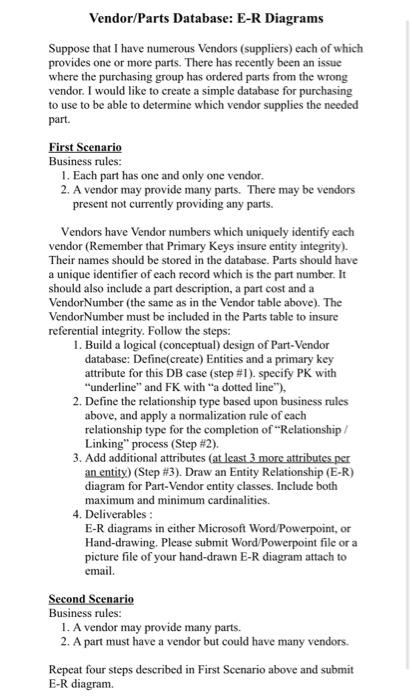
there isnt any more info
the comments jeep saying more info but there isnt any more
Vendor/Parts Database: E-R Diagrams Suppose that I have numerous Vendors (suppliers) each of which provides one or more parts. There has recently been an issue where the purchasing group has ordered parts from the wrong vendor. I would like to create a simple database for purchasing to use to be able to determine which vendor supplies the needed part. First Scenario Business rules: 1. Each part has one and only one vendor. 2. A vendor may provide many parts. There may be vendors present not currently providing any parts. Vendors have Vendor numbers which uniquely identify each vendor (Remember that Primary Keys insure entity integrity). Their names should be stored in the database. Parts should have a unique identifier of each record which is the part number. It should also include a part description, a part cost and a VendorNumber (the same as in the Vendor table above). The Vendor Number must be included in the Parts table to insure referential integrity. Follow the steps: 1. Build a logical (conceptual) design of Part-Vendor database: Define(create) Entities and a primary key attribute for this DB case (step #1). specify PK with "underline" and FK with "a dotted line"), 2. Define the relationship type based upon business rules above, and apply a normalization rule of each relationship type for the completion of "Relationship Linking process (Step #2). 3. Add additional attributes (at least 3 more attributes per an entity) (Step #3). Draw an Entity Relationship (E-R) diagram for Part-Vendor entity classes. Include both maximum and minimum cardinalities. 4. Deliverables: E-R diagrams in either Microsoft Word/Powerpoint, or Hand-drawing, Please submit Word/Powerpoint file or a picture file of your hand-drawn E-R diagram attach to email. Second Scenario Business rules: 1. A vendor may provide many parts. 2. A part must have a vendor but could have many vendors. Repeat four steps described in First Scenario above and submit E-R diagram Vendor/Parts Database: E-R Diagrams Suppose that I have numerous Vendors (suppliers) each of which provides one or more parts. There has recently been an issue where the purchasing group has ordered parts from the wrong vendor. I would like to create a simple database for purchasing to use to be able to determine which vendor supplies the needed part. First Scenario Business rules: 1. Each part has one and only one vendor. 2. A vendor may provide many parts. There may be vendors present not currently providing any parts. Vendors have Vendor numbers which uniquely identify each vendor (Remember that Primary Keys insure entity integrity). Their names should be stored in the database. Parts should have a unique identifier of each record which is the part number. It should also include a part description, a part cost and a VendorNumber (the same as in the Vendor table above). The Vendor Number must be included in the Parts table to insure referential integrity. Follow the steps: 1. Build a logical (conceptual) design of Part-Vendor database: Define(create) Entities and a primary key attribute for this DB case (step #1). specify PK with "underline" and FK with "a dotted line"), 2. Define the relationship type based upon business rules above, and apply a normalization rule of each relationship type for the completion of "Relationship Linking process (Step #2). 3. Add additional attributes (at least 3 more attributes per an entity) (Step #3). Draw an Entity Relationship (E-R) diagram for Part-Vendor entity classes. Include both maximum and minimum cardinalities. 4. Deliverables: E-R diagrams in either Microsoft Word/Powerpoint, or Hand-drawing, Please submit Word/Powerpoint file or a picture file of your hand-drawn E-R diagram attach to email. Second Scenario Business rules: 1. A vendor may provide many parts. 2. A part must have a vendor but could have many vendors. Repeat four steps described in First Scenario above and submit E-R diagram
Step by Step Solution
There are 3 Steps involved in it
1 Expert Approved Answer
Step: 1 Unlock

Question Has Been Solved by an Expert!
Get step-by-step solutions from verified subject matter experts
Step: 2 Unlock
Step: 3 Unlock
 Study Help