







Question: Please help me to solve this lab, After watching the video and following... The video, and lab instructions from the instructions sheet, we have to
Please help me to solve this lab, After watching the video and following... The video, and lab instructions from the instructions sheet, we have to fill the data sheet ... It will be a great help for me. Thank You!
https://www.youtube.com/watch?v=I4u_1ST7Ezk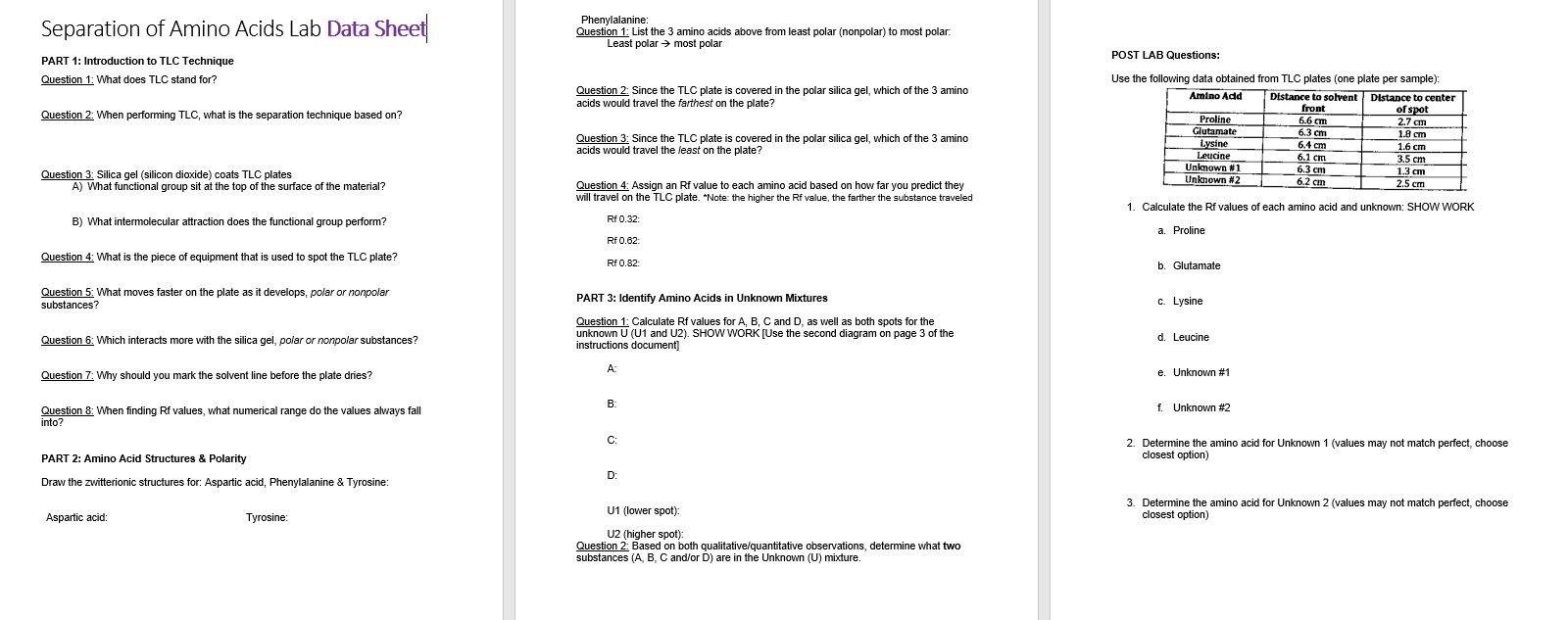
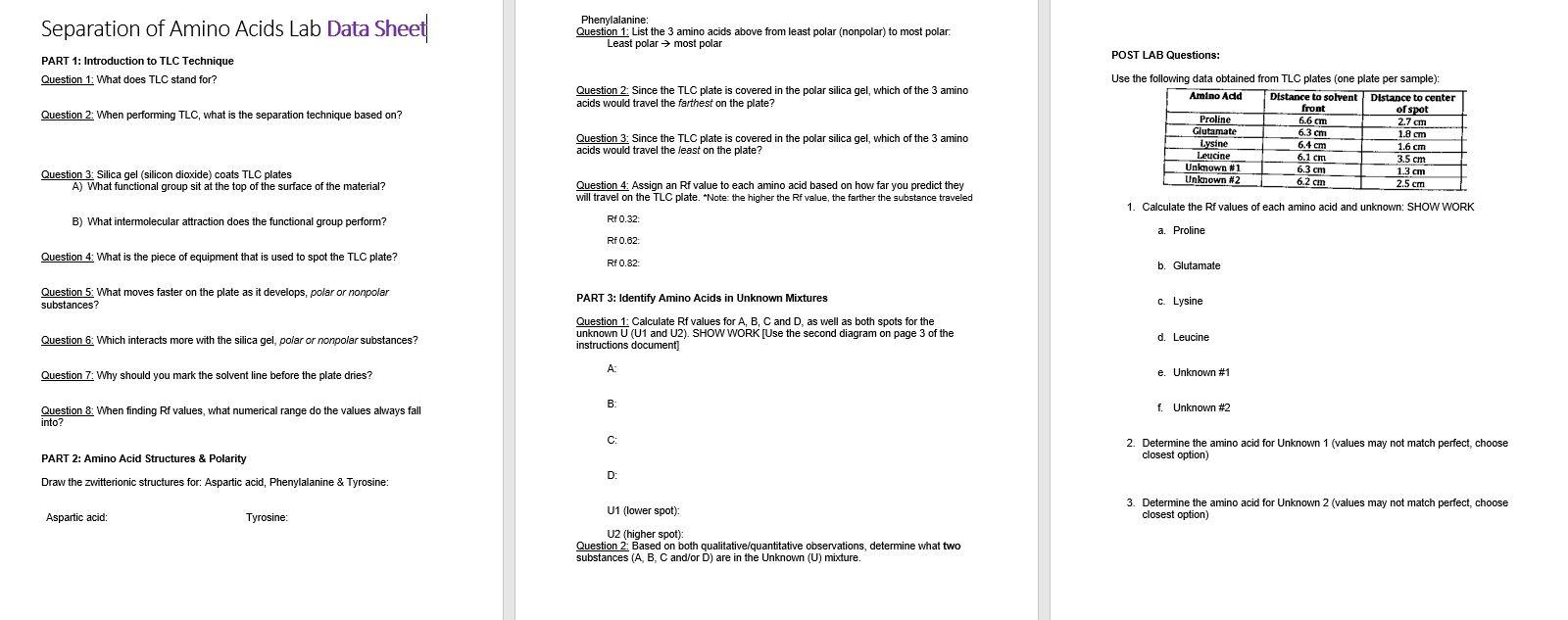
Separation of Amino Acids Lab Data Sheet Phenylalanine: Phenylalanine: Question 1: List the 3 amino acids above from least polar (nonpolar) to most polar. Least polar most polar PART 1: Introduction to TLC Technique Question 1: What does TLC stand for? Least polar most polar POST LAB Questions: Use the following data obtained from TLC plates (one plate per sample): Question 2: When performing TLC, what is the separation technique based on? Question 2: Since the TLC plate is covered in the polar silica gel, which of the 3 amino acids would travel the farthest on the plate? Question 3: Since the TLC plate is covered in the polar silica gel, which of the 3 amino acids would travel the least on the plate? Question 3: Silica gel (silicon dioxide) coats TLC plates What functional group sit at the top of the surface of the material? Question 4: Assign an Rf value to each amino acid based on how far you predict they will travel on the TLC plate. "Note: the higher the Rf value, the farther the substance traveled B) What intermolecular attraction does the functional group perform? Question 4: What is the piece of equipment that is used to spot the TLC plate? Question 5: What moves faster on the plate as it develops, polar or nonpolar substances? Question 1: Calculate Rf values for A, B, C and D, as well as both spots for the unknown U (U1 and U2). SHOW WORK [Use the second diagram on page 3 of the 1. Calculate the Rf values of each amino acid and unknown: SHOW WORK Question 6: Which interacts more with the silica gel, polar or nonpolar substances? Question 7: Why should you mark the solvent line before the plate dries? Question 8 : When finding Rf values, what numerical range do the values aluays fall into? instructions document] 1. Proline PART 2: Amino Acid Structures \& Polarity Draw the zvitterionic structures for: Aspartic acid, Phenylalanine \& Tyrosine: A: D: U1 (lower spot): Q2 (higher spot): Question 2: Based on both qualitative/quantitative observations, determine what two substances (A, B, C and/or D) are in the Unknown (U) mixture. 2. Determine the amino acid for Unknown 1 (values may not match perfect, choose closest option) 3. Determine the amino acid for Unknown 2 (values may not match perfect, choose closest option) closest option) Separation of Amino Acids Lab Data Sheet Phenylalanine: Phenylalanine: Question 1: List the 3 amino acids above from least polar (nonpolar) to most polar. Least polar most polar PART 1: Introduction to TLC Technique Question 1: What does TLC stand for? Least polar most polar POST LAB Questions: Use the following data obtained from TLC plates (one plate per sample): Question 2: When performing TLC, what is the separation technique based on? Question 2: Since the TLC plate is covered in the polar silica gel, which of the 3 amino acids would travel the farthest on the plate? Question 3: Since the TLC plate is covered in the polar silica gel, which of the 3 amino acids would travel the least on the plate? Question 3: Silica gel (silicon dioxide) coats TLC plates What functional group sit at the top of the surface of the material? Question 4: Assign an Rf value to each amino acid based on how far you predict they will travel on the TLC plate. "Note: the higher the Rf value, the farther the substance traveled B) What intermolecular attraction does the functional group perform? Question 4: What is the piece of equipment that is used to spot the TLC plate? Question 5: What moves faster on the plate as it develops, polar or nonpolar substances? Question 1: Calculate Rf values for A, B, C and D, as well as both spots for the unknown U (U1 and U2). SHOW WORK [Use the second diagram on page 3 of the 1. Calculate the Rf values of each amino acid and unknown: SHOW WORK Question 6: Which interacts more with the silica gel, polar or nonpolar substances? Question 7: Why should you mark the solvent line before the plate dries? Question 8 : When finding Rf values, what numerical range do the values aluays fall into? instructions document] 1. Proline PART 2: Amino Acid Structures \& Polarity Draw the zvitterionic structures for: Aspartic acid, Phenylalanine \& Tyrosine: A: D: U1 (lower spot): Q2 (higher spot): Question 2: Based on both qualitative/quantitative observations, determine what two substances (A, B, C and/or D) are in the Unknown (U) mixture. 2. Determine the amino acid for Unknown 1 (values may not match perfect, choose closest option) 3. Determine the amino acid for Unknown 2 (values may not match perfect, choose closest option) closest option) Separation of Amino Acids Lab Data Sheet Phenylalanine: Phenylalanine: Question 1: List the 3 amino acids above from least polar (nonpolar) to most polar. Least polar most polar PART 1: Introduction to TLC Technique Question 1: What does TLC stand for? Least polar most polar POST LAB Questions: Use the following data obtained from TLC plates (one plate per sample): Question 2: When performing TLC, what is the separation technique based on? Question 2: Since the TLC plate is covered in the polar silica gel, which of the 3 amino acids would travel the farthest on the plate? Question 3: Since the TLC plate is covered in the polar silica gel, which of the 3 amino acids would travel the least on the plate? Question 3: Silica gel (silicon dioxide) coats TLC plates What functional group sit at the top of the surface of the material? Question 4: Assign an Rf value to each amino acid based on how far you predict they will travel on the TLC plate. "Note: the higher the Rf value, the farther the substance traveled B) What intermolecular attraction does the functional group perform? Question 4: What is the piece of equipment that is used to spot the TLC plate? Question 5: What moves faster on the plate as it develops, polar or nonpolar substances? Question 1: Calculate Rf values for A, B, C and D, as well as both spots for the unknown U (U1 and U2). SHOW WORK [Use the second diagram on page 3 of the 1. Calculate the Rf values of each amino acid and unknown: SHOW WORK Question 6: Which interacts more with the silica gel, polar or nonpolar substances? Question 7: Why should you mark the solvent line before the plate dries? Question 8 : When finding Rf values, what numerical range do the values aluays fall into? instructions document] 1. Proline PART 2: Amino Acid Structures \& Polarity Draw the zvitterionic structures for: Aspartic acid, Phenylalanine \& Tyrosine: A: D: U1 (lower spot): Q2 (higher spot): Question 2: Based on both qualitative/quantitative observations, determine what two substances (A, B, C and/or D) are in the Unknown (U) mixture. 2. Determine the amino acid for Unknown 1 (values may not match perfect, choose closest option) 3. Determine the amino acid for Unknown 2 (values may not match perfect, choose closest option) closest option) Separation of Amino Acids Lab Data Sheet Phenylalanine: Phenylalanine: Question 1: List the 3 amino acids above from least polar (nonpolar) to most polar. Least polar most polar PART 1: Introduction to TLC Technique Question 1: What does TLC stand for? Least polar most polar POST LAB Questions: Use the following data obtained from TLC plates (one plate per sample): Question 2: When performing TLC, what is the separation technique based on? Question 2: Since the TLC plate is covered in the polar silica gel, which of the 3 amino acids would travel the farthest on the plate? Question 3: Since the TLC plate is covered in the polar silica gel, which of the 3 amino acids would travel the least on the plate? Question 3: Silica gel (silicon dioxide) coats TLC plates What functional group sit at the top of the surface of the material? Question 4: Assign an Rf value to each amino acid based on how far you predict they will travel on the TLC plate. "Note: the higher the Rf value, the farther the substance traveled B) What intermolecular attraction does the functional group perform? Question 4: What is the piece of equipment that is used to spot the TLC plate? Question 5: What moves faster on the plate as it develops, polar or nonpolar substances? Question 1: Calculate Rf values for A, B, C and D, as well as both spots for the unknown U (U1 and U2). SHOW WORK [Use the second diagram on page 3 of the 1. Calculate the Rf values of each amino acid and unknown: SHOW WORK Question 6: Which interacts more with the silica gel, polar or nonpolar substances? Question 7: Why should you mark the solvent line before the plate dries? Question 8 : When finding Rf values, what numerical range do the values aluays fall into? instructions document] 1. Proline PART 2: Amino Acid Structures \& Polarity Draw the zvitterionic structures for: Aspartic acid, Phenylalanine \& Tyrosine: A: D: U1 (lower spot): Q2 (higher spot): Question 2: Based on both qualitative/quantitative observations, determine what two substances (A, B, C and/or D) are in the Unknown (U) mixture. 2. Determine the amino acid for Unknown 1 (values may not match perfect, choose closest option) 3. Determine the amino acid for Unknown 2 (values may not match perfect, choose closest option) closest option)
Step by Step Solution
There are 3 Steps involved in it

Get step-by-step solutions from verified subject matter experts
 Study Help