







Question: Please help me with this assignment. D E F G H Deriving Discount Rates (L1-2) Problem 1 B Using what you learned in Lesson 1,
 Please help me with this assignment.
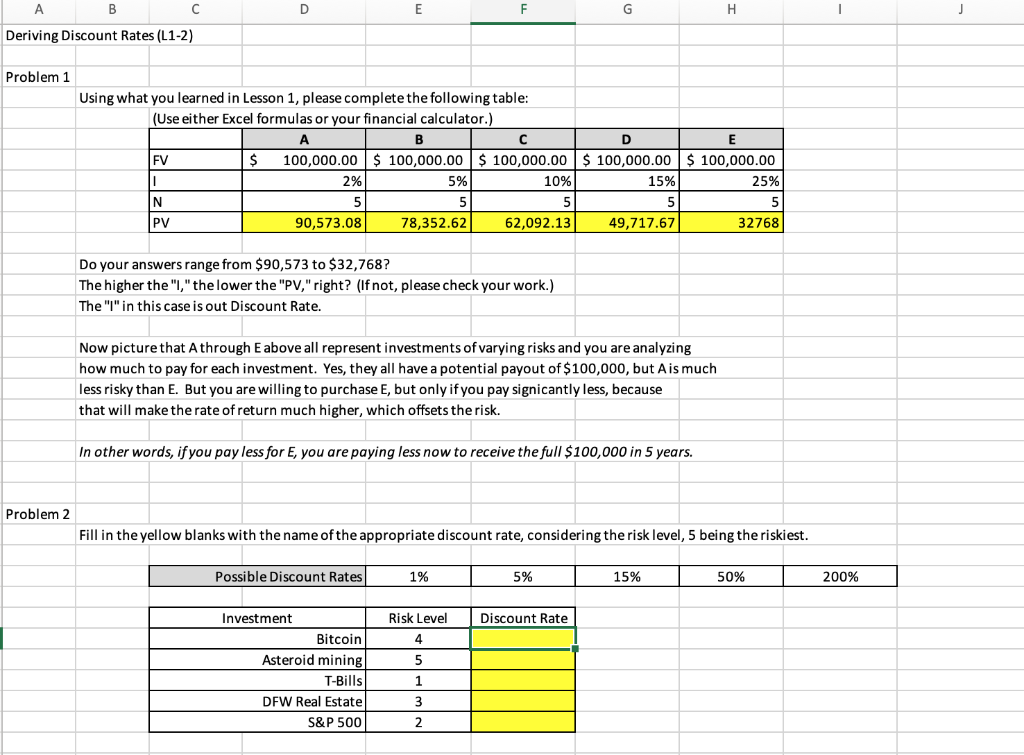
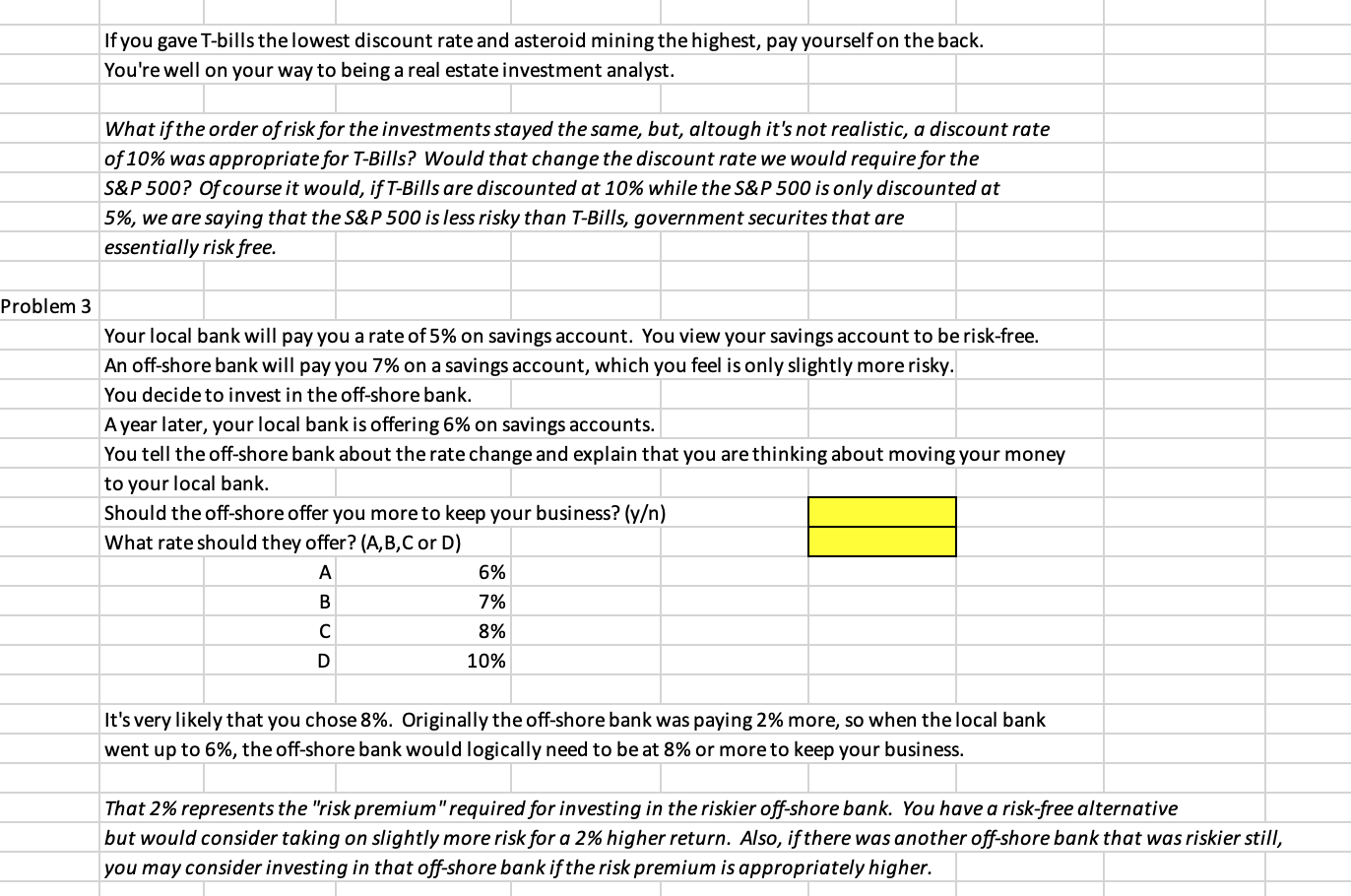
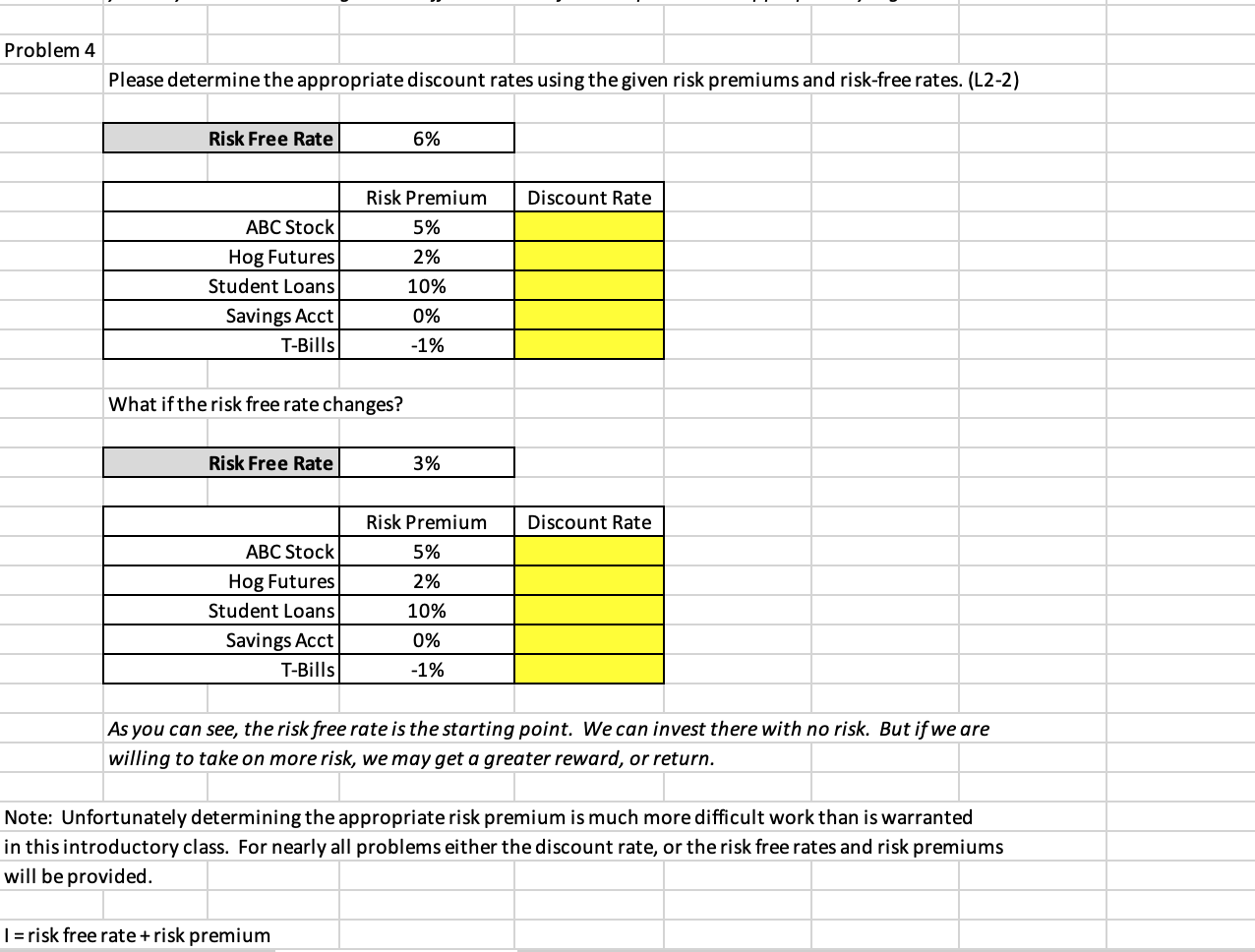
D E F G H Deriving Discount Rates (L1-2) Problem 1 B Using what you learned in Lesson 1, please complete the following table: (Use either Excel formulas or your financial calculator.) A D E FV $ 100,000.00 $ 100,000.00 $ 100,000.00 $ 100,000.00 $ 100,000.00 2% 5% 10% 15% 25% N 5 5 5 5 PV 90,573.08 78,352.62 62,092.13 49,717.67 327681 Do your answers range from $90,573 to $32,768? The higher the","the lower the "PV,"right? (If not, please check your work.) The "l"in this case is out Discount Rate. Now picture that A through E above all represent investments of varying risks and you are analyzing how much to pay for each investment. Yes, they all have a potential payout of $100,000, but Ais much less risky than E. But you are willing to purchase E, but only if you pay signicantly less, because that will make the rate of return much higher, which offsets the risk. In other words, if you pay less for E, you are paying less now to receive the full $100,000 in 5 years. Problem 2 Fill in the yellow blanks with the name of the appropriate discount rate, considering the risk level, 5 being the riskiest. Possible Discount Rates 1% 5% 15% 50% 200% Risk Level Discount Rate 4 5 Investment Bitcoin Asteroid mining T-Bills DFW Real Estate S&P 500 1 3 2 If you gave T-bills the lowest discount rate and asteroid mining the highest, pay yourself on the back. You're well on your way to being a real estate investment analyst. What if the order of risk for the investments stayed the same, but, altough it's not realistic, a discount rate of 10% was appropriate for T-Bills? Would that change the discount rate we would require for the S&P 500? Of course it would, if T-Bills are discounted at 10% while the S&P 500 is only discounted at 5%, we are saying that the S&P 500 is less risky than T-Bills, government securites that are essentially risk free. Problem 3 Your local bank will pay you a rate of 5% on savings account. You view your savings account to be risk-free. An off-shore bank will pay you 7% on a savings account, which you feel is only slightly more risky. You decide to invest in the off-shore bank. A year later, your local bank is offering 6% on savings accounts. You tell the off-shore bank about the rate change and explain that you are thinking about moving your money to your local bank. Should the off-shore offer you more to keep your business? (y) What rate should they offer? (A,B,C or D) A 6% B 7% 8% D 10% It's very likely that you chose 8%. Originally the off-shore bank was paying 2% more, so when the local bank went up to 6%, the off-shore bank would logically need to be at 8% or more to keep your business. That 2% represents the "risk premium" required for investing in the riskier off-shore bank. You have a risk-free alternative but would consider taking on slightly more risk for a 2% higher return. Also, if there was another off-shore bank that was riskier still, you may consider investing in that off-shore bank if the risk premium is appropriately higher. Problem 4 Please determine the appropriate discount rates using the given risk premiums and risk-free rates. (L2-2) Risk Free Rate 6% Discount Rate Risk Premium 5% 2% ABC Stock Hog Futures Student Loans Savings Acct T-Bills 10% 0% -1% What if the risk free rate changes? Risk Free Rate 3% Discount Rate Risk Premium 5% 2% ABC Stock Hog Futures Student Loans Savings Acct T-Bills 10% 0% -1% As you can see, the risk free rate is the starting point. We can invest there with no risk. But if we are willing to take on more risk, we may get a greater reward, or return. Note: Unfortunately determining the appropriate risk premium is much more difficult work than is warranted in this introductory class. For nearly all problems either the discount rate, or the risk free rates and risk premiums will be provided. 1 = risk free rate + risk premium
Step by Step Solution
There are 3 Steps involved in it

Get step-by-step solutions from verified subject matter experts
 Study Help