







Question: Please help me with this question. It is complete question with no missing graph, or other components Problem 2 Consider the following method of dissolving
Please help me with this question. It is complete question with no missing graph, or other components
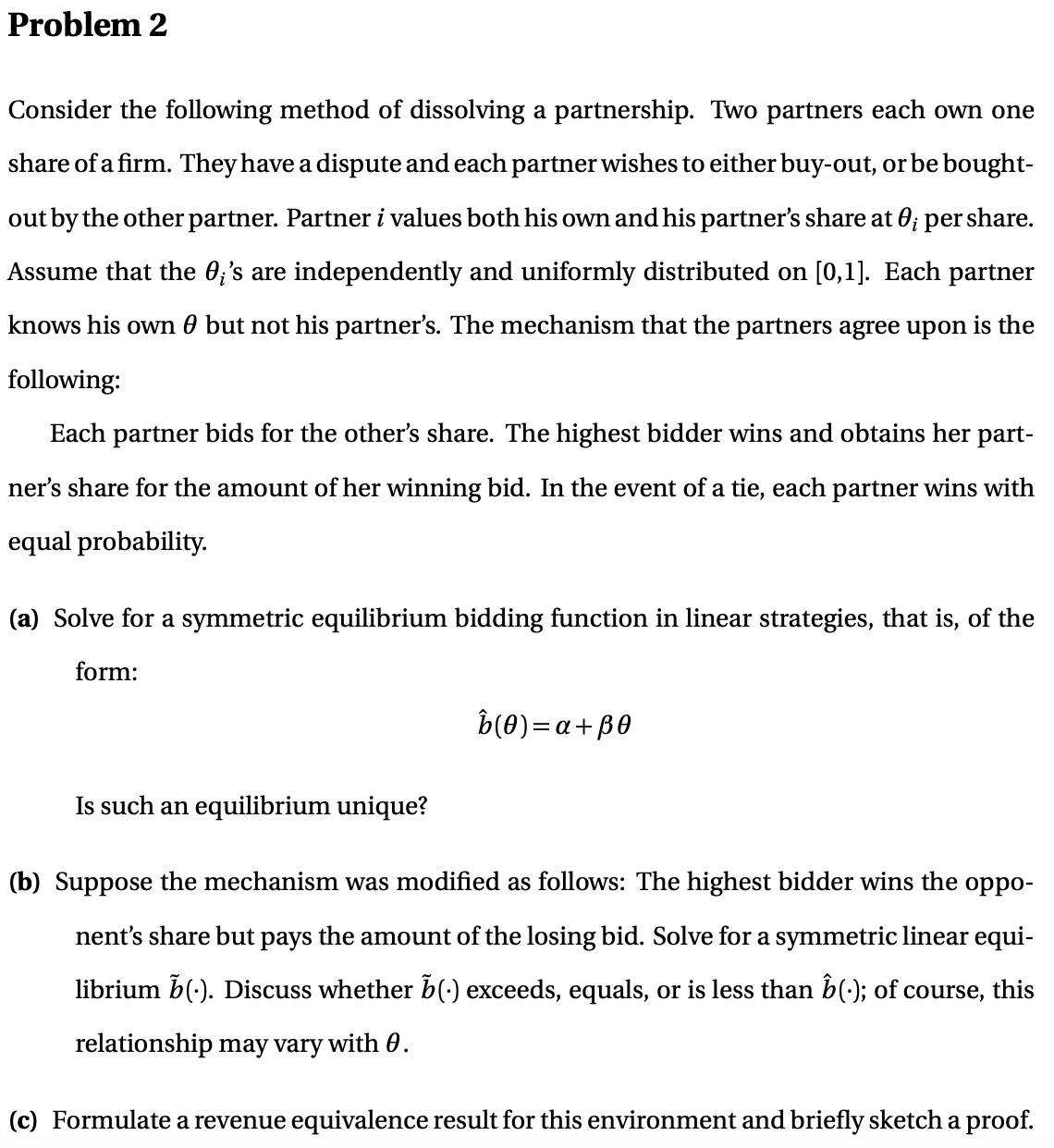
Problem 2 Consider the following method of dissolving a partnership. Two partners each own one share of a rm. They have a dispute and each partner wishes to either buy-out, or be bought- out by the other partner. Partner 1' values both his own and his partner's share at 9,- per share. Assume that the 6,'s are independently and uniformly distributed on [0,1]. Each partner knows his own 9 but not his partner's. The mechanism that the partners agree upon is the following: Each partner bids for the other's share. The highest bidder wins and obtains her part- ner's share for the amount of her winning bid. In the event of a tie, each partner wins with equal probability. (a) Solve for a symmetric equilibrium bidding function in linear strategies, that is, of the form: l} (6) = a + 6 Is such an equilibrium unique? (b) Suppose the mechanism was modied as follows: The highest bidder wins the oppo- nent's share but pays the amount of the losing bid. Solve for a symmetric linear equi- librium 130). Discuss whether 50) exceeds, equals, or is less than fat); of course, this relationship may vary with 6. (c) Formulate a revenue equivalence result for this environment and briey sketch a proof
Step by Step Solution
There are 3 Steps involved in it

Get step-by-step solutions from verified subject matter experts
 Study Help