



Question: Please Help P(A and B) = P(A) - P(B) P(A and B) = P(A) - P(B given A) = P(A) - P(B | A) (equation
Please Help
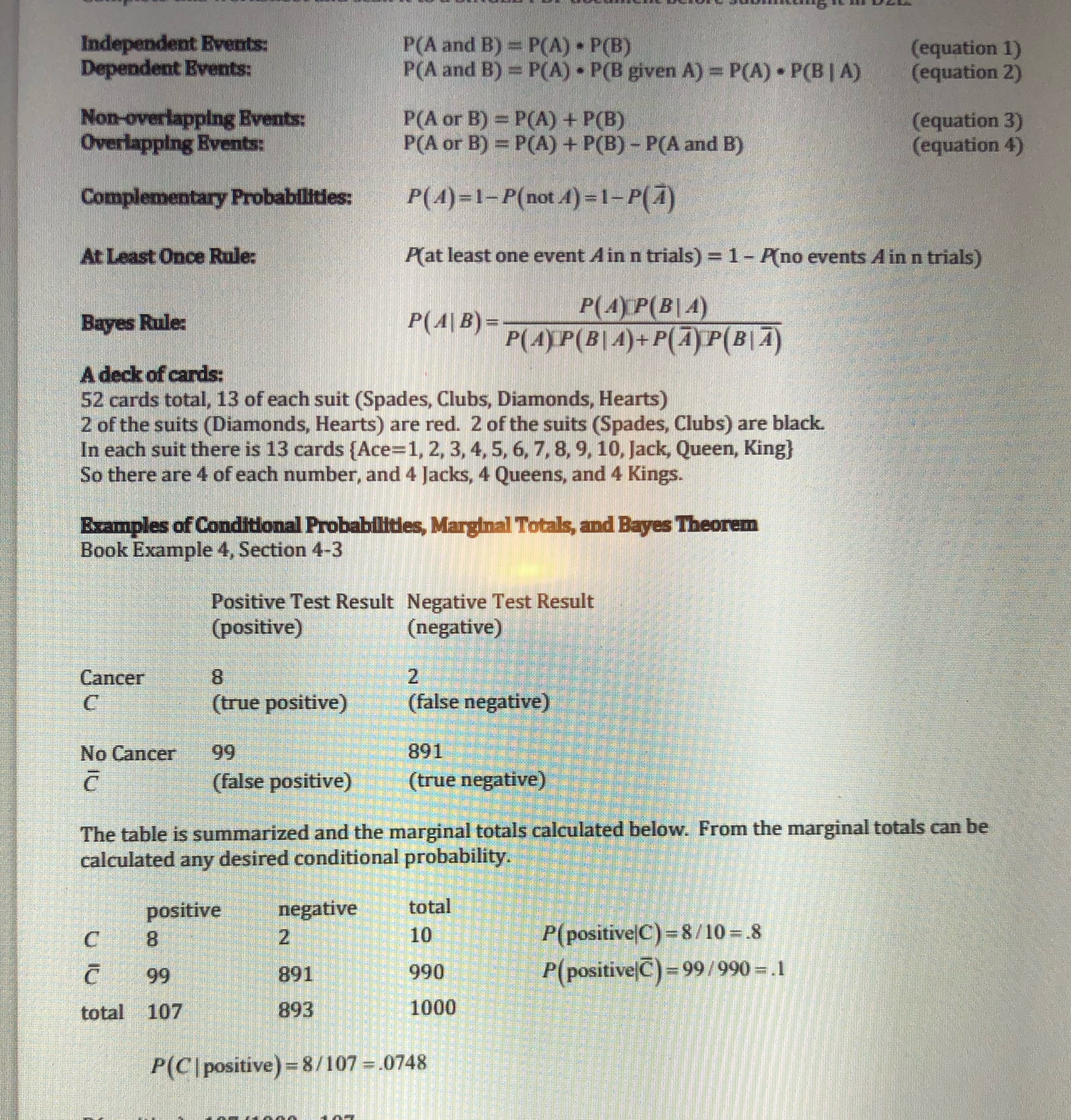
P(A and B) = P(A) - P(B) P(A and B) = P(A) - P(B given A) = P(A) - P(B | A) (equation 1) (equation 2) P(A or B) = P(A) + P(B) P(A or B) = P(A) + P(B) - P(A and B) (equation 3) (equation 4) P( 4)-1-P(not 4) =1-P(1) P(at least one event A in n trials) = 1 - P( no events A in n trials) ayes Rule: P( 4| B) = P( 4) P ( B |4) P( AP ( B | 4) + P( 4) P( B | 4) A deck of cards: 52 cards total, 13 of each suit (Spades, Clubs, Diamonds, Hearts) 2 of the suits (Diamonds, Hearts) are red. 2 of the suits (Spades, Clubs) are black. In each suit there is 13 cards {Ace=1, 2, 3, 4, 5, 6, 7, 8, 9, 10, Jack, Queen, King} e are 4 of each number, and 4 Jacks, 4 Queens, and 4 Kings. samples of Conditional Probabilities, Marginal Totals, and Bayes Theorem Book Example 4, Section 4-3 Positive Test Result Negative Test Result (positive) (negative) Cancer (true positive) ( false negative ) No Cancer 891 (false po (true negativ The table is summarized and the marginal totals calculated below. From the marginal totals can be calculated any desired conditional probability. positive negative total 8 10 (positive C) -8/10 =.8 89 990 (positive C) - 99 /990 =.1 total 107 893 1000 P(C | positive) = 8/107 =.0748
Step by Step Solution
There are 3 Steps involved in it

Get step-by-step solutions from verified subject matter experts