







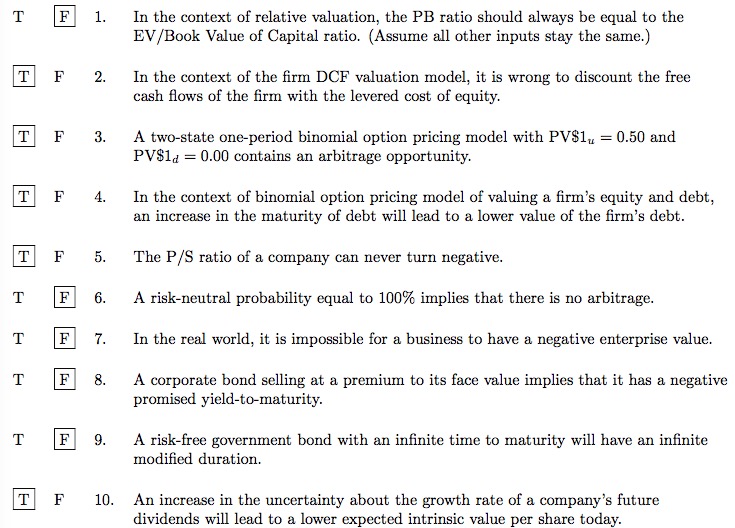
Question: Please help to explain the reason why it is true or false T F 1. In the context of relative valuation, the PB ratio should
Please help to explain the reason why it is true or false
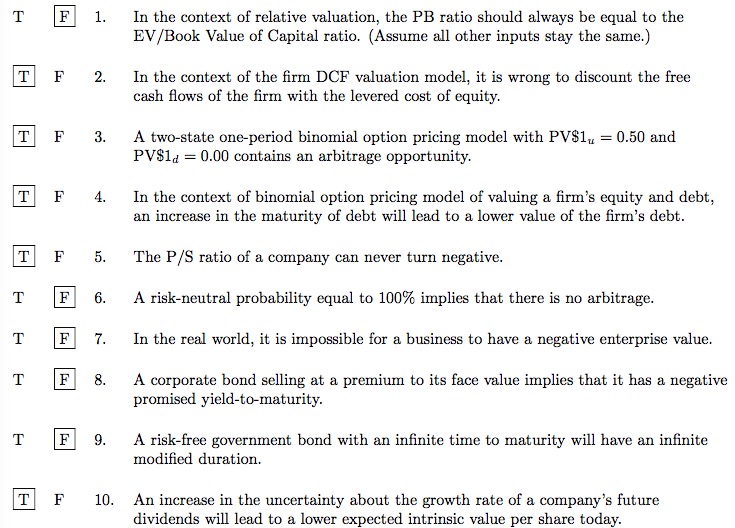
T F 1. In the context of relative valuation, the PB ratio should always be equal to the EV/Book Value of Capital ratio. (Assume all other inputs stay the same.) T F 2. In the context of the firm DCF valuation model, it is wrong to discount the free cash flows of the firm with the levered cost of equity. T F 3. A two-state one-period binomial option pricing model with PV$1, = 0.50 and PV$1 = 0.00 contains an arbitrage opportunity. T F 4. In the context of binomial option pricing model of valuing a firm's equity and debt, an increase in the maturity of debt will lead to a lower value of the firm's debt. T F 5. The P/S ratio of a company can never turn negative. T F 6. A risk-neutral probability equal to 100% implies that there is no arbitrage. T F 7. In the real world, it is impossible for a business to have a negative enterprise value. T F 8. A corporate bond selling at a premium to its face value implies that it has a negative promised yield-to-maturity. T F 9. A risk-free government bond with an infinite time to maturity will have an infinite modified duration. T F 10. An increase in the uncertainty about the growth rate of a company's future dividends will lead to a lower expected intrinsic value per share today
Step by Step Solution
There are 3 Steps involved in it

Get step-by-step solutions from verified subject matter experts
 Study Help