







Question: please help with answer asap Share Comments 12 -- F Times New Roman A A Aa A Aa Bbc AaBbCel ABCD Paste 19 Editing B
please help with answer asap
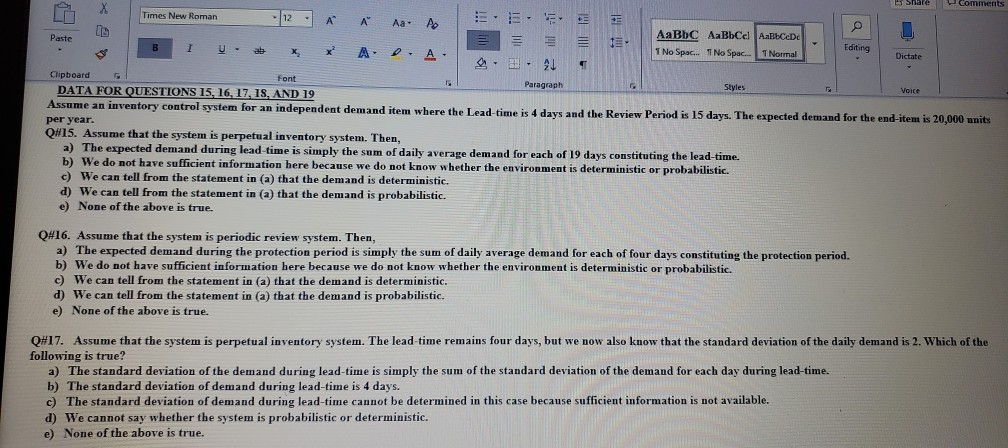
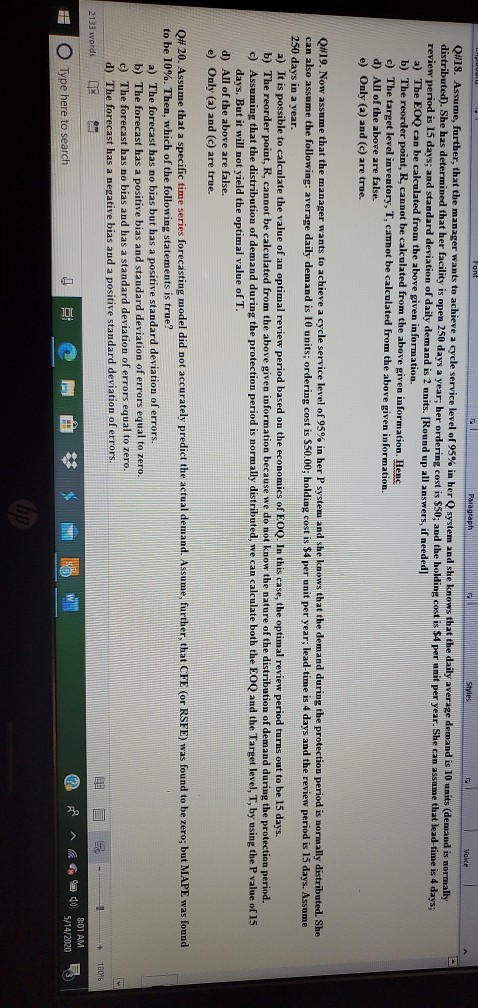
Share Comments 12 -- F Times New Roman A A Aa A Aa Bbc AaBbCel ABCD Paste 19 Editing B x A.D.A. 1 No Spac... T No Spac... 1 Normal Dictate AL Clipboard Font Paragraph Styles Voice DATA FOR QUESTIONS 15, 16, 17, 18, AND 19 Assume an inventory control system for an independent demand item where the Lead time is 4 days and the Review Period is 15 days. The expected demand for the end-item is 20,000 units per year. Q#15. Assume that the system is perpetual inventory system. Then, a) The expected demand during lead time is simply the sum of daily average demand for each of 19 days constituting the lead-time. b) We do not have sufficient information here because we do not know whether the environment is deterministic or probabilistic. c) We can tell from the statement in (a) that the demand is deterministic. d) We can tell from the statement in (a) that the demand is probabilistic. e) None of the above is true. Q#16. Assume that the system is periodic review system. Then, a) The expected demand during the protection period is simply the sum of daily average demand for each of four days constituting the protection period. b) We do not have sufficient information here because we do not know whether the environment is deterministic or probabilistic. c) We can tell from the statement in (a) that the demand is deterministic. d) We can tell from the statement in (a) that the demand is probabilistic. e) None of the above is true. Q#17. Assume that the system is perpetual inventory system. The lead-time remains four days, but we now also know that the standard deviation of the daily demand is 2. Which of the following is true? a) The standard deviation of the demand during lead-time is simply the sum of the standard deviation of the demand for each day during lead-time. b) The standard deviation of demand during lead-time is 4 days. c) The standard deviation of demand during lead-time cannot be determined in this case because sufficient information is not available. d) We cannot say whether the system is probabilistic or deterministic. e) None of the above is true. Volce Paragraph Styles Q#18. Assume, further, that the manager wants to achieve a cycle service level of 95% in her Q system and she knows that the daily average demand is 10 units (demand is normally distributed). She has determined that her facility is open 250 days a year; her ordering cost is $50; and the holding cost is $4 per unit per year. She can assume that lead-time is 4 days; review period is 15 days; and standard deviation of daily demand is 2 units. [Round up all answers, if needed] a) The EOQ can be calculated from the above given information. b) The reorder point, R. cannot be calculated from the above given information. Henc c) The target level inventory, T, cannot be calculated from the above given information. d) All of the above are false. e) Only (a) and (c) are true. Q#19. Now assume that the manager wants to achieve a cycle service level of 95% in her P system and she knows that the demand during the protection period is normally distributed. She can also assume the following: average daily demand is 10 units; ordering cost is $50.00; holding cost is $4 per unit per year; lead-time is 4 days and the review period is 15 days. Assume 250 days in a year. a) It is possible to calculate the value of an optimal review period based on the economics of EOQ. In this case, the optimal review period turns out to be 15 days. b) The reorder point, R, cannot be calculated from the above given information because we do not know the nature of the distribution of demand during the protection period. c) Assuming that the distribution of demand during the protection period is normally distributed, we can calculate both the EOQ and the Target level, T, by using the P value of 15 days. But it will not yield the optimal value of T. d) All of the above are false. e) Only (a) and (c) are true. Q# 20. Assume that a specific time series forecasting model did not accurately predict the actual demand. Assume, further, that CFE (or RSFE) was found to be zero; but MAPE was found to be 10%. Then, which of the following statements is true? a) The forecast has no bias but has a positive standard deviation of errors. b) The forecast has a positive bias and standard deviation of errors equal to zero. c) The forecast has no bias and has a standard deviation of errors equal to zero. d) The forecast has a negative bias and a positive standard deviation of errors. 2133 words LE 8:01 AM Type here to search Om du ce? 5/14/2020 10016 AStep by Step Solution
There are 3 Steps involved in it
1 Expert Approved Answer
Step: 1 Unlock

Question Has Been Solved by an Expert!
Get step-by-step solutions from verified subject matter experts
Step: 2 Unlock
Step: 3 Unlock
 Study Help