







Question: Please help with parts a through e Part 2: In Part 1, we studied the phenomenology of the ozone depletion kinetics, both for the uncatalyzed
 Please help with parts a through e
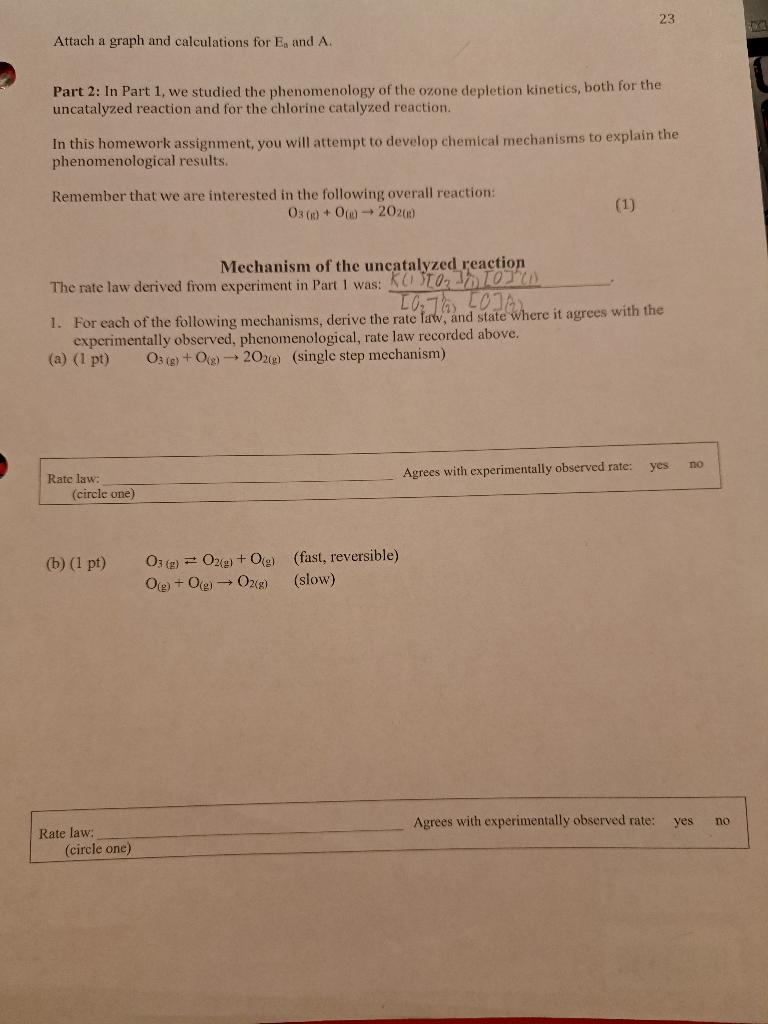
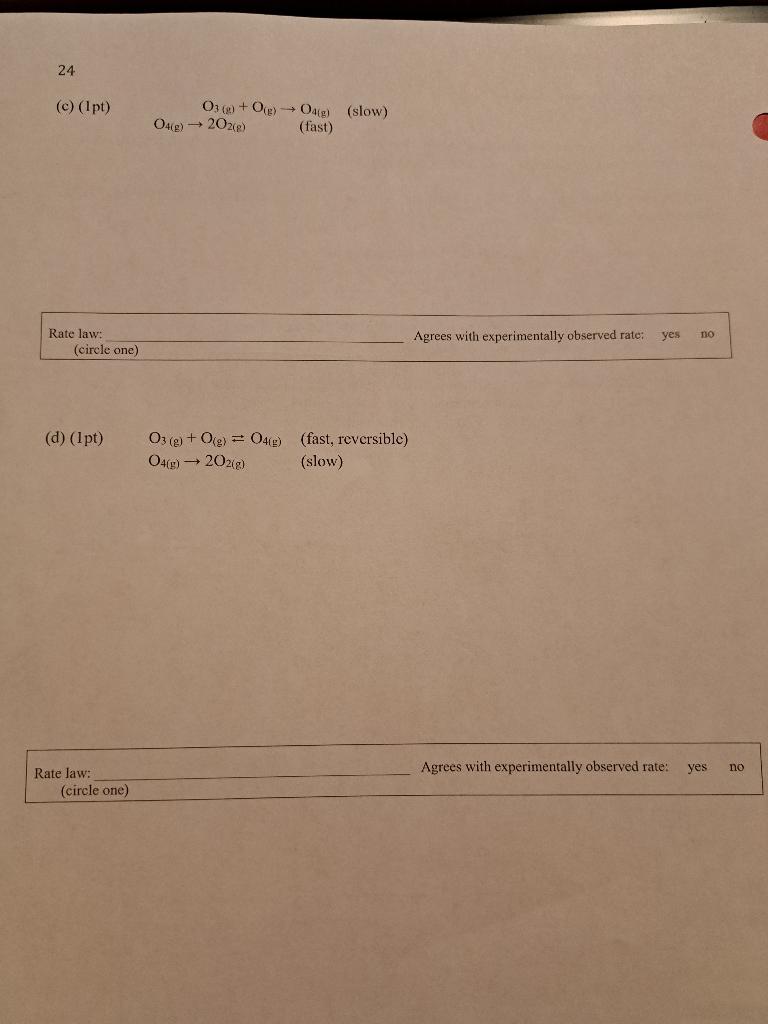
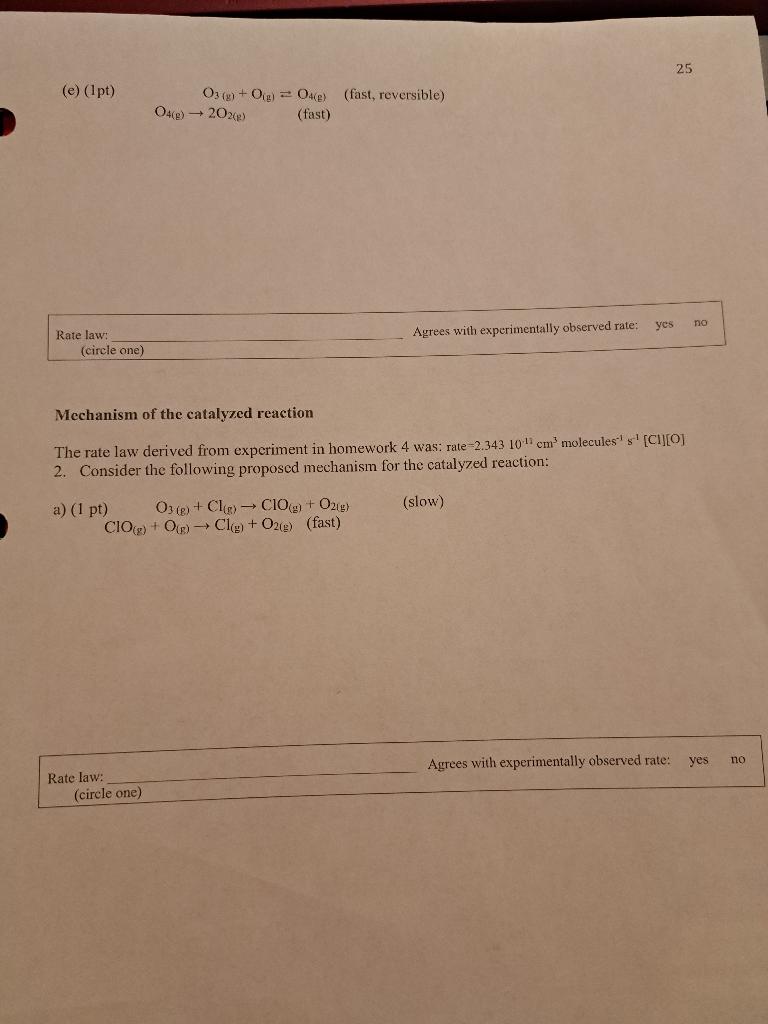
Part 2: In Part 1, we studied the phenomenology of the ozone depletion kinetics, both for the uncatalyzed reaction and for the chlorine catalyzed reaction. In this homework assignment, you will attempt to develop chemical mechanisms to explain the phenomenological results. Remember that we are interested in the following overall reaction: O3(s)+O(s)2O2(s) Mechanism of the uncatalyzed reaction 1. For each of the following mechanisms, derive the rate faw, and state where it agrees with the experimentally observed, phenomenological, rate law recorded above. (a) (1pt)O3(g)+O(g)2O2(g) (single step mechanism) Rate law: Agrees with experimentally observed rate: yes no (circle one) (b) (1 pt) O3(g)O2(g)+O(g) (fast, reversible) O(g)+O(g)O2(g)(slow) Rate law: Agrees with experimentally observed rate: yes no (circle one) (c) (1pt) Rate law: Agrees with experimentally observed rate: yes no (circle one) (d) (1pt) O3(g)+O(g)O4(g)O4(g)2O2(g)(fast,reversible)(slow) Rate law: Agrees with experimentally observed rate: yes no (circle one) (e) (1pt) O3(g)+O(g)O4(g)(fast,reversible)O4(g)2O2(g)(fast) Rate law: Agrees with experimentally observed rate: yes no (circle one) Mechanism of the catalyzed reaction The rate law derived from experiment in homework 4 was: rate =2.3431013cm3 molecules 1s1[Cl][O] 2. Consider the following proposed mechanism for the catalyzed reaction: a) (1pt) O3(g)+Cl(g)ClO(g)+O2(g)(slow)ClO(g)+O(g)Cl(g)+O2(g)(fast) Rate law: Agrees with experimentally observed rate: yes no (circle one)
Step by Step Solution
There are 3 Steps involved in it

Get step-by-step solutions from verified subject matter experts
 Study Help