







Question: Please help with questions 2,3 and 4 if the study is indeed observational. Many sports enthusiasts believe there is an advantage to playing on the
Please help with questions 2,3 and 4 if the study is indeed observational.
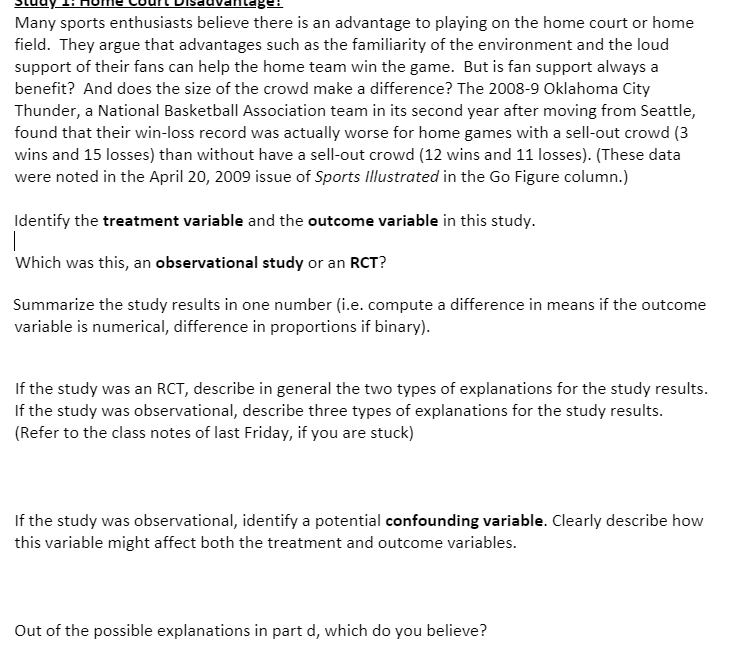
Many sports enthusiasts believe there is an advantage to playing on the home court or home field. They argue that advantages such as the familiarity of the environment and the loud support of their fans can help the home team win the game. But is fan support always a benefit? And does the size of the crowd make a difference? The 2008-9 Oklahoma City Thunder, a National Basketball Association team in its second year after moving from Seattle, found that their win-loss record was actually worse for home games with a sell-out crowd (3 wins and 15 losses) than without have a sell-out crowd (12 wins and 11 losses). (These data were noted in the April 20, 2009 issue of Sports Illustrated in the Go Figure column.) Identify the treatment variable and the outcome variable in this study. 1 Which was this, an observational study or an RCT? Summarize the study results in one number (i.e. compute a difference in means if the outcome variable is numerical, difference in proportions if binary). If the study was an RCT, describe in general the two types of explanations for the study results. If the study was observational, describe three types of explanations for the study results. (Refer to the class notes of last Friday, if you are stuck) If the study was observational, identify a potential confounding variable. Clearly describe how this variable might affect both the treatment and outcome variables. Out of the possible explanations in part d, which do you believe? Many sports enthusiasts believe there is an advantage to playing on the home court or home field. They argue that advantages such as the familiarity of the environment and the loud support of their fans can help the home team win the game. But is fan support always a benefit? And does the size of the crowd make a difference? The 2008-9 Oklahoma City Thunder, a National Basketball Association team in its second year after moving from Seattle, found that their win-loss record was actually worse for home games with a sell-out crowd (3 wins and 15 losses) than without have a sell-out crowd (12 wins and 11 losses). (These data were noted in the April 20, 2009 issue of Sports Illustrated in the Go Figure column.) Identify the treatment variable and the outcome variable in this study. 1 Which was this, an observational study or an RCT? Summarize the study results in one number (i.e. compute a difference in means if the outcome variable is numerical, difference in proportions if binary). If the study was an RCT, describe in general the two types of explanations for the study results. If the study was observational, describe three types of explanations for the study results. (Refer to the class notes of last Friday, if you are stuck) If the study was observational, identify a potential confounding variable. Clearly describe how this variable might affect both the treatment and outcome variables. Out of the possible explanations in part d, which do you believeStep by Step Solution
There are 3 Steps involved in it
1 Expert Approved Answer
Step: 1 Unlock

Question Has Been Solved by an Expert!
Get step-by-step solutions from verified subject matter experts
Step: 2 Unlock
Step: 3 Unlock
 Study Help