







Question: Please help with the Python code using the default template and example output. Thank you. Template. # Import the correct modules # Read in gpa.csv
Please help with the Python code using the default template and example output. Thank you.
Template.
# Import the correct modules
# Read in gpa.csv gpa = # Code to read in data set
value = float(input()) cutoff = float(input())
# Determine the number of students with a gpa higher than cutoff counts = # Code to count number of students with gpa > cutoff
# Determine the total number of students nobs = # Code to count total number of students
# Perform z-test for counts, nobs, and value ztest = # Code to perform z-test print(f'({ztest[0]:.6E}, {ztest[1]:.6E})')
# Determine the correct conclusion if # Finish the if statment print(f'The two-tailed p-value, {ztest[1]:.6E}, is less than \u03B1. Thus, sufficient evidence exists to support the hypothesis that the proportion is different from {value}') else: print(f'The two-tailed p-value, {ztest[1]:.6E}, is greater than than \u03B1. Thus, insufficient evidence exists to support the hypothesis that the proportion is different from {value}')
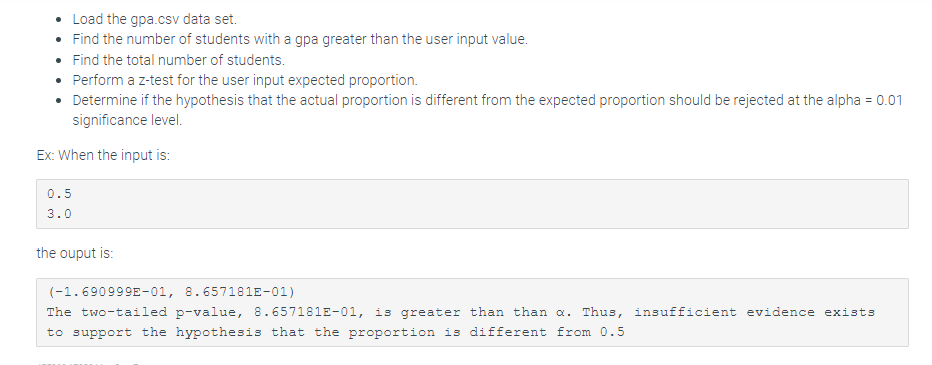
- Load the gpa.csv data set. - Find the number of students with a gpa greater than the user input value. - Find the total number of students. - Perform a z-test for the user input expected proportion. - Determine if the hypothesis that the actual proportion is different from the expected proportion should be rejected at the alpha =0.01 significance level. Ex: When the input is: 0.5 3.0 the ouput is: (1.690999E01,8.657181E01) The two-tailed p-value, 8.657181E01, is greater than than . Thus, insufficient evidence exists to support the hypothesis that the proportion is different from 0.5
Step by Step Solution
There are 3 Steps involved in it

Get step-by-step solutions from verified subject matter experts
 Study Help