



Question: Please help with the QM questions below: Consider the spherically-symmetric infinite potential well, with potential V(r) = 0 0 5 rza rza . (5) (a)
Please help with the QM questions below:
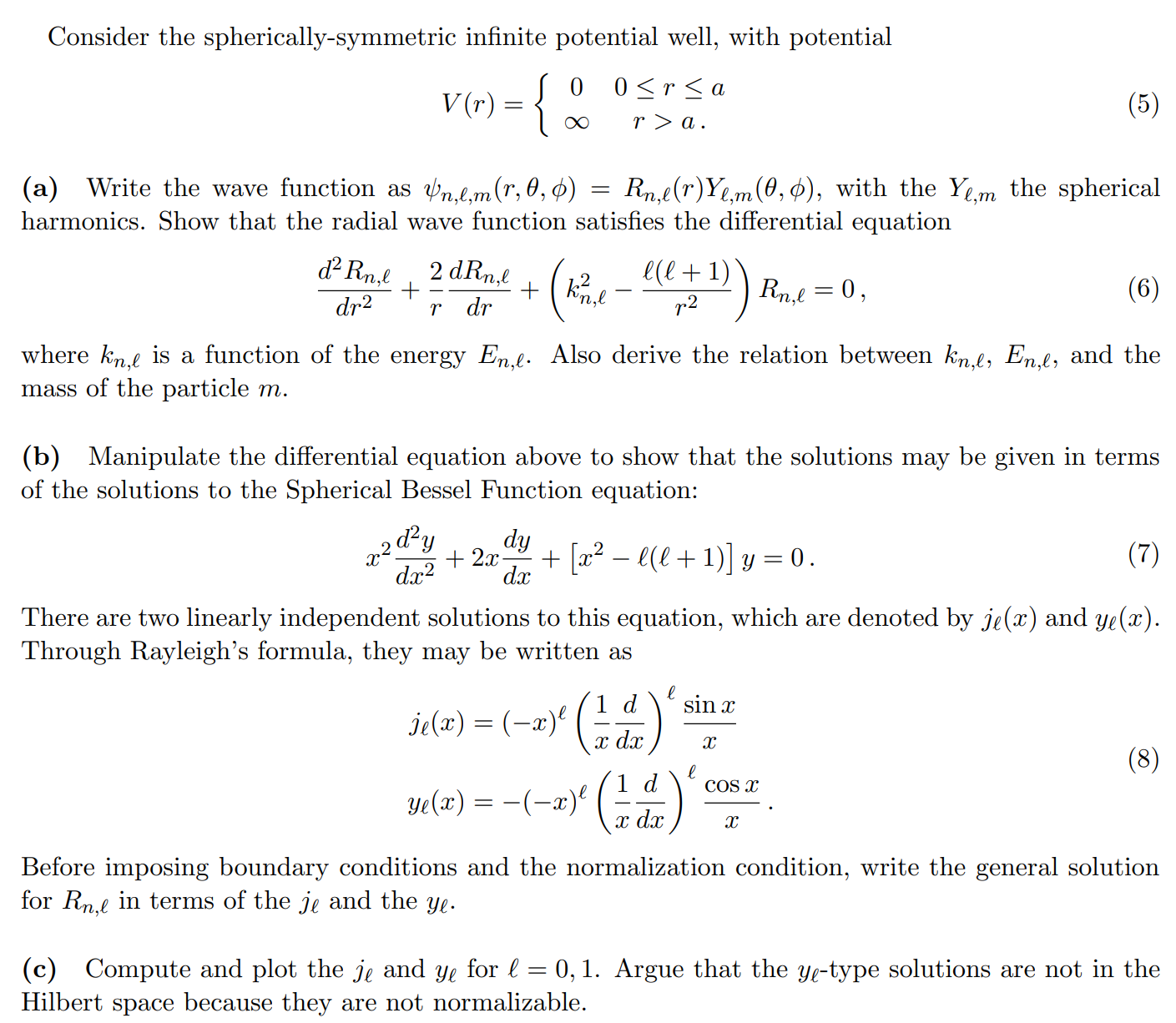
Consider the spherically-symmetric infinite potential well, with potential V(r) = 0 0 5 rza rza . (5) (a) Write the wave function as Un,l,m(r, 0, Q) = Rn,e(r) Ye,m(0, 4), with the Ye,m the spherical harmonics. Show that the radial wave function satisfies the differential equation d' Run,e , 2 dRn,l + kne- e ( e + 1 ) ) 7 2 Rn,l = 0 , (6) dr2 dr where kn,e is a function of the energy En,e. Also derive the relation between kn,(, En,e, and the mass of the particle m. (b) Manipulate the differential equation above to show that the solutions may be given in terms of the solutions to the Spherical Bessel Function equation: 2 2 day dy da2 + 21 + [x2 - e(6 + 1 ) ]y=0. (7 ) There are two linearly independent solutions to this equation, which are denoted by je(x) and ye(x). Through Rayleigh's formula, they may be written as je ( 20) = ( -20) e ( 1- d sin x x dxx x (8) ye ( 20 ) = - (-20)e 1 d COS X x dx Before imposing boundary conditions and the normalization condition, write the general solution for Rn,e in terms of the je and the ye. (c) Compute and plot the je and ye for ( = 0, 1. Argue that the ye-type solutions are not in the Hilbert space because they are not normalizable
Step by Step Solution
There are 3 Steps involved in it

Get step-by-step solutions from verified subject matter experts