







Question: Please help with this assembly Program. # Prog2_test_harness.s #------------------------------------------------------------------------- # PLACE YOUR FUNCTION HERE #------------------------------------------------------------------------- .text #------------------------------------------------------------------------- # DO NOT MODIFY BELOW THIS COMMENT #-------------------------------------------------------------------------
Please help with this assembly Program.
# Prog2_test_harness.s
#------------------------------------------------------------------------- # PLACE YOUR FUNCTION HERE #------------------------------------------------------------------------- .text
#------------------------------------------------------------------------- # DO NOT MODIFY BELOW THIS COMMENT #-------------------------------------------------------------------------
# Test harness # Ask user to enter the hex string. # Print the resulting integer, or report overflow. # An empty string will terminate the program.
.data
# User prompt strings prompt_str: .asciiz "Enter your hexadecimal string. Just hit enter to quit: " your_str: .asciiz "Your string: " linefeed: .asciiz " " dbl_linefeed: .asciiz " " value_str: .asciiz "Value : " overflow_str: .asciiz "Overflow detected! " all_done_str: .asciiz " Good luck with your program!. Goodbye. " hex_str_buf: # Space for input string from user. .space 256
.text .globl main .globl convert_hex_str
main:
get_input_string:
# display prompt li $v0,4 # code for print_string la $a0,prompt_str # point $a0 to prompt string syscall # print the string
# get the input string from the user li $v0,8 # code for read_string la $a0,hex_str_buf # $a0 - input buffer address li $a1,256 # $a1 - Input buffer length syscall # Get the string # The string is NUL terminated. la $s0,hex_str_buf # Save string in $s0 # SPIM puts a closing NEW LINE (ASCII 0xa) on the end of the string. # We need to strip that off, since that is not a legal character in our hex format. # We just overwrite it with NUL (ASCII 0)
move $s1, $s0 # $s1 char pointer strip_nl: lbu $s2, ($s1) # $s2 Get the current character beqz $s2, remove_nl addi $s1, $s1, 1 # Next character j strip_nl remove_nl: li $s2, 10 # Expected NL = ASCII 10 (0xa) lbu $s3, -1($s1) # Character just before the NUL terminator bne $s3, $s2, check_for_exit
li $s2, 0 # NUL Char (0) sb $s2, -1($s1) # Wipe out NL
check_for_exit: # Check if the input string is empty. lbu $s2, ($s0) # Load first byte of the string. beq $s2, $0, all_done # Exit if first byte is NUL terminator # print result string # - Prompt string li $v0,4 # code for print_string la $a0, your_str syscall # print the string
# - The string li $v0,4 # code for print_string move $a0, $s0 syscall # print the string
# - LF li $v0,4 # code for print_string la $a0,linefeed # point $a0 to string syscall # print the string # Call Hex Converter move $a0, $s0 jal convert_hex_str
move $s1, $v0 # Save value result in $s0 move $s2, $v1 # Save error result in $s1 beq $v1, $0, no_overflow
# - Overflow detected
# Print overflow message li $v0,4 la $a0, overflow_str syscall # print the string
j get_input_string # Repeat # - Value no_overflow: # Print value message. li $v0,4 # code for print_string la $a0, value_str syscall # print value prompt
li $v0,1 # code for print_int move $a0, $s1 syscall # print the value itself.
li $v0,4 la $a0,dbl_linefeed syscall # print the linefeed
j get_input_string # Repeat # - Prompt string li $v0,4 # code for print_string la $a0, error_str syscall # print the string # All done, thank you! all_done: li $v0,4 # code for print_string la $a0, all_done_str syscall # print the string li $v0,10 # code for exit syscall # exit program
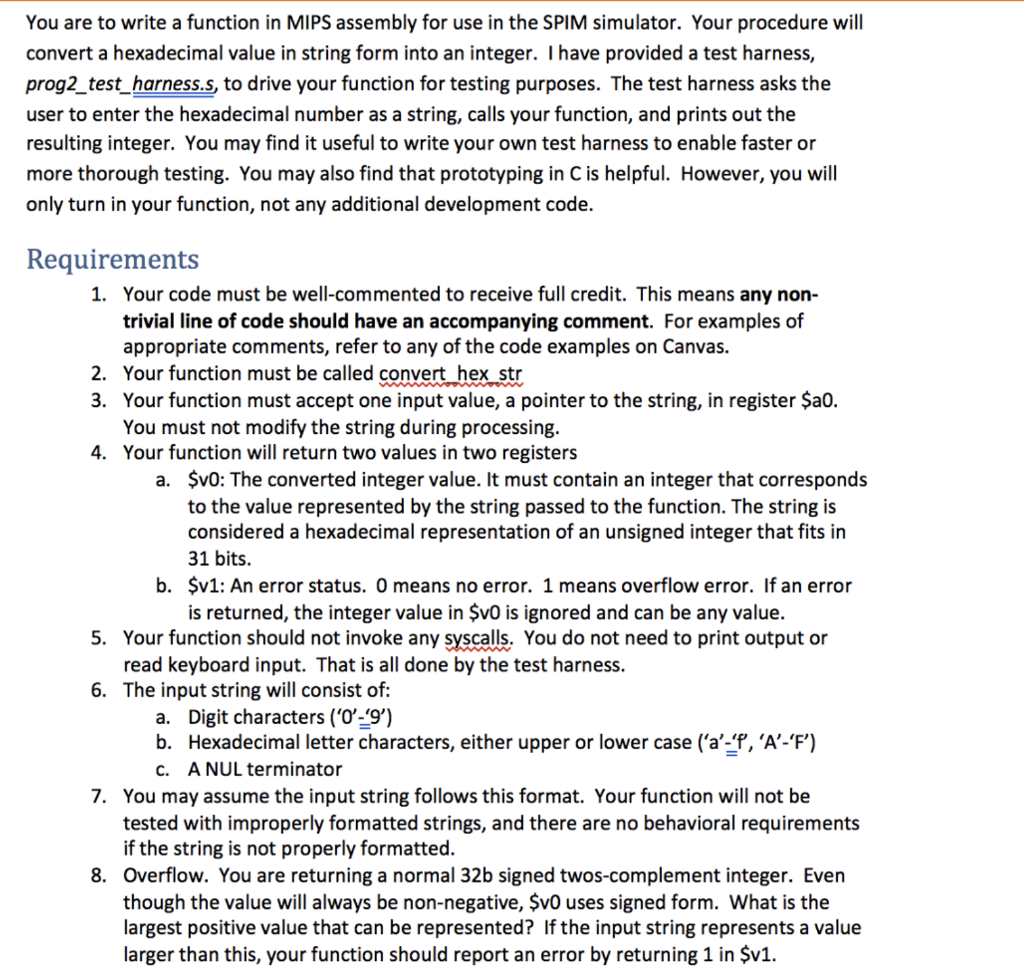
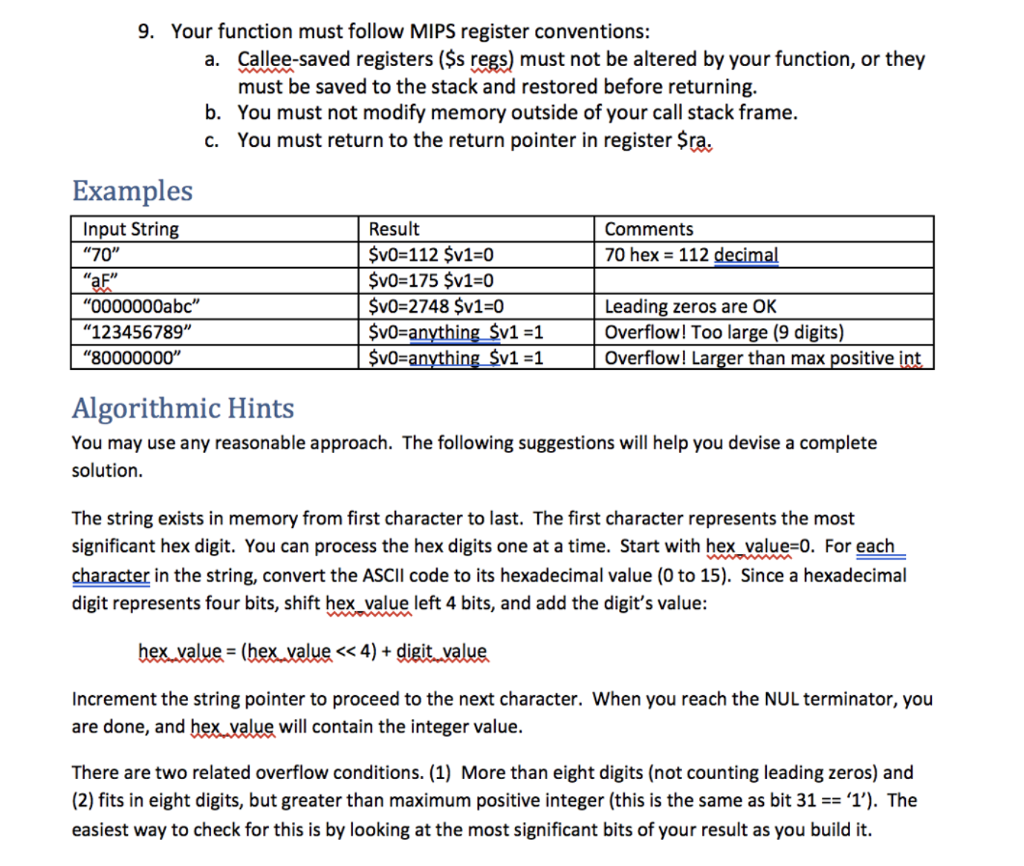
You are to write a function in MIPS assembly for use in the SPIM simulator. Your procedure will convert a hexadecimal value in string form into an integer. I have provided a test harness, prog2_test_harness.s, to drive your function for testing purposes. The test harness asks the user to enter the hexadecimal number as a string, calls your function, and prints out the resulting integer. You may find it useful to write your own test harness to enable faster or more thorough testing. You may also find that prototyping in C is helpful. However, you will only turn in your function, not any additional development code. Requirements 1. Your code must be well-commented to receive full credit. This means any non- trivial line of code should have an accompanying comment. For examples of appropriate comments, refer to any of the code examples on Canvas. 2. Your function must be called convert hex_str 3. Your function must accept one input value, a pointer to the string, in register $ao. You must not modify the string during processing. 4. Your function will return two values in two registers a. $v0: The converted integer value. It must contain an integer that corresponds to the value represented by the string passed to the function. The string is considered a hexadecimal representation of an unsigned integer that fits in 31 bits. b. $v1: An error status. O means no error. 1 means overflow error. If an error is returned, the integer value in $vo is ignored and can be any value. 5. Your function should not invoke any syscalls. You do not need to print output or read keyboard input. That is all done by the test harness. 6. The input string will consist of: a. Digit characters ('0-'9'). b. Hexadecimal letter characters, either upper or lower case ('a'-P, 'A'-'F'). C. ANUL terminator 7. You may assume the input string follows this format. Your function will not be tested with improperly formatted strings, and there are no behavioral requirements if the string is not properly formatted. Overflow. You are returning a normal 32b signed twos-complement integer. Even though the value will always be non-negative, $vo uses signed form. What is the largest positive value that can be represented? If the input string represents a value larger than this, your function should report an error by returning 1 in $v1. You are to write a function in MIPS assembly for use in the SPIM simulator. Your procedure will convert a hexadecimal value in string form into an integer. I have provided a test harness, prog2_test_harness.s, to drive your function for testing purposes. The test harness asks the user to enter the hexadecimal number as a string, calls your function, and prints out the resulting integer. You may find it useful to write your own test harness to enable faster or more thorough testing. You may also find that prototyping in C is helpful. However, you will only turn in your function, not any additional development code. Requirements 1. Your code must be well-commented to receive full credit. This means any non- trivial line of code should have an accompanying comment. For examples of appropriate comments, refer to any of the code examples on Canvas. 2. Your function must be called convert hex_str 3. Your function must accept one input value, a pointer to the string, in register $ao. You must not modify the string during processing. 4. Your function will return two values in two registers a. $v0: The converted integer value. It must contain an integer that corresponds to the value represented by the string passed to the function. The string is considered a hexadecimal representation of an unsigned integer that fits in 31 bits. b. $v1: An error status. O means no error. 1 means overflow error. If an error is returned, the integer value in $vo is ignored and can be any value. 5. Your function should not invoke any syscalls. You do not need to print output or read keyboard input. That is all done by the test harness. 6. The input string will consist of: a. Digit characters ('0-'9'). b. Hexadecimal letter characters, either upper or lower case ('a'-P, 'A'-'F'). C. ANUL terminator 7. You may assume the input string follows this format. Your function will not be tested with improperly formatted strings, and there are no behavioral requirements if the string is not properly formatted. Overflow. You are returning a normal 32b signed twos-complement integer. Even though the value will always be non-negative, $vo uses signed form. What is the largest positive value that can be represented? If the input string represents a value larger than this, your function should report an error by returning 1 in $v1
Step by Step Solution
There are 3 Steps involved in it

Get step-by-step solutions from verified subject matter experts
 Study Help