Question: please help with this.. For the case study presented below, apply the ethical decision-making paradigm presented in Section 11.5 to analyze the situation. Present potential
please help with this..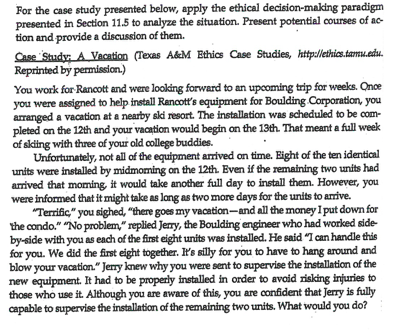
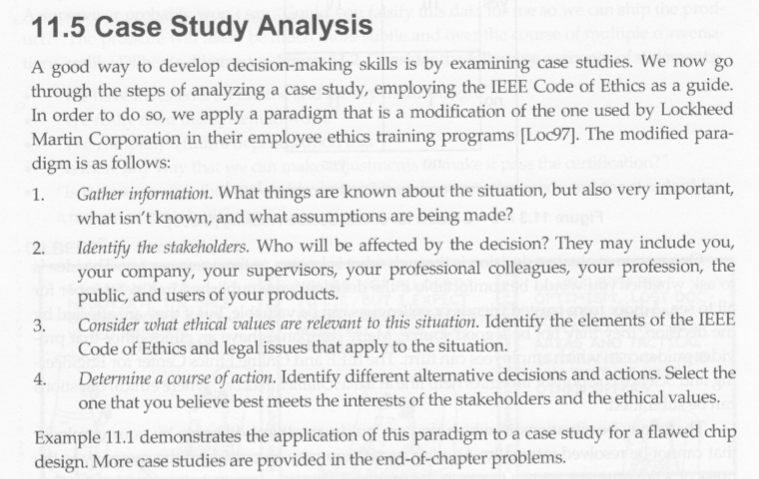
For the case study presented below, apply the ethical decision-making paradigm presented in Section 11.5 to analyze the situation. Present potential courses of ac- tion and provide a discussion of them. Case Study, A Vacation (Texas A&M Ethics Case Studies, http://ethics.tamu.edu. Reprinted by permission.) You work for Rancott and were looking forward to an upcoming trip for weeks. Once you were assigned to help install Rancott's equipment for Boulding Corporation, you arranged a vacation at a nearby ski resort. The installation was scheduled to be com- pleted on the 12th and your vacation would begin on the 13th. That meant a full week of skiing with three of your old college buddies. Unfortunately, not all of the equipment arrived on time. Eight of the ten identical units were installed by midmorning on the 12th. Even if the remaining two units had arrived that morning it would take another full day to install them. However, you were informed that it might take as long as two more days for the units to arrive. "Terrific," you sighed, "there goes my vacation--and all the money I put down for the condo." "No problem," replied Jerry, the Boulding engineer who had worked side by-side with you as each of the first eight units was installed. He said "I can handle this for you. We did the first eight together. It's silly for you to have to hang around and blow your vacation." Jerry knew why you were sent to supervise the installation of the new equipment. It had to be properly installed in order to avoid risking injuries to those who use it. Although you are aware of this, you are confident that Jerry is fully capable to supervise the installation of the remaining two units. What would you do? 11.5 Case Study Analysis A good way to develop decision-making skills is by examining case studies. We now go through the steps of analyzing a case study, employing the IEEE Code of Ethics as a guide. In order to do so, we apply a paradigm that is a modification of the one used by Lockheed Martin Corporation in their employee ethics training programs [Loc97]. The modified para- digm is as follows: 1. Gather information. What things are known about the situation, but also very important, what isn't known, and what assumptions are being made? 2. Identify the stakeholders. Who will be affected by the decision? They may include you, your company, your supervisors, your professional colleagues, your profession, the public, and users of your products. 3. Consider what ethical values are relevant to this situation. Identify the elements of the IEEE Code of Ethics and legal issues that apply to the situation. 4. Determine a course of action. Identify different alternative decisions and actions. Select the one that you believe best meets the interests of the stakeholders and the ethical values. Example 11.1 demonstrates the application of this paradigm to a case study for a flawed chip design. More case studies are provided in the end-of-chapter problems









 Study Help