







Question: PLEASE HELP WITH THIS; Which of the first four resignations discussed in the last section of the case is most alarming to you, and why?
PLEASE HELP WITH THIS; "Which of the first four resignations discussed in the last section of the case is most alarming to you, and why? Choose only one What are the main reasons for the employees departure? What do these reasons imply about the need to change organizational structure, culture, and processes at CloudFlare?"
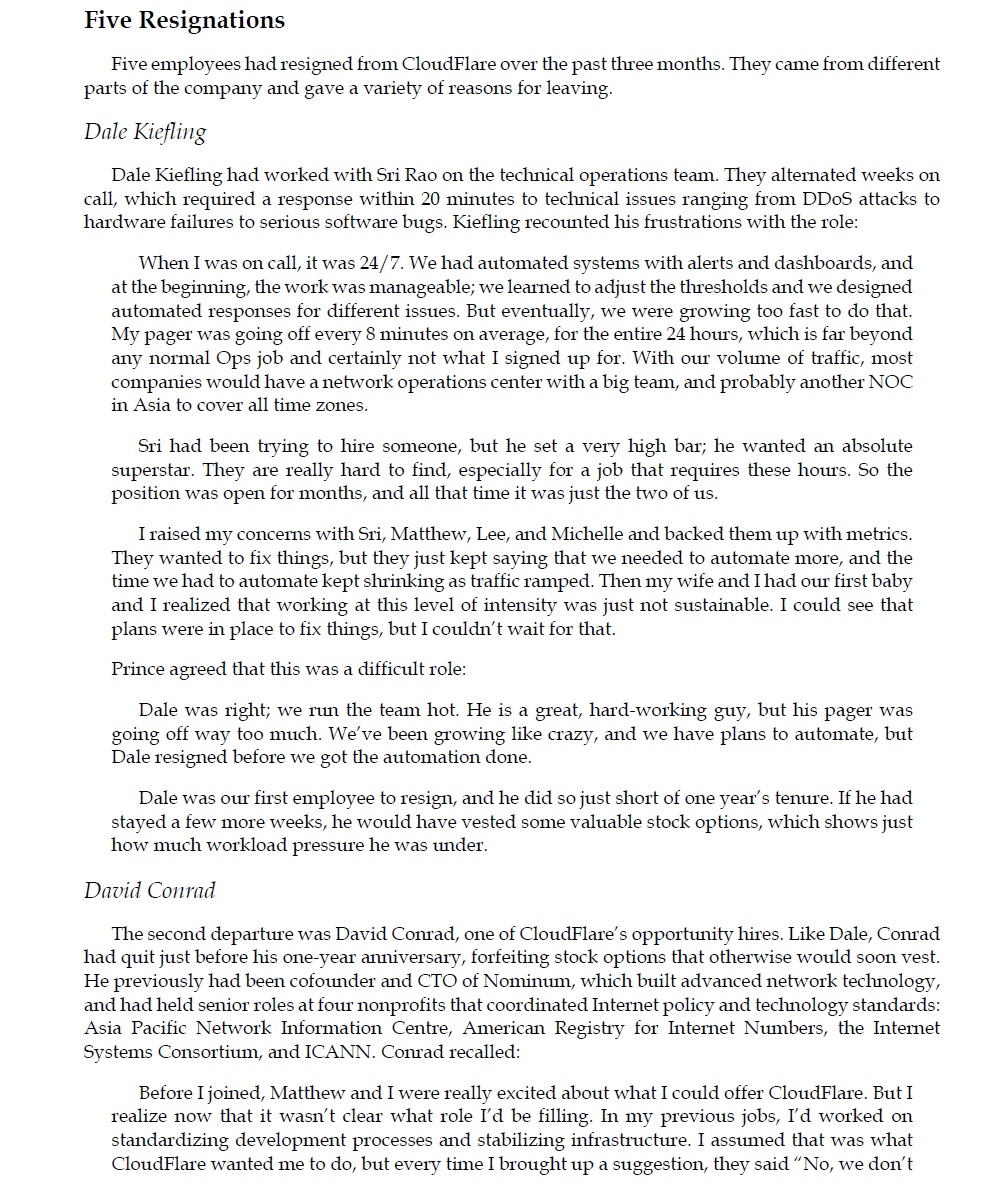
Five Resignations
Five employees had resigned from CloudFlare over the past three months. They came from different
parts of the company and gave a variety of reasons for leaving.
Dale Kiefling
Dale Kiefling had worked with Sri Rao on the technical operations team. They alternated weeks on
call, which required a response within minutes to technical issues ranging from DDoS attacks to
hardware failures to serious software bugs. Kiefling recounted his frustrations with the role:
When I was on call, it was We had automated systems with alerts and dashboards, and
at the beginning, the work was manageable; we learned to adjust the thresholds and we designed
automated responses for different issues. But eventually, we were growing too fast to do that.
My pager was going off every minutes on average, for the entire hours, which is far beyond
any normal Ops job and certainly not what I signed up for. With our volume of traffic, most
companies would have a network operations center with a big team, and probably another NOC
in Asia to cover all time zones.
Sri had been trying to hire someone, but he set a very high bar; he wanted an absolute
superstar. They are really hard to find, especially for a job that requires these hours. So the
position was open for months, and all that time it was just the two of us
I raised my concerns with Sri, Matthew, Lee, and Michelle and backed them up with metrics.
They wanted to fix things, but they just kept saying that we needed to automate more, and the
time we had to automate kept shrinking as traffic ramped. Then my wife and I had our first baby
and I realized that working at this level of intensity was just not sustainable. I could see that
plans were in place to fix things, but I couldn't wait for that.
Prince agreed that this was a difficult role:
Dale was right; we run the team hot. He is a great, hardworking guy, but his pager was
going off way too much. We've been growing like crazy, and we have plans to automate, but
Dale resigned before we got the automation done.
Dale was our first employee to resign, and he did so just short of one year's tenure. If he had
stayed a few more weeks, he would have vested some valuable stock options, which shows just
how much workload pressure he was under.
David Conrad
The second departure was David Conrad, one of CloudFlare's opportunity hires. Like Dale, Conrad
had quit just before his oneyear anniversary, forfeiting stock options that otherwise would soon vest.
He previously had been cofounder and CTO of Nominum, which built advanced network technology,
and had held senior roles at four nonprofits that coordinated Internet policy and technology standards:
Asia Pacific Network Information Centre, American Registry for Internet Numbers, the Internet
Systems Consortium, and ICANN. Conrad recalled:
Before I joined, Matthew and I were really excited about what I could offer CloudFlare. But I
realize now that it wasn't clear what role Id be filling. In my previous jobs, Id worked on
standardizing development processes and stabilizing infrastructure. I assumed that was what
CloudFlare wanted me to do but every time I brought up a suggestion, they said No we don't
Step by Step Solution
There are 3 Steps involved in it
1 Expert Approved Answer
Step: 1 Unlock

Question Has Been Solved by an Expert!
Get step-by-step solutions from verified subject matter experts
Step: 2 Unlock
Step: 3 Unlock
 Study Help