







Question: please i need help atleast half a page please i need help ( business management issues) Case 2-1 Goldman Sachs and Information Advantages for Major
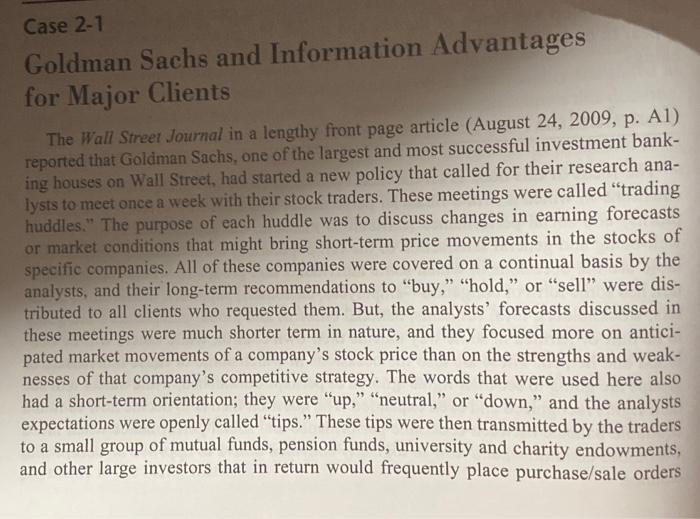
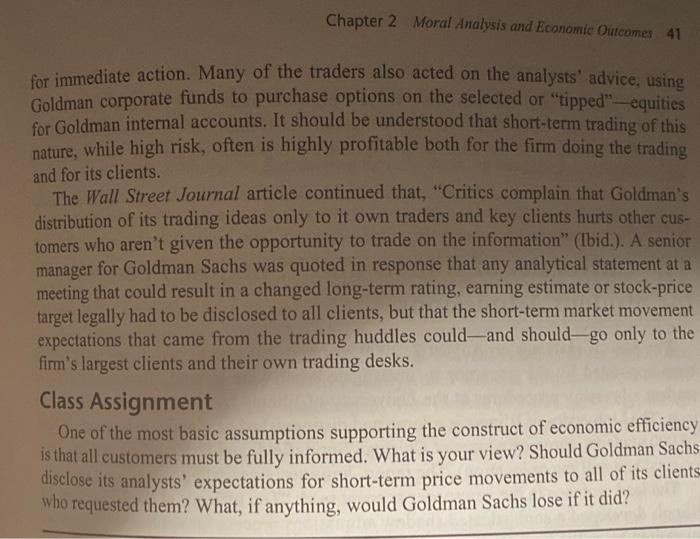
Case 2-1 Goldman Sachs and Information Advantages for Major Clients The Wall Street Journal in a lengthy front page article (August 24, 2009, p. A1) reported that Goldman Sachs, one of the largest and most successful investment banking houses on Wall Street, had started a new policy that called for their research analysts to meet once a week with their stock traders. These meetings were called "trading huddles." The purpose of each huddle was to discuss changes in earning forecasts or market conditions that might bring short-term price movements in the stocks of specific companies. All of these companies were covered on a continual basis by the analysts, and their long-term recommendations to "buy," "hold," or "sell" were distributed to all clients who requested them. But, the analysts' forecasts discussed in these meetings were much shorter term in nature, and they focused more on anticipated market movements of a company's stock price than on the strengths and weaknesses of that company's competitive strategy. The words that were used here also had a short-term orientation; they were "up," "neutral," or "down," and the analysts expectations were openly called "tips." These tips were then transmitted by the traders to a small group of mutual funds, pension funds, university and charity endowments, and other large investors that in return would frequently place purchase/sale orders for immediate action. Many of the traders also acted on the analysts' advice, using Goldman corporate funds to purchase options on the selected or "tipped"-equities for Goldman internal accounts. It should be understood that short-term trading of this nature, while high risk, often is highly profitable both for the firm doing the trading and for its clients. The Wall Street Journal article continued that, "Critics complain that Goldman's distribution of its trading ideas only to it own traders and key clients hurts other customers who aren't given the opportunity to trade on the information" (Ibid.). A senior manager for Goldman Sachs was quoted in response that any analytical statement at a meeting that could result in a changed long-term rating, earning estimate or stock-price target legally had to be disclosed to all clients, but that the short-term market movement expectations that came from the trading huddles could-and should-go only to the firm's largest clients and their own trading desks. Class Assignment One of the most basic assumptions supporting the construct of economic efficiency is that all customers must be fully informed. What is your view? Should Goldman Sachs disclose its analysts' expectations for short-term price movements to all of its clients who requested them? What, if anything, would Goldman Sachs lose if it did
Step by Step Solution
There are 3 Steps involved in it

Get step-by-step solutions from verified subject matter experts
 Study Help