







Question: Please I need help for part b c and d 1. Randy likes both skiing and hiking. His utility from these activities can be described
Please I need help for part b c and d
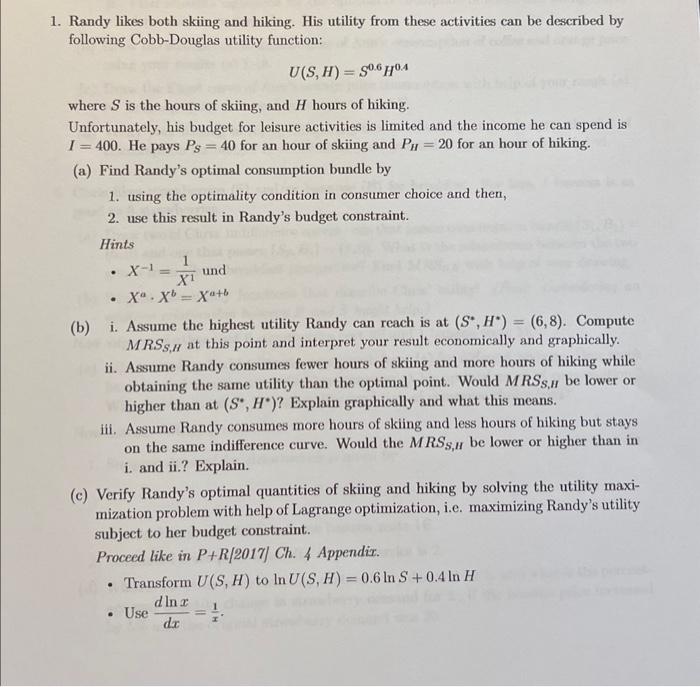
1. Randy likes both skiing and hiking. His utility from these activities can be described by following Cobb-Douglas utility function: U(S,H)=S0.6H0.4 where S is the hours of skiing, and H hours of hiking. Unfortunately, his budget for leisure activities is limited and the income he can spend is I=400. He pays PS=40 for an hour of skiing and PH=20 for an hour of hiking. (a) Find Randy's optimal consumption bundle by 1. using the optimality condition in consumer choice and then, 2. use this result in Randy's budget constraint. Hints - X1=X11 und - XaXb=Xa+b (b) i. Assume the highest utility Randy can reach is at (S,H)=(6,8). Compute MRSS,H at this point and interpret your result economically and graphically. ii. Assume Randy consumes fewer hours of skiing and more hours of hiking while obtaining the same utility than the optimal point. Would MRSS,H be lower or higher than at (S,H) ? Explain graphically and what this means. iii. Assume Randy consumes more hours of skiing and less hours of hiking but stays on the same indifference curve. Would the MRSS,H be lower or higher than in i. and ii.? Explain. (c) Verify Randy's optimal quantities of skiing and hiking by solving the utility maximization problem with help of Lagrange optimization, i.e. maximizing Randy's utility subject to her budget constraint. Proceed like in P+R[2017] Ch. 4 Appendix. - Transform U(S,H) to lnU(S,H)=0.6lnS+0.4lnH - Use dxdlnx=x1. 1. Randy likes both skiing and hiking. His utility from these activities can be described by following Cobb-Douglas utility function: U(S,H)=S0.6H0.4 where S is the hours of skiing, and H hours of hiking. Unfortunately, his budget for leisure activities is limited and the income he can spend is I=400. He pays PS=40 for an hour of skiing and PH=20 for an hour of hiking. (a) Find Randy's optimal consumption bundle by 1. using the optimality condition in consumer choice and then, 2. use this result in Randy's budget constraint. Hints - X1=X11 und - XaXb=Xa+b (b) i. Assume the highest utility Randy can reach is at (S,H)=(6,8). Compute MRSS,H at this point and interpret your result economically and graphically. ii. Assume Randy consumes fewer hours of skiing and more hours of hiking while obtaining the same utility than the optimal point. Would MRSS,H be lower or higher than at (S,H) ? Explain graphically and what this means. iii. Assume Randy consumes more hours of skiing and less hours of hiking but stays on the same indifference curve. Would the MRSS,H be lower or higher than in i. and ii.? Explain. (c) Verify Randy's optimal quantities of skiing and hiking by solving the utility maximization problem with help of Lagrange optimization, i.e. maximizing Randy's utility subject to her budget constraint. Proceed like in P+R[2017] Ch. 4 Appendix. - Transform U(S,H) to lnU(S,H)=0.6lnS+0.4lnH - Use dxdlnx=x1
Step by Step Solution
There are 3 Steps involved in it

Get step-by-step solutions from verified subject matter experts
 Study Help