







Question: please I need help solving these 2 questions with the steps and explanations Question 4: A typical telephone channel has the bandwidth of 3100 Hz
please I need help solving these 2 questions with the steps and explanations
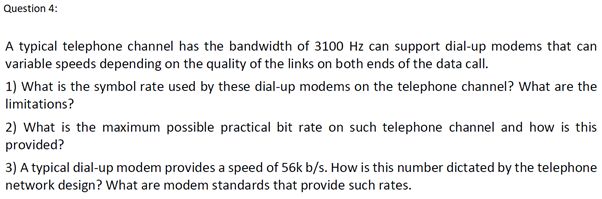
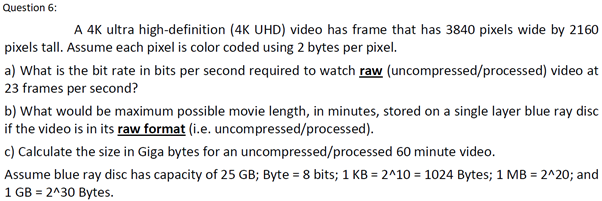
Question 4: A typical telephone channel has the bandwidth of 3100 Hz can support dial-up modems that can variable speeds depending on the quality of the links on both ends of the data call. 1) What is the symbol rate used by these dial-up modems on the telephone channel? What are the limitations? 2) What is the maximum possible practical bit rate on such telephone channel and how is this provided? 3) A typical dial-up modem provides a speed of 56kb/s. How is this number dictated by the telephone network design? What are modem standards that provide such rates. Question 6: A 4k ultra high-definition (4K UHD) video has frame that has 3840 pixels wide by 2160 pixels tall. Assume each pixel is color coded using 2 bytes per pixel. a) What is the bit rate in bits per second required to watch raw (uncompressed/processed) video at 23 frames per second? b) What would be maximum possible movie length, in minutes, stored on a single layer blue ray disc if the video is in its raw format (.e. uncompressed/processed). c) Calculate the size in Giga bytes for an uncompressed/processed 60 minute video. Assume blue ray disc has capacity of 25 GB; Byte = 8 bits; 1 KB = 2^10 = 1024 Bytes; 1 MB = 2*20; and 1 GB = 230 Bytes
Step by Step Solution
There are 3 Steps involved in it
Question 4 1 Symbol Rate and Limitations Symbol Rate Calculation Bandwidth of the telephone channel 3100 Hz Symbol rate is typically equal to the band... View full answer

Get step-by-step solutions from verified subject matter experts
 Study Help